Nine-line poems perfectly profound

Advertisement

Advertise with us

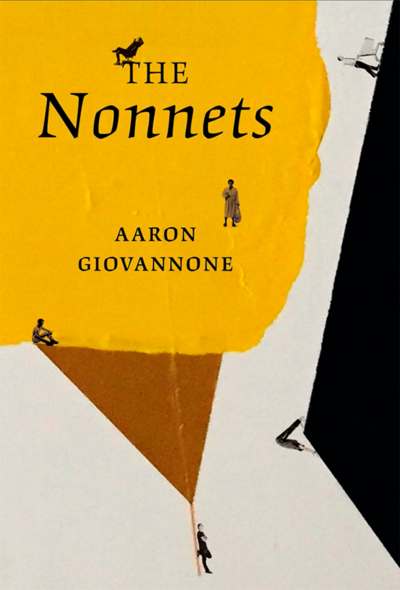
“A human’s writing this, I swear,” writes Aaron Giovannone in The Nonnets (Book*hug, 72 pages, $18). He has outdone his exceptional debut, The Loneliness Machine, with this collection of nine-line poems.

Read this article for free:


or

Already have an account? Log in here »

To continue reading, please subscribe:

Subscribe and receive a limited-edition Free Press branded hat or tote.

Digital Subscription

One year of digital access for only $205*

  • Enjoy unlimited reading on winnipegfreepress.com
  • Read the E-Edition, our digital replica newspaper
  • Access News Break, our award-winning app
  • Play interactive puzzles

*First annual payment billed as $205.00 + GST for one year. This annual subscription will automatically renew at $233.00 + GST every 52 weeks (10% off the regular annual price of $259.35). Offer available to new and qualified returning subscribers only. Cancel any time.

To continue reading, please subscribe:

Add Free Press access to your Brandon Sun subscription for only an additional

$1 for the first 4 weeks*

  • Enjoy unlimited reading on winnipegfreepress.com
  • Read the E-Edition, our digital replica newspaper
  • Access News Break, our award-winning app
  • Play interactive puzzles
Start now

*Your next Brandon Sun subscription payment will increase by $1.00 and you will be charged $17.95 plus GST for four weeks. After four weeks, your payment will increase to $24.95 plus GST every four weeks.

Hey there, time traveller!
This article was published 23/06/2018 (2983 days ago), so information in it may no longer be current.

“A human’s writing this, I swear,” writes Aaron Giovannone in The Nonnets (Book*hug, 72 pages, $18). He has outdone his exceptional debut, The Loneliness Machine, with this collection of nine-line poems.

The poems use simple language in a clean way, but have very complicated resonances. Subtle and dense yet breezy and conversational — a stunning feat given the depth and affecting nature of these startling poems.

“A butterfly flutters by. / That’s my grandmother’s soul. / If you laughed at that, you’re dead inside.” Put this statement up against another familial image: “Walking to the car, I’m already sad. / A crumpled bag of Dad’s brand cookies / on the concrete really is my dad’s.”

Notice how both contain refrained rhyme and turn clichés into fresh ideas through juxtapositions and joke-like twists. Giovannone’s poems seems effortless and easy, masterfully polished to a shine without losing their edge.

● ● ●

Eric Schmaltz’s Surfaces (Invisible, 120 pages, $20) contains visual poems themselves concerned with containers — with how writing, as a physical object, is created and contained.

One series of images is crafted out of the shapes that hold negative space inside of a letterform. Simple shapes, such as the hole inside of an O or the triangle inside of a capital A, combine in a complex array of interlocking images with an elegant, radiant beauty.

Schmaltz’s poems extend an already strong tradition of Canadian concrete poetry for a diverse, delightful debut.

● ● ●

Suzanne Zelazo’s Lances All Alike (Coach House, 88 pages, $20) is the followup to 2003’s Parlance.

In Lances All Alike, Zelazo imagines a relationship between modernist poet-painters Mina Loy and Baroness Elsa von Freytag, who seem to have never met despite having many common friends. Zelazo uses this concept to investigate the ways women and their work have been shaped or suppressed by male gatekeepers.

“Pale repressed energy. / Peace exists somewhere, / freely, wholly, / terribly hard / for my dead mother.” The build from one line to the next here gives a strong impression of how Zelazo’s work builds — developing and twisting into rich, thick braids.

Other images are sharper: “Startled / orchestra / crab-crashes / to silence.”

Zelazo’s gift for cutting, fragmentary poems shines through in this solid sophomore effort.

● ● ●

Anne Michaels’ Infinite Gradation (Exile, 82 pages, $20) collects short, poetic essays on art and writing, sutured by small, sad meditations on the deaths of beloved artists.

“Poetry can be an ambush — the glint of a knife on a dark road — because it asks: how much is your life worth?”

Michaels seems obsessed by this question, and how life and art might support one another, rather than vying against the other, when art so often seems to align with death.

“We ask of art not that we understand it, but that it understand us — the same liberty the living often take with the dead.”

Winnipeg English professor Jonathan Ball (@jonathanballcom) lives online at JonathanBall.com.

Report Error Submit a Tip

More Stories

Nine-line poems perfectly profound

Jonathan Ball 3 minute read Preview

Nine-line poems perfectly profound

Jonathan Ball 3 minute read Saturday, Jun. 23, 2018

“A human’s writing this, I swear,” writes Aaron Giovannone in The Nonnets (Book*hug, 72 pages, $18). He has outdone his exceptional debut, The Loneliness Machine, with this collection of nine-line poems.

The poems use simple language in a clean way, but have very complicated resonances. Subtle and dense yet breezy and conversational — a stunning feat given the depth and affecting nature of these startling poems.

“A butterfly flutters by. / That’s my grandmother’s soul. / If you laughed at that, you’re dead inside.” Put this statement up against another familial image: “Walking to the car, I’m already sad. / A crumpled bag of Dad’s brand cookies / on the concrete really is my dad’s.”

Notice how both contain refrained rhyme and turn clichés into fresh ideas through juxtapositions and joke-like twists. Giovannone’s poems seems effortless and easy, masterfully polished to a shine without losing their edge.

Read
Saturday, Jun. 23, 2018

Five Things: PM Carney explains why Canada left the U.S. negotiating table

David Baxter, The Canadian Press 5 minute read Preview

Five Things: PM Carney explains why Canada left the U.S. negotiating table

David Baxter, The Canadian Press 5 minute read Updated: Yesterday at 1:58 PM CDT

OTTAWA - Canada is preparing to hit the U.S. with dollar-for-dollar tariffs in response to new 50 per cent duties on $28 billion worth of Canadian products that took effect when talks between the two nations collapsed as negotiations neared the finish line. 

Prime Minister Mark Carney was quiet publicly during the final days of negotiations, but now has now explained his rationale for telling the Canadian negotiating team, led by Canada-U.S. Trade Minister Dominic LeBlanc and chief negotiator Janice Charette, to leave the table.

Restrictions on further trade deals

"The U.S. Introduced at the last hours, in the last hours, efforts to restrict our ability to have other trade deals. You heard me say a moment ago, what we've accomplished in the past year, 20 new deals, economic and security partnerships, the prospect of doubling our market access because we believe in free trade. We're the partner of choice in many respects for countries around the world and the Americans wanted to restrict that. They had language that what they wanted to restrict that, unacceptable," Carney said during a press conference on Parliament Hill.

Read
Updated: Yesterday at 1:58 PM CDT

Executive exodus continues at Shared Health with three recent departures

Chris Kitching 5 minute read Preview

Executive exodus continues at Shared Health with three recent departures

Chris Kitching 5 minute read Friday, Aug. 21, 2026

Manitoba’s provincial health authority is looking for its fourth chief financial officer since 2023 and additional replacements after the recent departures of three executives.

Read
Friday, Aug. 21, 2026

Wooed by wood, Cedarella founder takes pride in handcrafted designs

David Sanderson 8 minute read Preview

Wooed by wood, Cedarella founder takes pride in handcrafted designs

David Sanderson 8 minute read Yesterday at 6:00 AM CDT

Marina Bulan is the founder of Cedarella, a two-year-old venture that turns out eye-catching wood products such as jewelry, kitchen decor, children’s toys and, most recently, metre-high outdoor planters that double as home street-number indicators.

Ahead of immigrating to Winnipeg a decade ago from their native Russia, Bulan and her partner thought it would be prudent to conduct some research on their soon-to-be new home, a city they knew next to nothing about.

Imagine their surprise as they were viewing the 2007 surrealist film My Winnipeg, which comically blends historical facts about our burg with what Winnipeg-born writer/director Guy Maddin has termed “mystical hypothesizing.”

(For instance, there is no proof that, as reported in the award-winning flick, Winnipeg is the sleepwalking capital of the world, and that residents keep keys to their former abodes on their person in the event they turn up there during a bout of somnambulism.)

Read
Yesterday at 6:00 AM CDT

The trolls inside the Conservative tent

David McLaughlin 5 minute read Preview

The trolls inside the Conservative tent

David McLaughlin 5 minute read Yesterday at 2:00 AM CDT

The Conservative Party of Canada has a troll problem. And it’s coming from inside the tent.

Once, trolls existed only in imagination. They were figures of mythical proportion, big and small. They lived solitary lives under bridges, in caves, or forests. They were considered dim-witted and mean. Best avoided.

Today, they are real, unavoidable, and ubiquitous on social media. They are anything but solitary. There are tribes of them out there and tribal is how they think and post. As for dim-witted and mean, others can opine but they are uniformly mean and dismissive.

Mean to anyone who disagrees with their views. Dismissive of any view but their own. They distribute questionable, at best, facts and opinions grounded in hostility towards anything or anyone deemed disagreeable or heretical to their world view.

Read
Yesterday at 2:00 AM CDT

Plenty of alternatives to U.S. wines on the shelves

Ben Sigurdson 5 minute read Preview

Plenty of alternatives to U.S. wines on the shelves

Ben Sigurdson 5 minute read Yesterday at 6:00 AM CDT

In February 2025, Manitoba (and most other provinces) pulled American liquor from store shelves as part of the ongoing trade dispute with the United States.

Then in December, the province followed a similar course to others and put American booze that was already on hand back on shelves, selling off inventory that had been wasting away in warehouses for months, and directing proceeds from those sales to charities.

Lineups sprung up at numerous stores as consumers snapped up bestselling American products — think Maker’s Mark, Jack Daniel’s, Apothic Red and the like. After that initial rush, what was left has been languishing on shelves ever since, with many products eventually being drastically discounted for a quick sale, lest they become too long in the tooth.

I decided early on not to write about/review U.S. products in this space until things were well and truly sorted. But a few months back, I found myself in the mood for a big, oaky red wine and — in a moment of weakness, or nostalgia, or maybe just curiosity — I picked up a $30-ish California Cabernet Sauvignon.

Read
Yesterday at 6:00 AM CDT