Dionne Brand on that which goes unwritten: ‘What is withheld multiplies’
Advertisement
Read this article for free:
or
Already have an account? Log in here »
To continue reading, please subscribe:

Digital Subscription
One year of digital access for only $205*
- Enjoy unlimited reading on winnipegfreepress.com
- Read the E-Edition, our digital replica newspaper
- Access News Break, our award-winning app
- Play interactive puzzles
*First annual payment billed as $205.00 + GST for one year. This annual subscription will automatically renew at $233.00 + GST every 52 weeks (10% off the regular annual price of $259.35). Offer available to new and qualified returning subscribers only. Cancel any time.
To continue reading, please subscribe:
Add Free Press access to your Brandon Sun subscription for only an additional
$1 for the first 4 weeks*
- Enjoy unlimited reading on winnipegfreepress.com
- Read the E-Edition, our digital replica newspaper
- Access News Break, our award-winning app
- Play interactive puzzles
*Your next Brandon Sun subscription payment will increase by $1.00 and you will be charged $17.95 plus GST for four weeks. After four weeks, your payment will increase to $24.95 plus GST every four weeks.
Read unlimited articles for free today:
or
Already have an account? Log in here »
Hey there, time traveller!
This article was published 05/06/2019 (2674 days ago), so information in it may no longer be current.
TORONTO – As she looks out the window of a cafe in Toronto’s west end, poet Dionne Brand is collecting “all the materials that exist in the world.”
There’s the UPS truck carrying a load of deliveries, the contents of each package a mystery. Three people are huddled on the corner waiting for the light to change as they set off towards an unknown destination. A downpour dampens the bustle of Dundas Street, shaping the city’s rhythms in ways impossible to predict.
Just as Brand tries to take in the totality of the moment, and the limitless possibilities embedded therein, it shifts. And the process begins all over again.
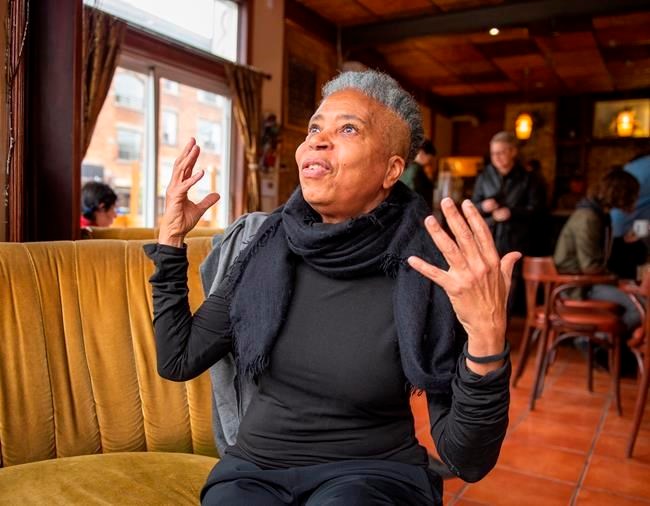
It’s a condition Brand describes as being “clinically aware,” a hoarding of the consciousness that forms the basis of her poetry. But only a slim share of these observations make it to the page, she says.
In the “Blue Clerk,” Brand takes stock of what has gone unwritten in her prolific career, which has been punctuated with honours including the Governor General’s Award for poetry, the Trillium Book Award and the Griffin Poetry Prize.
The ars poetica centres on a dialogue between a poet and the clerk who keeps inventory of the words the writer accumulates, probing which observations have been published and what has been withheld.
Published by McClelland & Stewart, the book could earn Brand her second Griffin along with a $65,000 cheque, and has been nominated for this year’s Trillium prize.
The former Toronto poet laureate spoke to The Canadian Press ahead of the Griffin gala in Toronto on Thursday.
CP: Tell me about the process of writing “The Blue Clerk.”
Brand: It began with that idea at the beginning of the book about how writing is a kind of negotiation between what is written and what is withheld, and then how what is withheld multiplies, much more than what you would actually write down.
CP: How would you describe the role of the clerk and the role of the author?
Brand: I think the clerk is the part of you that attends to your surroundings, and makes note of it. The author is the one, or the part of you, that makes the decisions of what to do with that.
CP: What was it like to lay bare all that was unwritten over the years?
Brand: It was a process of attending very, very carefully, and hopefully with a kind of honesty, to what was left out, to what was withheld, and to the reasons that they were withheld. This makes the relationship between the author and the poet extremely contentious. Because the clerk disagrees with what the author has left out, which is another reason why the clerk collects. Just to remind me, or the author, as to the misreadings or miswritings.
CP: Do you see any tension between poetry as an act of capturing beauty, and poetry as a political act?
Brand: I think those are the same thing. I think the poet Aime Cesaire says, “Justice listens at beauty’s door.” … I come from a tradition of poets who think of poetry as a political act, who think about poetry as a kind of making new meaning in the world. Given that the world we have to attend to is a racist world, a world that doesn’t value working people or poor people, those are the things we notice.
CP: I understand you’ve expressed some unease with the narrative about CanLit becoming more diverse. Do you feel like diversity has always been part of the literary scene, and the industry is just catching up?
Brand: It is true that many poets of colour haven’t had opportunities for publishing, and that’s really important. But there’s always been also a thriving scene that published poets like me … (There’s) a consumer culture and a meaning-making culture. Those two don’t always have to align. And the intention of meaning-makers isn’t always to enter consumerist culture. That consumerist culture can also be racist culture. It can reproduce dominant racist narratives, but the meaning-making culture is a more complicated scene.
CP: Do you think that writing about the art of poetry will influence your work going forward?
Brand: Every book of poems has what I call a failure in it. It’s a point; it’s a knot. And you think, if I were just ethereal enough, I would have got that, but that’s the point I go back to for the next book… I’ve learned to think of that moment as the moment of creativity, in a way, the expansion of creativity. But at that point in your life, you weren’t there to do it, to completely get it. I’ll probably never get it. That’s probably death. The revelation will be so great, that well, what am I going to do?
— This interview has been edited and condensed for clarity.