Endearing, estranged siblings struggle to connect

Advertisement

Advertise with us

In her second novel, Manitoba author Lauren Carter explores the emotional aftermath left in the wake of a double murder.

Read this article for free:


or

Already have an account? Log in here »

To continue reading, please subscribe:

Subscribe and receive a limited-edition Free Press branded hat or tote.

Digital Subscription

One year of digital access for only $205*

  • Enjoy unlimited reading on winnipegfreepress.com
  • Read the E-Edition, our digital replica newspaper
  • Access News Break, our award-winning app
  • Play interactive puzzles

*First annual payment billed as $205.00 + GST for one year. This annual subscription will automatically renew at $233.00 + GST every 52 weeks (10% off the regular annual price of $259.35). Offer available to new and qualified returning subscribers only. Cancel any time.

To continue reading, please subscribe:

Add Free Press access to your Brandon Sun subscription for only an additional

$1 for the first 4 weeks*

  • Enjoy unlimited reading on winnipegfreepress.com
  • Read the E-Edition, our digital replica newspaper
  • Access News Break, our award-winning app
  • Play interactive puzzles
Start now

*Your next Brandon Sun subscription payment will increase by $1.00 and you will be charged $17.95 plus GST for four weeks. After four weeks, your payment will increase to $24.95 plus GST every four weeks.

Hey there, time traveller!
This article was published 07/12/2019 (2436 days ago), so information in it may no longer be current.

In her second novel, Manitoba author Lauren Carter explores the emotional aftermath left in the wake of a double murder.

Set in 1994, with the Rwandan genocide often mentioned and playing on TV in the background, This Has Nothing to Do With You follows Melony (Mel) Barnett, a young 20-something living in the fictional town of Hixon River, Ont. She works at the library, volunteers at an animal shelter and lives in an apartment building across a back alley from the house where her brother Matt lives with his wife and young daughter.

As the novel begins, Mel decides to adopt a dog from the shelter, a large and ill-behaved mastiff who was abused and for whom it is proving difficult to find an adoptive home. Though her apartment does not allow pets and she doesn’t fully acknowledge what will really be required to care for the dog, she takes him home — and much chaos ensues.

The dog destroys her apartment, bites her friend’s husband and gets her threatened with eviction. When she turns to her brother for help, she’s met with little more than an eyeroll and an assertion that this is yet another in her long list of bad decisions and lack of responsibility. This shows the reader the real focus of the novel: the rift between Mel and her brother Matt.

The year Mel graduated from high school, only three years earlier, her mother murdered her father and his mistress. After pleading guilty, her mother was sent to prison, and Mel has not seen or spoken to her since.

In the years since the murder and the present setting of the novel, Mel left her brother behind and lived off friends, ventured off with New Age pals and even had a brief stint of homelessness.

The full details of her years away, as well as more information about the murders, is filled in at length through flashbacks, while the forward momentum of the narrative concerns Mel struggling to find a way to care for her new dog as well as repair the damage in her and Matt’s relationship.

The press material refers to the book as a “literary crime novel,” which is a slight misnomer. While there is indeed a crime involved in the plot — a double murder, no less — novel’s focus is not on the crime, but rather the effects on the surviving family members. Mel and Matt experience differing but extreme forms of trauma, and their inability to communicate seems to stem from not fully understanding the suffering endured by the other sibling.

Setting much of the novel in 1994 at the beginning of the Rwandan genocide provides a number of timely parallels to our own historical moment, as we watch chaos unfold in other countries and feel powerless to enact any kind of agency against such catastrophic forces.

That said, most of the novel does take place in the flashbacks, which reveal the details of what Mel, Matt and the other characters have lived through since the murders. For a generic crime novel, this would be an odd choice, but it works well as a more realist, CanLit character study.

Carter’s characters are endearing and enduring creations. Their decisions are sometimes frustrating, much like real people, but their emotions and the consequences they suffer create a powerful connection with the reader.

Those looking for a murder mystery or a more straightforward crime novel won’t really get it here, but readers will certainly enjoy a well-crafted and thoughtful novel about how a family seeks to repair itself after a traumatic event.

Keith Cadieux is a Winnipeg writer and editor.
Report Error Submit a Tip

More Stories

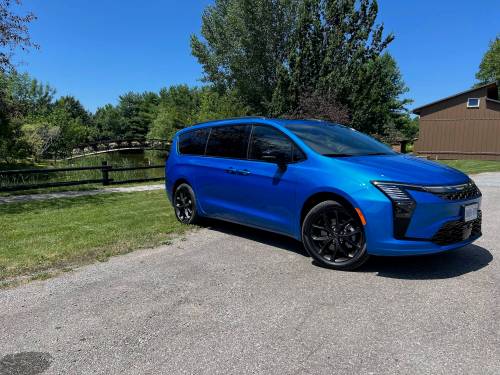
Chrysler refines Pacifica and Grand Caravan as buyers return to practical family hauler

Kelly Taylor 5 minute read Preview

Chrysler refines Pacifica and Grand Caravan as buyers return to practical family hauler

Kelly Taylor 5 minute read Yesterday at 3:00 AM CDT

BURLINGTON, Ont. — The mighty minivan — relegated to the scrap heap by the rush to crossovers and SUVs — is making a comeback, and Chrysler hopes to lead the way with its top-selling, Canadian-made Grand Caravan and Pacifica models.

While many manufacturers — Mazda, Ford, GM, Hyundai and Nissan — abandoned the once-popular family hauler, Chrysler has continued to play in the segment since it was launched by Lee Iacocca in 1983.

For 2027, the Pacifica gets a cosmetic refresh and the Grand Caravan is a holdover, but new this year are price savings of up to $7,200, Chrysler product planner Mike Szymkiewicz told journalists assembled here for the launch of the two vehicles.

“It’s primarily that we’re taking less margin, but we’re also adding content,” he said. “So less margin but we hope more volume.”

Read
Yesterday at 3:00 AM CDT

Watching while we work

Tory McNally 7 minute read Preview

Watching while we work

Tory McNally 7 minute read 2:01 AM CDT

For many employees, the idea that their employer might be tracking how long they spend at their keyboard, how often they move their mouse, or whether they are actively working throughout the day feels unsettling. For many employers, however, workplace surveillance is increasingly viewed as another management tool, particularly as hybrid and remote work become more common. The recent news that TD plans to monitor certain employees’ activity during the workday has reignited a conversation that has been quietly growing for several years: where is the line between legitimate oversight and excessive monitoring?

The reality is that workplace surveillance is nothing new. Employers have long monitored attendance, reviewed security camera footage, tracked company vehicles using GPS, audited expense reports, and reviewed internet usage on company-owned devices. What has changed is the sophistication of the technology. Today’s software can record login times, monitor application usage, track keystrokes, capture screenshots, analyze email activity, and even generate reports ranking employees based on their perceived productivity.

This naturally raises an important question. Does increased surveillance actually make people work harder?

The answer is not nearly as straightforward as many organizations hope.

Read
2:01 AM CDT

Jefferson, face of the Bombers defensive line, shares game day routine

Taylor Allen 8 minute read Preview

Jefferson, face of the Bombers defensive line, shares game day routine

Taylor Allen 8 minute read Yesterday at 5:48 PM CDT

Clearly, Willie Jefferson’s game-day routine works wonders.

The future Hall of Famer is still as dominant as ever at age 35 and is currently tied for the CFL lead with six sacks.

But what does the lead-up to kickoff at Princess Auto Stadium typically look like for the face of the Winnipeg Blue Bombers’ defence?

The Free Press had a lengthy chat with the defensive end before the bye week to find out.

Read
Yesterday at 5:48 PM CDT

Sending the wrong message

Andrea Charron 4 minute read 2:01 AM CDT

The U.S. State Department has announced plans to close five overseas diplomatic posts approved by Congress: Douala, Cameroon (a branch office); St. George’s, Grenada (an embassy); Nagoya, Japan (a consulate); Medan, Indonesia (a consulate); and Winnipeg, Canada (a consulate).

All are located in countries that are partners or allies of the United States.

It is unusual for the United States to reduce its diplomatic footprint. With the exception of some retrenchment efforts during the Trump administration, Washington has generally viewed diplomacy as a force multiplier. Diplomacy is not simply a matter of authority and leverage. It requires sustained local engagement, relationships and presence.

Consulates and branch offices are not the same as embassies. They are smaller missions, headed by consuls or consuls general rather than ambassadors and often provide a more limited range of services. Yet they play a vital political, economic and cultural role, supporting both local populations and American citizens abroad.

Livestreamed mental-health meltdown underscores medium’s disturbing decline

Melissa Martin 7 minute read Preview

Livestreamed mental-health meltdown underscores medium’s disturbing decline

Melissa Martin 7 minute read Updated: Yesterday at 4:42 PM CDT

On Tuesday evening, a well-known celebrity blogger, best known by the nom de plume Perez Hilton, opened up his TikTok account and began a livestream from his Miami home. What unfolded over the next 30 minutes horrified all who witnessed it — and should force the rest of us to take a very sober look at the ways social media can harm.

Read
Updated: Yesterday at 4:42 PM CDT

Mayoral race lineup grows to 10 candidates

Joyanne Pursaga 2 minute read Preview

Mayoral race lineup grows to 10 candidates

Joyanne Pursaga 2 minute read Thursday, Aug. 6, 2026

An electrical contractor has become the 10th candidate to register for the race to become Winnipeg’s next mayor.

Zac Uminski has thrown his name into the competition, after Scott Gillingham signed up to seek re-election as mayor and eight other candidates previously registered.

The father of four said concern about homelessness and addictions sparked his interest in politics.

“My campaign will focus on practical solutions to improve public safety, support families and strengthen the city services,” Uminski said. “We need safer communities.”

Read
Thursday, Aug. 6, 2026