Canada complicit in Vietnam War effort

Advertisement

Advertise with us

Canada has been working tremendously hard as of late to return to the prestigious and strategic table of the UN Security Council. During the gloomy Stephen Harper days, many moaned when we lost out to Portugal, lamenting our tarnished reputation. But last year, despite a kinder and gentler leadership, Canada again lost its bid for a seat. And this time with fewer votes.

Read this article for free:


or

Already have an account? Log in here »

To continue reading, please subscribe:

Subscribe and receive a limited-edition Free Press branded hat or tote.

Digital Subscription

One year of digital access for only $205*

  • Enjoy unlimited reading on winnipegfreepress.com
  • Read the E-Edition, our digital replica newspaper
  • Access News Break, our award-winning app
  • Play interactive puzzles

*First annual payment billed as $205.00 + GST for one year. This annual subscription will automatically renew at $233.00 + GST every 52 weeks (10% off the regular annual price of $259.35). Offer available to new and qualified returning subscribers only. Cancel any time.

To continue reading, please subscribe:

Add Free Press access to your Brandon Sun subscription for only an additional

$1 for the first 4 weeks*

  • Enjoy unlimited reading on winnipegfreepress.com
  • Read the E-Edition, our digital replica newspaper
  • Access News Break, our award-winning app
  • Play interactive puzzles
Start now

*Your next Brandon Sun subscription payment will increase by $1.00 and you will be charged $17.95 plus GST for four weeks. After four weeks, your payment will increase to $24.95 plus GST every four weeks.

Hey there, time traveller!
This article was published 17/07/2021 (1890 days ago), so information in it may no longer be current.

Canada has been working tremendously hard as of late to return to the prestigious and strategic table of the UN Security Council. During the gloomy Stephen Harper days, many moaned when we lost out to Portugal, lamenting our tarnished reputation. But last year, despite a kinder and gentler leadership, Canada again lost its bid for a seat. And this time with fewer votes.

For many Canadians, history and myth become blurred when we think of our international reputation. We recall the halcyon days of prime minister Lester B. Pearson, the Blue Helmets, the Universal Declaration of Human Rights and peacekeeping. But perhaps, like all memory, our historic recollection is fraught with story and legend rather than the hard truth.

Such is the task of historians, popular and academic alike. John Boyko, author of Blood and Daring and Cold Fire, confronts Canada’s dubious complicity in international conflict through his investigation of our participation in the Vietnam War.
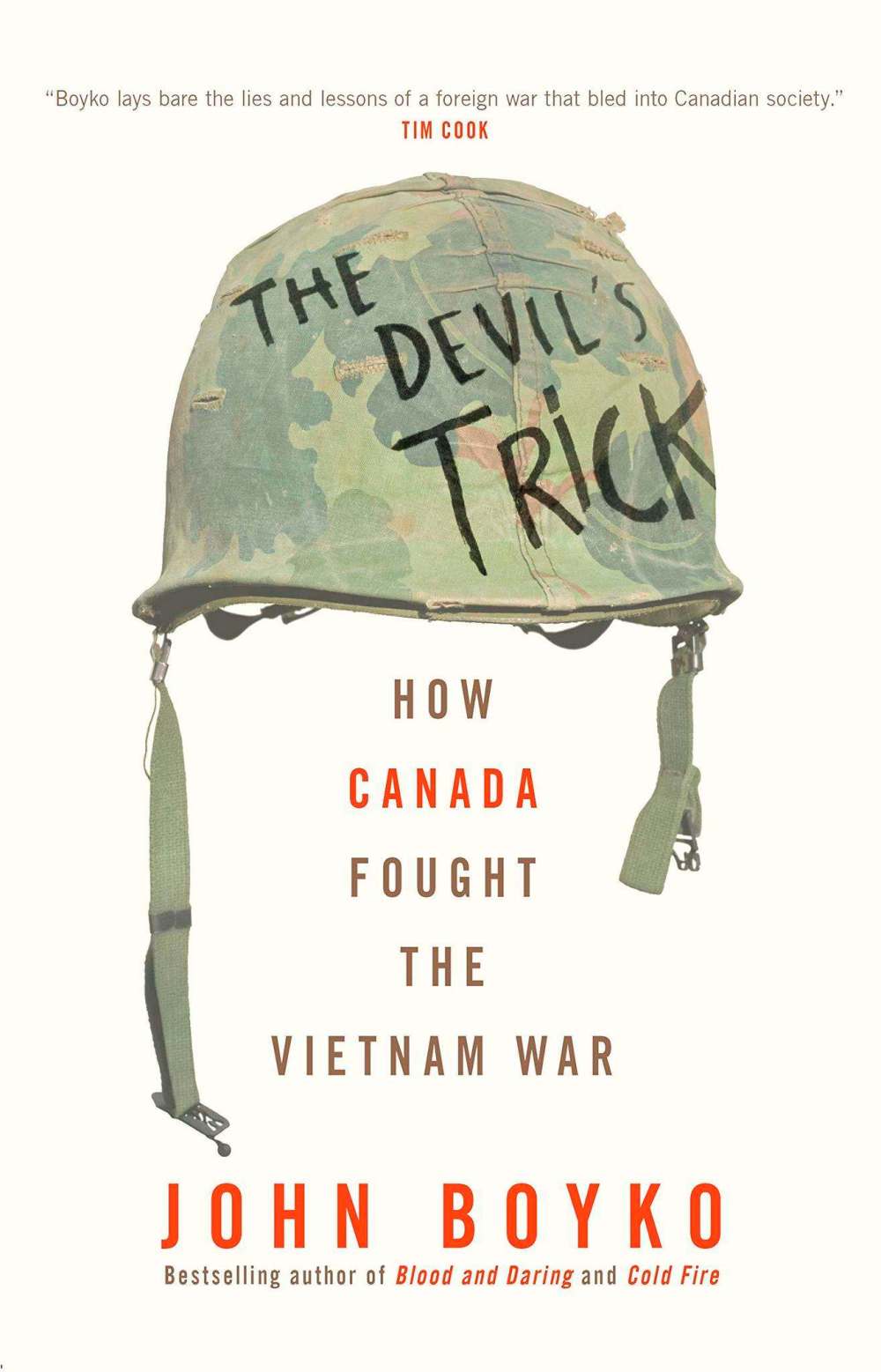
In The Devil’s Trick: How Canada Fought the Vietnam War, Boyko reveals that even in the heyday of the Liberal Party’s international influence under Pearson and Louis St. Laurent, our struggle to reconcile economic growth with moral action persisted.

Methodologically, Boyko uses the stories of six individuals to tell the story of how Canada supported the war effort, conspired with the CIA, sold arms and resources as a means to profit from the war, welcomed and then despised draft dodgers and deserters, and held similar views of refugees who were fleeing the horrors of Vietnam.

Through the stories of two diplomats, Sherwood Lett and Blair Seaborn, Boyko explains how Canada reluctantly became involved in the conflict, due mostly to the gravitational pull of allyship. Coming out of the Second World War, Canada enjoyed what Boyko describes as a “quiet diplomacy,” but Vietnam was about to force Canada, St. Laurent and Pearson to make significant decisions that were not only ideological but moral in nature.

Despite Canada’s urging in the 1950s for the Americans and the international community not to become further involved in the conflict, U.S. president John F. Kennedy’s (and later Lyndon Johnson’s) obsession with the domino theory proved to be a runaway train.

Despite secret dispatches of Canadian diplomats to sue for peace with Ho Chi Minh, the Americans were determined to prop up phony governments in the South and eradicate a communist foe in the North. Canada would be drawn into the horrifying conflict, despite the pleas of the likes of diplomat J. Blair Seaborn: “If we are not doing anything really useful, why do we not pull out, if need be, unilaterally?”

Boyko then shifts his focus to other personalities, namely the radical nurse Claire Culhane, who served in a hospital in South Vietnam while at the same time observing how Canada was handing over medical records to the CIA. Disgusted, Culhaine returned to Canada, held a famous hunger strike and even met with then-prime minister Pierre Trudeau to register her abhorrence to our complicity in war profiteering.

“All cabinet members knew for decades Canada had been swapping sovereignty or security and principle for jobs, but the Faustian bargain was acceptable when the threats and wars were believed to be just,” Boyko reveals.

Despite pressure from the likes of Tommy Douglas and David Lewis, critical voices when even unpopular, the Liberal governments chose economics time and time again — this despite the fact that the war machine produced nearly 6,000 jobs in Winnipeg and draft dodgers like Joe Erickson were able to start a new life in St. Vital. War is complex. War is hell. Even at home.

According to Boyko, as history now tends to rhyme with itself, à la Mark Twain, “Vietnam buried what remained of Canada’s golden age.” If it ever existed. Now as we supply Saudi Arabia with munitions for its exploits in Yemen and are caught up in America’s request for extraditions, we need to find a new moral stance

As Boyko argues, our task may be to “understand who we are and to somehow, hopefully with grace, make ourselves a little better tomorrow than we are today.” And this might in fact be the purpose of history.

Matt Henderson is assistant superintendent of Seven Oaks School Division.
Report Error Submit a Tip

More Stories

Hellebuyck standoff caused by… Nathan MacKinnon?

Mike McIntyre 6 minute read Preview

Hellebuyck standoff caused by… Nathan MacKinnon?

Mike McIntyre 6 minute read Yesterday at 6:34 PM CDT

Looking for someone to blame in the Connor Hellebuyck fiasco and cast as public enemy No. 1? How about long-time Winnipeg Jets nemesis Nathan MacKinnon?

Allow us to explain as we fire up the time machine and head back to February in Italy.

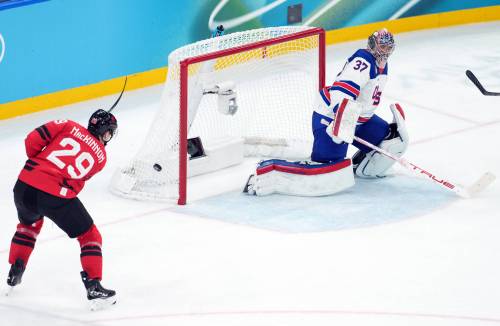
Oh, what could have been if MacKinnon had been able to score on what appeared to be an open net late in the third period of the men’s gold medal game with Hellebuyck down and seemingly out of position.

Instead, the star forward fired wide, keeping the score deadlocked at 1-1 as the clock ticked down on regulation.

Read
Yesterday at 6:34 PM CDT

A life’s story: activist, educator, organizer knew the true meaning of community

Janine LeGal 7 minute read Preview

A life’s story: activist, educator, organizer knew the true meaning of community

Janine LeGal 7 minute read 3:00 AM CDT

Somewhere between a love for sharing stories and a love of community connections, Michael (Mike) Maunder lived his life. Giving voice to people and neighbourhoods was a passion for the natural-born community organizer.

An author, teacher and principal, Maunder lived in a one-bedroom apartment in West Broadway and devoted himself to community development, education and neighbourhood renewal.

He maintained a connection with Augustine United Church, whose commitment to social justice he appreciated, volunteered at the Sandy-Saulteaux Spiritual Centre, and found comfort in a Buddhist prayer community.

Maunder died on July 15 at the age of 80.

Read
3:00 AM CDT

‘She was looking to destroy me’: convicted harasser faces new charges

Dean Pritchard 6 minute read Preview

‘She was looking to destroy me’: convicted harasser faces new charges

Dean Pritchard 6 minute read Thursday, Sep. 17, 2026

When Agnieszka Ciochon-Newton moved into the 55-plus apartment building on Stradbrook Avenue last year, she came across as “timid, soft-spoken and sensitive,” said building manager Tanya Owen.

Little did Owen know the meek-looking 58-year-old woman would soon turn her life and the lives of many of her tenants upside down and threaten her career and family.

“She was looking to destroy me for a simple tenant disagreement,” Owen said Thursday.

Court records show Ciochon-Newton was arrested earlier this month and charged with seven counts of criminal harassment, two counts of uttering threats and one count each of fraud, breaking and entering, attempting to obstruct justice, intimidation of a justice official, mischief and defamatory libel.

Read
Thursday, Sep. 17, 2026

Jets GM insists club’s not working under any deadline in netminder’s trade request

Mike McIntyre 7 minute read Preview

Jets GM insists club’s not working under any deadline in netminder’s trade request

Mike McIntyre 7 minute read Thursday, Sep. 17, 2026

Connor Hellebuyck and his family were subject to so much post-Olympic vitriol that both the Winnipeg Jets security team and even police had to get involved.

Read
Thursday, Sep. 17, 2026

Family account spiced with magic realism, geopolitical intrigue and a ghost story

Reviewed by Zilla Jones 4 minute read Preview

Family account spiced with magic realism, geopolitical intrigue and a ghost story

Reviewed by Zilla Jones 4 minute read 2:01 AM CDT

Tom Lin’s second novel Babylon, South Dakota moves beyond a historical account of an immigrant family’s struggle, delightfully blending and bending genres.

Lin is a Chinese-born novelist whose family emigrated to the U.S. when he was four years old. His debut novel, The Thousand Crimes of Ming Tsu, won the 2022 Andrew Carnegie Medal for Excellence in Fiction, making him the youngest ever recipient of that award. He earned a PhD in English from the University of California Davis and is currently an assistant professor of English and creative writing at the University of Iowa.

Babylon, South Dakota takes place in an unspecified time period that can be understood to be during the Mao era — likely the 1950s or ’60s. A young Chinese couple, the Hsuis, immigrate to the rural community that gives the book its title. They take the names Saul and Mei and settle on a 160-acre homestead left to them by a distant relative.

Saul’s dream is to breed and sell chrysanthemums from seeds he brought from China, while Mei wants to raise livestock. They speak no English, know nothing of life in the United States, are unprepared for the harshness of winter and the isolation of the farm and bring nothing with them except some gold, which Mei hides around the house for emergencies. Their only link to the outside world is a discarded and marginally functioning TV set, which Saul rescues and rigs up.

Read
2:01 AM CDT

Day 1 of Jets training camp in the books with pairings essentially cemented

Ken Wiebe 7 minute read Preview

Day 1 of Jets training camp in the books with pairings essentially cemented

Ken Wiebe 7 minute read Thursday, Sep. 17, 2026

Nearly six minutes into his question-and-answer session, Scott Arniel took a welcome detour from the news of the day.

After exhausting the discussion around the goalie who wasn’t in training camp, the head coach of the Winnipeg Jets finally got a query about the line combinations and defensive pairings that were unveiled in training camp.

And unlike past years, when exhibition games were more frequent and the training camp wasn’t this condensed, Arniel conceded these groupings were intentional and were likely staying together for some time.

The expansion to an 84-game regular season brings with it a reduction to four pre-season games and a much shorter training camp, which could limit the amount of experimentation that Arniel can do during the next two weeks.

Read
Thursday, Sep. 17, 2026