Inuk author Norma Dunning wins $25K Governor General’s fiction prize

Advertisement

Advertise with us

A mother of boys, Norma Dunning says she likes to think of her books as her "girls," even using the pronouns "she" and "her" to refer to her works.

Read this article for free:


or

Already have an account? Log in here »

To continue reading, please subscribe:

Subscribe and receive a limited-edition Free Press branded hat or tote.

Digital Subscription

One year of digital access for only $205*

  • Enjoy unlimited reading on winnipegfreepress.com
  • Read the E-Edition, our digital replica newspaper
  • Access News Break, our award-winning app
  • Play interactive puzzles

*First annual payment billed as $205.00 + GST for one year. This annual subscription will automatically renew at $233.00 + GST every 52 weeks (10% off the regular annual price of $259.35). Offer available to new and qualified returning subscribers only. Cancel any time.

To continue reading, please subscribe:

Add Free Press access to your Brandon Sun subscription for only an additional

$1 for the first 4 weeks*

  • Enjoy unlimited reading on winnipegfreepress.com
  • Read the E-Edition, our digital replica newspaper
  • Access News Break, our award-winning app
  • Play interactive puzzles
Start now

*Your next Brandon Sun subscription payment will increase by $1.00 and you will be charged $17.95 plus GST for four weeks. After four weeks, your payment will increase to $24.95 plus GST every four weeks.

Hey there, time traveller!
This article was published 17/11/2021 (1777 days ago), so information in it may no longer be current.

A mother of boys, Norma Dunning says she likes to think of her books as her “girls,” even using the pronouns “she” and “her” to refer to her works.

One of her girls, “Tainna: The Unseen Ones,” has given the Inuk writer a whole lot to be proud of as the 2021 winner of the Governor General’s Literary Award for fiction.

Dunning said she didn’t know the book of short stories had been submitted for the $25,000 prize until she opened her inbox last month to find out “Tainna” had been named as a finalist.
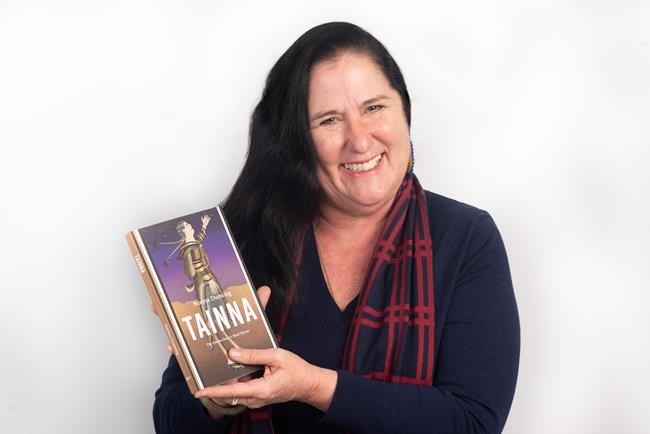
Writer Norma Dunning poses with her book
Writer Norma Dunning poses with her book "Tainna: The Unseen Ones" in this undated handout photo. Inuk writer and academic Norma Dunning has won the $25,000 Governor General's Literary Award for fiction for "Tainna: The Unseen Ones." The book of short stories, published by Douglas & McIntyre, centres on the experiences of Inuit who live outside of their home territories. THE CANADIAN PRESS/HO - Emily Welz Studios

The Edmonton author, academic and grandmother said the win affords her a level of visibility that she’s often denied as an older Indigenous woman.

“For someone who’s been a lifelong writer, it’s a validation of the work that I put forward,” Dunning, 62, said by phone ahead of the awards announcement on Wednesday. “It’s just a beautiful reward at the end of it all.”

While she’s been writing since youth, Dunning said she hadn’t considered pursuing her passion at a professional level until her sons started having children of their own.

“Everything I’ve done has been late,” she said. “I started to think … I should have others reading this. It’s not just for me anymore.”

Dunning enrolled in university at age 50, focusing her scholarship on native studies and education sciences, while honing her craft in creative writing courses.

As she rose through the ranks of academia, eventually becoming an instructor at the University of Alberta, Dunning continued to balance research and fiction.

She wrote “Tainna” while working on her PhD dissertation in Victoria. The short story collection, published by Douglas & McIntyre, centres on the experiences of modern-day Inuit living outside their home territories.

“I wrote a lot about the expectations of others when it comes to Inuit,” Dunning said, noting that the stories touch on issues such as racism and missing and murdered Indigenous women and girls.

Dunning said she hopes the Governor General’s prize introduces new readers to “Tainna.”

“I love her, and so therefore, I want everyone to read her,” she said. “It’s a group of stories that really make all of us think about our own perceptions of what Inuit people are or should be.”

The Governor General’s Literary Awards, which are administered by the Canada Council for the Arts, handed out honours across seven categories in both English and French.

Kingston, Ont.-based poet Sadiqa de Meijer received the non-fiction prize for “alfabet/alphabet: a memoir of a first language,” published by Anstruther Books, which explores her transition from speaking Dutch to English.

Tolu Oloruntoba of Surrey, B.C., prevailed in the poetry category for “The Junta of Happenstance,” also from Anstruther Books.

The drama award went to Halifax’s Hannah Moscovitch for “Sexual Misconduct of the Middle Classes,” published by Playwrights Canada Press.

In young people’s literature, Philippa Dowding of Toronto took the text prize for “Firefly,” published by DCB, while Winnipeg writer David Robertson and Vancouver artist Julie Flett shared the illustrated books award for “On the Trapline,” published by Tundra Books.

The French-to-English translation winner was Erín Moure of Montreal for “This Radiant Life,” published by Book*hug Press, based on Chantal Neveu’s original work, “La vie radieuse.”

Each winner receives $25,000, while the publisher of each winning book receives $3,000 to support promotional activities. Finalists each receive $1,000.

There are separate French-language categories for francophone writing.

Founded in 1936, the Governor General’s Literary Awards give out a total of about $450,000 annually.

This report by The Canadian Press was first published Nov. 17, 2021.
Report Error Submit a Tip

More Stories

Manitoba PC leader Khan survives confidence vote

Carol Sanders 3 minute read Preview

Manitoba PC leader Khan survives confidence vote

Carol Sanders 3 minute read Updated: Yesterday at 8:33 PM CDT

Manitoba Progressive Conservative Leader Obby Khan survived a confidence vote last week.

Caucus communications director Alison Sutherland confirmed the vote was held Friday and that Khan still has “the full confidence” of the PC caucus.

She did not provide further details.

The party under Khan’s leadership is floundering, a recent poll suggests.

Read
Updated: Yesterday at 8:33 PM CDT

Canada resorting to its tried and true playbook

Niigaan Sinclair 5 minute read Preview

Canada resorting to its tried and true playbook

Niigaan Sinclair 5 minute read Yesterday at 6:00 AM CDT

In 1846, Britain faced an emergency influenced by the Irish famine, so leaders repealed the country’s “Corn Laws” and restrictions on imported food and grain, transitioning to a system of free trade.

This created a crisis in the then Province of Canada, which had relied on British “preferential” status to prop up its agricultural and resource industries.

As a result, Canada looked south for new markets and eventually negotiated a free trade agreement with the United States.

This required land to be acquired and converted for industrial use quickly, so Canada quickly dispatched Commissioner William Robinson to negotiate with Indigenous communities along Lake Huron and Lake Superior for land.

Read
Yesterday at 6:00 AM CDT

Orange Shirt Day project fits students to a tee

Maggie Macintosh 5 minute read Preview

Orange Shirt Day project fits students to a tee

Maggie Macintosh 5 minute read Yesterday at 6:57 PM CDT

On the eve of Orange Shirt Day, hundreds of black T-shirts will be handed out to teenagers at Elmwood High School — and there wasn’t a mixup in the clothing procurement process.

The student-run business behind the initiative wanted to make a statement about “truth and reconciliation” being a year-round activity, said Daniel Concepcion, a Grade 12 student.

Daniel said given that black is a staple in the wardrobe of teenagers, he hopes these shirts won’t sit on hangers for 364 days of the year.

“Every child matters, every part of the day, every day,” the 17-year-old said.

Read
Yesterday at 6:57 PM CDT

What’s open, what’s closed, what’s up in Winnipeg on National Day for Truth and Reconciliation Sept. 30, 2026

Free Press staff 4 minute read Preview

What’s open, what’s closed, what’s up in Winnipeg on National Day for Truth and Reconciliation Sept. 30, 2026

Free Press staff 4 minute read Sunday, Sep. 27, 2026

The National Day of Truth and Reconciliation, or Orange Shirt Day, as it's known in Manitoba, happens Sept. 30 with many commemorative community events scheduled.

Read
Sunday, Sep. 27, 2026

Khan cites infighting, quits as Tory leader

Carol Sanders 5 minute read Preview

Khan cites infighting, quits as Tory leader

Carol Sanders 5 minute read Updated: 9:56 AM CDT

Manitoba’s Leader of the Opposition is stepping down.

Progressive Conservative Leader Obby Khan announced late Monday afternoon he is quitting caucus and will sit in the legislature as an independent MLA, effective today.

He cited internal party fighting for his decision.

The former Winnipeg Blue Bombers offensive lineman survived a caucus confidence vote Friday. He said there were 13 votes for him to remain and six against, with one person absent.

Read
Updated: 9:56 AM CDT

Wab Kinew as ‘communicator in chief’

Paul G. Thomas 6 minute read Preview

Wab Kinew as ‘communicator in chief’

Paul G. Thomas 6 minute read Yesterday at 2:00 AM CDT

Premier Wab Kinew and his party have been riding high in the polls longer than normal for a government one year or less away from its first re-election contest. One reason is his ubiquitous, dominating communications presence as NDP leader and premier.

The argument here is that Kinew has supplemented his prerogatives as premier and party leader (such as appointing cabinet ministers and approving party nominations) with the skilful use of communications to advance his policy agenda, boost his personal popularity and maintain the competitive advantage of his party over the opposition Progressive Conservatives.

Communications has always been a significant part of politics and policy making. However, in the contemporary political and media environments, communications considerations have moved from the background to the foreground of decision-making by political parties, including when they are performing in the role of government. Campaigning and governing now overlap in what has been described as a permanent election campaign.

Political parties use communications strategies for several purposes: to establish an image of the leader which makes a positive emotional connection with voters; to promote a coherent message and to keep party members on message; and to gain favourable media coverage for its policies and other actions on almost a daily basis.

Read
Yesterday at 2:00 AM CDT