Rise and fall

Women political leaders in Canada still struggle with glass ceiling

Advertisement

Advertise with us

There are few occasions in which Canadians can hear women politicians speak unmediated by pundits, reporters and time constraints. Kate Graham’s No Second Chances offers this opportunity. Graham, a political scientist who lectures at Western University in London, Ont., interviewed 11 of Canada’s female premiers, and former prime minister Kim Campbell, to ask about their experiences in political life.

Read this article for free:


or

Already have an account? Log in here »

To continue reading, please subscribe:

Subscribe and receive a limited-edition Free Press branded hat or tote.

Digital Subscription

One year of digital access for only $205*

  • Enjoy unlimited reading on winnipegfreepress.com
  • Read the E-Edition, our digital replica newspaper
  • Access News Break, our award-winning app
  • Play interactive puzzles

*First annual payment billed as $205.00 + GST for one year. This annual subscription will automatically renew at $233.00 + GST every 52 weeks (10% off the regular annual price of $259.35). Offer available to new and qualified returning subscribers only. Cancel any time.

To continue reading, please subscribe:

Add Free Press access to your Brandon Sun subscription for only an additional

$1 for the first 4 weeks*

  • Enjoy unlimited reading on winnipegfreepress.com
  • Read the E-Edition, our digital replica newspaper
  • Access News Break, our award-winning app
  • Play interactive puzzles
Start now

*Your next Brandon Sun subscription payment will increase by $1.00 and you will be charged $17.95 plus GST for four weeks. After four weeks, your payment will increase to $24.95 plus GST every four weeks.

Hey there, time traveller!
This article was published 07/05/2022 (1603 days ago), so information in it may no longer be current.

There are few occasions in which Canadians can hear women politicians speak unmediated by pundits, reporters and time constraints. Kate Graham’s No Second Chances offers this opportunity. Graham, a political scientist who lectures at Western University in London, Ont., interviewed 11 of Canada’s female premiers, and former prime minister Kim Campbell, to ask about their experiences in political life.

It’s an important overview of how difficult the glass ceiling remains for women in politics — a concept Graham understands first-hand. In 2020, she ran for leader of the Ontario Liberal Party and came in third. She will represent the Liberals for the riding in London North Centre in June’s provincial election, running against the NDP incumbent.

Graham is the creator and host of NoSecondChances.ca, a podcast about the rise and fall of women in Canada’s most senior roles. This book is the long-form of the interviews found in the first season of those podcasts, funded by Canada 2020, an Ottawa policy think tank which supported Graham as she travelled across Canada to meet with “the women who have led our provinces, territories, and country.”
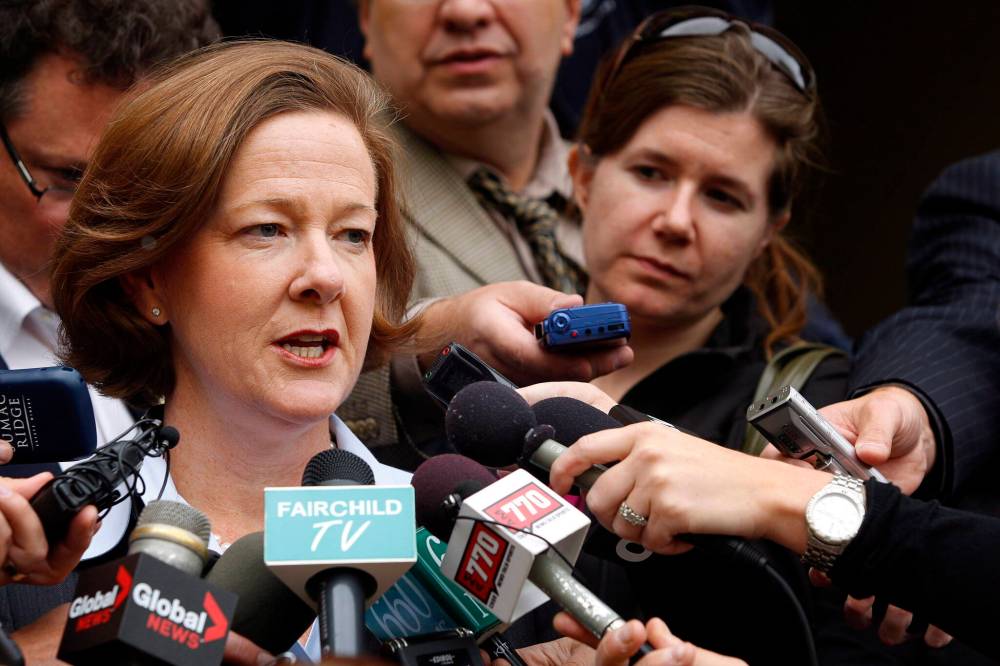
Jeff McIntosh / The Canadian Press files
Former Alberta premier Alison Redford faced considerable criticism after taking her child and nanny with her on government flights, although there were no rules aginst doing so.
Jeff McIntosh / The Canadian Press files Former Alberta premier Alison Redford faced considerable criticism after taking her child and nanny with her on government flights, although there were no rules aginst doing so.

In her introduction, Graham writes her hope is that “a Canadian picking up this book 50 or a hundred years in the future will find its contents foreign and peculiar. The experiences of women in Canada’s most senior political roles shed much light on the reasons why there have been so few of them in the first place.”

The interviews begin with Kim Campbell and then progress alphabetically, starting with Eva Aariak, Nunavut’s premier from 2008 to 2013; Catherine Callbeck, P.E.I.’s premier from 1993 until 1996; Christy Clark, who was B.C.’s premier from 2011 until 2017; the current premier of the Northwest Territories, Caroline Cochrane; the territory’s first female premier, Nellie Cournoyea, who held that post from 1991 until 1995; Pat Duncan, the premier of Yukon from 2000 until 2002; Kathy Dunderdale, Newfoundland and Labrador’s premier from 2010 until 2014; Quebec’s former premier Pauline Marois, who was in charge of that province from 2012 to 2014; Alberta premiers Rachel Notley (2015-2019) and Alison Redford (2011-2014); and finally, Kathleen Wynne, the premier of Ontario from 2013 until 2018.

As the book’s title suggests, female politicians are seldom given second chances in politics, a fact made very clear by the short timelines of each of the women’s tenures. As Graham points out, Canada “re-elect(s) political incumbents all the time — except when it comes to female first ministers. In fact, as of 2021, Canadian has never re-elected a female first minister.”

Graham qualifies this statement by pointing out Wynne’s 2014 win came after she had won the leadership race while her party was in government. But she didn’t win re-election after that. In B.C., Clark led her party to victory in 2013, but she didn’t win her own seat and had to run in a byelection. Her party won in 2017, but it couldn’t form majority government status and as a result a coalition was formed, after which Clark resigned.

There are no “second chances for women” who seldom serve more than one term as first ministers. Compare this to men, whose average run as first minister is roughly five years — and on average most serve two terms.

No Second Chances
No Second Chances

Graham asks Redford, Alberta’s first female premier and a Conservative, about why things seem to “fall apart” for women during their leadership. Redford faced considerable criticism because she had taken her child and a nanny along with her on government flights, although there were no rules against doing so.

“When men make mistakes, other men come to their defence,” Redford says. “For us as women, it’s pretty tough to go out there when we’ve been through the experiences that we’ve been through. If I went out tomorrow and stood up for a woman in politics who was having a hard time, the reaction would be, ‘Oh, yeah. But remember her. Remember what they said about her?’”

In her interview, Campbell says the federal Conservatives’ loss to the Liberals and Jean Chrétien in 1993 fell completely on her shoulders, including the disastrous negative ad campaign making fun of Chrétien’s face. Campbell tells Graham she hadn’t seen the ad until after it had run on television.

“As a woman, I was to blame for it all. Like Hillary Clinton, who people say was a flawed candidate. And I say, wait a minute, wait a minute, she got 66 million votes. She might not have been perfect, but she was amazing.”

There are some reassuring passages in the book, however. Aariak is asked by Graham why she thinks there are so many male premiers. “That is a good question that men should be asking themselves because women know the answers,” Aariak responds. “There are as many women as there are men who have the skills and knowledge and ability and strength to be in that position. Very much so. I strongly believe that we have enough women out there who can do it but getting there is the question… We just need to help them to get there and understand and support them and perhaps eliminate the barriers out there.”

Tom Hanson / The Canadian Press files
In this 1993 photo, outgoing prime minister Kim Campbell waves to supporters as she concedes defeat in the federal election.
Tom Hanson / The Canadian Press files In this 1993 photo, outgoing prime minister Kim Campbell waves to supporters as she concedes defeat in the federal election.

“There’s an old adage,” Wynne says, “that you have to ask a woman three times and you just have to show the man the application form.” She continues: “I think it’s partly because they haven’t seen a lot of women in these roles.”

With the help of Graham’s book, women will be able to read about women in these roles — and perhaps get a better idea of why they should run.

Shannon Sampert is a regular columnist for the Winnipeg Free Press and a retired political scientist whose research area focuses on Canadian politics, women and media.
Dave Chidley / The Canadian Press files
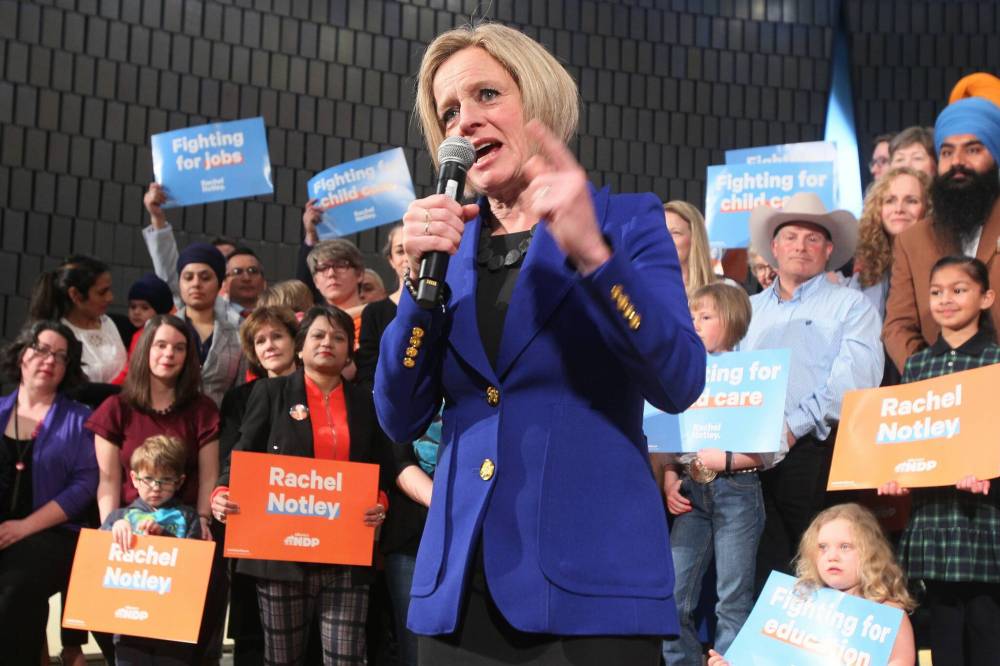
In this 2019 photo, Alberta premier Rachel Notley makes an announcement in Calgary the month before the provincial election which saw her lose to Jason Kenney and the United Conservative Party.
Dave Chidley / The Canadian Press files In this 2019 photo, Alberta premier Rachel Notley makes an announcement in Calgary the month before the provincial election which saw her lose to Jason Kenney and the United Conservative Party.
Report Error Submit a Tip

More Stories

Women political leaders in Canada still struggle with glass ceiling

Reviewed by Shannon Sampert 6 minute read Preview

Women political leaders in Canada still struggle with glass ceiling

Reviewed by Shannon Sampert 6 minute read Saturday, May. 7, 2022

There are few occasions in which Canadians can hear women politicians speak unmediated by pundits, reporters and time constraints. Kate Graham’s No Second Chances offers this opportunity. Graham, a political scientist who lectures at Western University in London, Ont., interviewed 11 of Canada’s female premiers, and former prime minister Kim Campbell, to ask about their experiences in political life.

It’s an important overview of how difficult the glass ceiling remains for women in politics — a concept Graham understands first-hand. In 2020, she ran for leader of the Ontario Liberal Party and came in third. She will represent the Liberals for the riding in London North Centre in June’s provincial election, running against the NDP incumbent.

Graham is the creator and host of NoSecondChances.ca, a podcast about the rise and fall of women in Canada’s most senior roles. This book is the long-form of the interviews found in the first season of those podcasts, funded by Canada 2020, an Ottawa policy think tank which supported Graham as she travelled across Canada to meet with “the women who have led our provinces, territories, and country.”

In her introduction, Graham writes her hope is that “a Canadian picking up this book 50 or a hundred years in the future will find its contents foreign and peculiar. The experiences of women in Canada’s most senior political roles shed much light on the reasons why there have been so few of them in the first place.”

Read
Saturday, May. 7, 2022

Happy email debt forgiveness day

Tory McNally 8 minute read Preview

Happy email debt forgiveness day

Tory McNally 8 minute read 2:01 AM CDT

There are few things more capable of producing an immediate feeling of guilt than opening your inbox and seeing an email you have not answered.

You know the one. It has been sitting there for three days or three months or perhaps long enough that responding now feels less like answering an email and more like reopening a historical case. You read it, think, “I really need to deal with that,” and then close it again.

The next week you see it, feel slightly worse and tell yourself you will answer it when you have more time. A month later, you are considering whether it would be less embarrassing to change your name and move to another province.

Fortunately, there is a solution: Sept. 30 is Email Debt Forgiveness Day, and I think it may be one of the most compassionate holidays we have invented.

Read
2:01 AM CDT

Puzzles Palace

1 minute read Monday, Jul. 27, 2026

To solve our puzzles, please subscribe with this special offer: |

Positive anticipation is growing about major housing developments underway in Winnipeg’s downtown

Gabrielle Piché 10 minute read Preview

Positive anticipation is growing about major housing developments underway in Winnipeg’s downtown

Gabrielle Piché 10 minute read Yesterday at 6:00 AM CDT

If traffic is light and the wind is down, Somia Sadiq is able to hear the roar of Winnipeg Jets fans twice: first through her window, then on TV.

From her apartment view high above downtown, she can look out at Graham Avenue’s painted pedestrian landscape, see construction cranes and hear the heavy equipment at work as massive housing projects take shape at The Forks, at what used to be Portage Place shopping centre and at the former Hudson’s Bay building.

Sadiq has lived at 300 Main for 2 1/2 years, a few steps from the city’s famous, windy and reopened-to-pedestrians Portage Avenue intersection. At 42 storeys, it’s the tallest building in Winnipeg.

She is among 18,000 downtown residents who will soon be joined by thousands of others attracted to the city’s core by the new wave of major construction projects.

Read
Yesterday at 6:00 AM CDT

No more Jets 1.0 or 2.0: League announces all eras of Winnipeg’s club to be merged

Ken Wiebe 6 minute read Preview

No more Jets 1.0 or 2.0: League announces all eras of Winnipeg’s club to be merged

Ken Wiebe 6 minute read Thursday, Sep. 24, 2026

Mark Scheifele’s goal was always to chase down his mentor and former Barrie Colts head coach Dale Hawerchuk, no matter what the official record book said.

So when the NHL and the Winnipeg Jets announced on Thursday morning that they were consolidating the franchise history to include the 1.0 and 2.0 eras (including the Atlanta Thrashers chapter of the club), Scheifele was among those to give the move two thumbs up.

“Yeah, it clarifies it for you guys more, not as much (for) me,” said Scheifele. “It’s really cool to bring in the old Jets records, and especially Dale. Chasing him down was always on my mind. So, it’s cool to do it actually in the record books.”

Scheifele remains the franchise leader in games played (961) and he’s likely to eclipse Hawerchuk in goals (Scheifele has 372 to Hawerchuk’s 379) and points (Scheifele has 907 to Hawerchuk’s 929) this season. He now has Thomas Steen’s 553 assists in his sights after amassing 535 heading into 2026-27.

Read
Thursday, Sep. 24, 2026

Gordon Bell students relish — ‘of all things’ — new pickleball courts

Maggie Macintosh 5 minute read Preview

Gordon Bell students relish — ‘of all things’ — new pickleball courts

Maggie Macintosh 5 minute read 6:00 AM CDT

Manitoba’s newest public school sports facility is bringing the pickleball craze to an inner-city campus.

Gordon Bell High School unveiled four custom-made courts for the popular paddle sport this fall as part of a multi-faceted makeover.

Grade 12 student Matea Thiessen Unger called the courts “the cherry on top,” of a multi-year construction project that consumed much of her high school career.

“It was happening for so long — it felt like it was never going to end,” the 16-year-old said.

Read
6:00 AM CDT