Painter’s wartime experiences chronicled

Advertisement

Advertise with us

Douglas Hunter is an award-winning journalist and historian. He has published books on a variety of historical topics including 2021’s The Place of Stone: Dighton Rock and the Erasure of America’s Indigenous Past.

Read this article for free:

or

Already have an account? Log in here »

To continue reading, please subscribe:

Subscribe and receive a limited-edition Free Press branded hat or tote.

Digital Subscription

One year of digital access for only $205*

  • Enjoy unlimited reading on winnipegfreepress.com
  • Read the E-Edition, our digital replica newspaper
  • Access News Break, our award-winning app
  • Play interactive puzzles

*First annual payment billed as $205.00 + GST for one year. This annual subscription will automatically renew at $233.00 + GST every 52 weeks (10% off the regular annual price of $259.35). Offer available to new and qualified returning subscribers only. Cancel any time.

To continue reading, please subscribe:

Add Free Press access to your Brandon Sun subscription for only an additional

$1 for the first 4 weeks*

  • Enjoy unlimited reading on winnipegfreepress.com
  • Read the E-Edition, our digital replica newspaper
  • Access News Break, our award-winning app
  • Play interactive puzzles
Start now

*Your next Brandon Sun subscription payment will increase by $1.00 and you will be charged $17.95 plus GST for four weeks. After four weeks, your payment will increase to $24.95 plus GST every four weeks.

Hey there, time traveller!
This article was published 02/07/2022 (1495 days ago), so information in it may no longer be current.

Douglas Hunter is an award-winning journalist and historian. He has published books on a variety of historical topics including 2021’s The Place of Stone: Dighton Rock and the Erasure of America’s Indigenous Past.

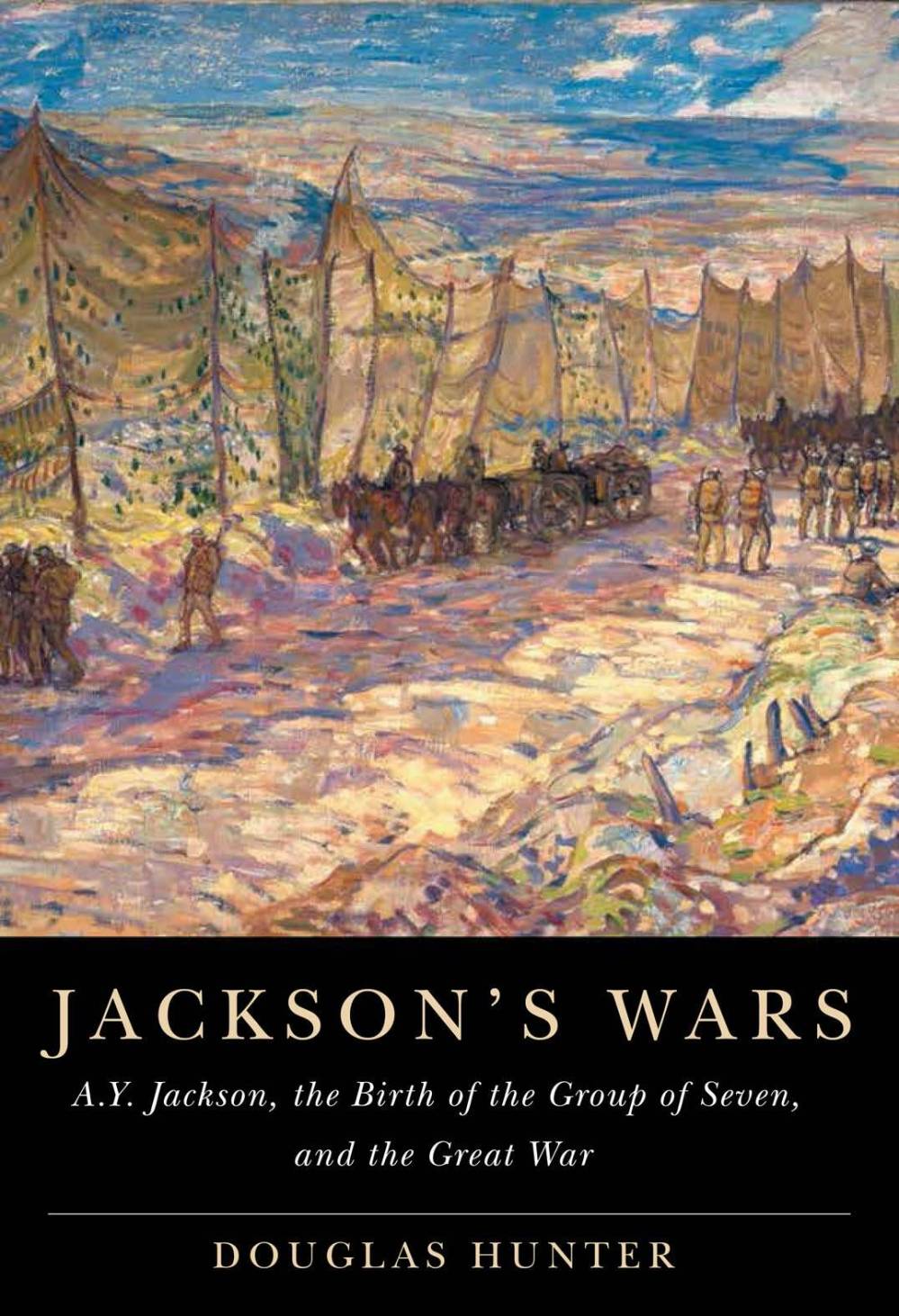
His latest book Jackson’s Wars is not a complete biography of painter A.Y. Jackson; rather, it is an account of his early life as an artist and his years at the western front during the First World War. Jackson was one of the founding painters of the Group of Seven; Hunter’s book gives us a lot of detail up to the early 1920s when, with the war over, the group actually began to exhibit and have some success in their “war” to establish a style of post-impressionist Canadian painting.

Alexander Young Jackson was born in Montreal in 1882. When he was nine, his father went bankrupt, and Jackson was forced to leave school and go to work in an advertising lithography firm to help the family pay bills. Later he studied in the Council of Arts and Manufactures beginning in 1898, and the lessons in lithography were invaluable. He was able to earn a living creating lithographs of mattresses, ladies shoes and literally everything that might appear in a catalogue. At night he went to the Art Association of Montreal. Jackson was impressed by the instructor William Brynner ,who was encouraging his students to try to create impressionist and post-impressionist art.
Jackson worked and studied in Chicago and saved money so he could go to Paris and study at the Académie Julian, where many other Canadians also studied. He went to France before the Great War, where he met his close friend, the painter Rudolf Hewlett, and studied impressionistic and post-impressionistic painters, striving to develop new styles and new colours. Before the war, they mounted a two-man show which received positive reviews and were called promising. For artists like them, they were beginning in a time of depression, after 1912, when people who had been collecting paintings could no longer afford to do so.

With the beginning of the First World War, several Canadian painters joined the army. Jackson hesitated until 1915, when he became a private in the Canadian infantry, saying he wanted to start at the bottom so he could learn about the army. He was friends with Lawren Harris by this time and Harris, being wealthy — from the Harris family of Massey Harris — offered to get him made a lieutenant. Jackson refused.

Most of the men who would form the Group of Seven were in the army. Jackson became exhausted and shell-shocked from his experiences in the trenches. In 1917, Canadian artists suffered a tragic loss when Tom Thomson, a painter who acted as a sort of inspiration and mentor to many young artists, drowned in Canoe Lake in northern Ontario. While Thomson had not been willing to join the army, he was lost to Canadian painting nevertheless.

Jackson was involved in several bloody battles, eventually carrying two pieces of shrapnel in his body. In November 1917 he was saved from further danger when Lord Beaverbrook decided to begin funding a series of paintings by Canadian artists which would show the Canadian public what their soldiers were doing at the front. Jackson was one of the painters Beaverbrook recruited for his artwork, making him a lieutenant and, like the other painters, telling him to do whatever paintings he wanted. The Canadians were told to make sketches of scenes which would then be given to British painters to turn into major oils.

Jackson and other artists returned to Canada as the war ended and asked to create paintings of war factories and show what had been done to support the war at home. Jackson took some of this work, but soon he and the other members of the Group of Seven, which had now taken shape, opened two exhibitions, in 1920 and 1921 — and the Group was truly established.

While Jackson’s Wars is largely about the war and Jackson’s war experiences, it provides a worthwhile introduction to the Group of Seven’s development and birth. It is well-written and amply footnoted should readers want to learn more, and is recommended for general readers as well.

Jim Blanchard is a local historian and retired librarian at the Univerity of Manitoba.

Report Error Submit a Tip

More Stories

Homegrown grub: Resto turns to the Leaf for freshest ingredients

AV Kitching 4 minute read Preview

Homegrown grub: Resto turns to the Leaf for freshest ingredients

AV Kitching 4 minute read Yesterday at 3:39 PM CDT

The term “eat local” has taken on a whole new meaning at Gather Craft Kitchen and Bar, where the journey from plot to plate is measured in footsteps rather than miles.

Head chef Mike Licharson has expanded the restaurant’s focus on local sourcing by incorporating fruit and vegetables grown in The Leaf’s biomes and outdoor kitchen garden into his menu.

Bananas from the tropical biomes star in his banana-bread French toast and accompanying banana compote. Leeks, braised slowly and paired with Manitoba-grown beluga lentils, and Swiss chard — which takes the place of grape leaves in Licharson’s play on classic meze dolmades, a nod to the chef’s Greek-Ukrainian-Irish heritage — are both grown in the outdoor kitchen garden.

The park’s produce complements the restaurant’s other locally sourced ingredients, Licharson says.

Read
Yesterday at 3:39 PM CDT

Drunk driver who killed cycling couple, orphaned their infant daughter, sentenced to eight years

Dean Pritchard 4 minute read Preview

Drunk driver who killed cycling couple, orphaned their infant daughter, sentenced to eight years

Dean Pritchard 4 minute read Yesterday at 5:47 PM CDT

A Winnipeg man responsible for a drunk-driving crash that killed two cyclists last summer and left their infant child an orphan has been sentenced to eight years in prison.

Kuldeep Singh Gill was arrested Sept. 13 after fleeing from a high-speed collision on Kenaston Boulevard that killed 31-year-old Egor Popov and his 25-year-old common-law partner Kerry Ashley Bonner.

Gill, 46, pleaded guilty earlier this year to two counts of impaired driving causing death and two counts of failing to stop at the scene of a collision.

Gill, who has a prior conviction for impaired driving, made a conscious decision to drive drunk, knowing it made him a danger on the road, provincial court Judge David Ireland said at a sentencing hearing Tuesday.

Read
Yesterday at 5:47 PM CDT

‘Sewing angels’ come to Folklorama pavilion’s rescue after Ghana dancers’ costumes stolen

Chris Kitching 4 minute read Preview

‘Sewing angels’ come to Folklorama pavilion’s rescue after Ghana dancers’ costumes stolen

Chris Kitching 4 minute read Updated: Yesterday at 8:27 PM CDT

Parents and volunteers had tears in their eyes when dozens of young dancers took to the stage for their opening performances at Folklorama’s Ghana pavilion Sunday night.

Read
Updated: Yesterday at 8:27 PM CDT

Bell sheds 19 more Manitoba employees

Gabrielle Piché 3 minute read Preview

Bell sheds 19 more Manitoba employees

Gabrielle Piché 3 minute read Yesterday at 6:30 PM CDT

At least 19 Manitoba jobs were lost recently during Bell Canada’s ongoing restructuring.

Parent company BCE Inc. confirmed in June it’d axe nearly 700 jobs through organizational changes. Those changes began last year.

A dozen Manitoba staff were laid off on July 30, according to Team-IFPTE Local 161, the union representing the workers.

Another seven union members left voluntarily though a departure program, the union reported Tuesday.

Read
Yesterday at 6:30 PM CDT

Building bridges for the next generation

Zoe Pierce 8 minute read Preview

Building bridges for the next generation

Zoe Pierce 8 minute read Yesterday at 6:00 AM CDT

Change has been the motivation behind Clayton Sandy’s work for decades.

A member of Sioux Valley Dakota First Nation, Sandy is an Indigenous knowledge keeper, cultural advisor and community advocate. His work has taken him into newcomer organizations, schools, hospitals and workplaces across Manitoba, where he teaches Indigenous history, mentors youth and helps build relationships between communities.

Sitting down for an interview with the Free Press, Sandy arrived with a busy calendar in hand, a reflection of the many projects and initiatives that continue to fill his days as he works to create change for future generations.

“I have two boys and I have five grandchildren. The racism I put up with was really bad,” Sandy said. “And I don’t want my grandchildren to put up with that garbage.”

Read
Yesterday at 6:00 AM CDT

Book gives patients tools for navigating the Canadian health-care system and getting treatment they need

Janine LeGal 8 minute read Preview

Book gives patients tools for navigating the Canadian health-care system and getting treatment they need

Janine LeGal 8 minute read Yesterday at 6:00 AM CDT

More than a few of us have been known to complain about the Canadian health-care system: the lack of staffing, the long ER waits, the challenge of finding a family physician, the lengthy waiting lists for specialized tests and surgeries. There’s been an outcry for answers for a long time.

The publication of The Canadian Health Care Guerrilla Handbook: How to Fight for What You Need is welcome news for anyone seeking those answers.

Written by Michael Decter, who served as cabinet secretary in Manitoba before his move to Ontario — and Mike McCarthy, patient advocate and consultant who brings a personal story of living with hemophilia, the book is a must-have, packed with answers to commonly asked questions that will help the reader navigate a complex and fractured system.

The book, written in plain language, talks about how to get what you want and need: a family doctor, diagnostic tests, appropriate medications, a second opinion, long-term care, home care, mental-health care — all of that and more is easily accessible in its 217 pages.

Read
Yesterday at 6:00 AM CDT