Figures of resistance
Graphic-novel anthology amplifies feminist Indigenous voices on a global scale
Advertisement
Read this article for free:
or
Already have an account? Log in here »
To continue reading, please subscribe:

Digital Subscription
One year of digital access for only $205*
- Enjoy unlimited reading on winnipegfreepress.com
- Read the E-Edition, our digital replica newspaper
- Access News Break, our award-winning app
- Play interactive puzzles
*First annual payment billed as $205.00 + GST for one year. This annual subscription will automatically renew at $233.00 + GST every 52 weeks (10% off the regular annual price of $259.35). Offer available to new and qualified returning subscribers only. Cancel any time.
To continue reading, please subscribe:
Add Free Press access to your Brandon Sun subscription for only an additional
$1 for the first 4 weeks*
- Enjoy unlimited reading on winnipegfreepress.com
- Read the E-Edition, our digital replica newspaper
- Access News Break, our award-winning app
- Play interactive puzzles
*Your next Brandon Sun subscription payment will increase by $1.00 and you will be charged $17.95 plus GST for four weeks. After four weeks, your payment will increase to $24.95 plus GST every four weeks.
Read unlimited articles for free today:
or
Already have an account? Log in here »
Hey there, time traveller!
This article was published 31/12/2022 (1348 days ago), so information in it may no longer be current.
This new graphic novel anthology presents lively, heartfelt short comics chronicling instances of feminist Indigenous resistance in the global South.
The idea for the book began with an open-call project from the Goethe-Institut Indonesien in Jakarta, and the resulting anthology of eight comics showcases activism for access to ecological resources, education, art and basic human rights. Through personal accounts of discrimination and collective efforts for justice, Movements and Moments explores the disruptive agency of underrepresented women, through events spanning from the 1930s to as recently as 2020.
As most of these stories have been adapted and translated from languages found all across the global South, many comics feature words in the author’s native languages, along with corresponding glossaries. In places, though, the accompanying English text could be scaled back without losing any of the narrative, as some passages simply recap the already-stunning visuals instead of enhancing them with additional information or insight.
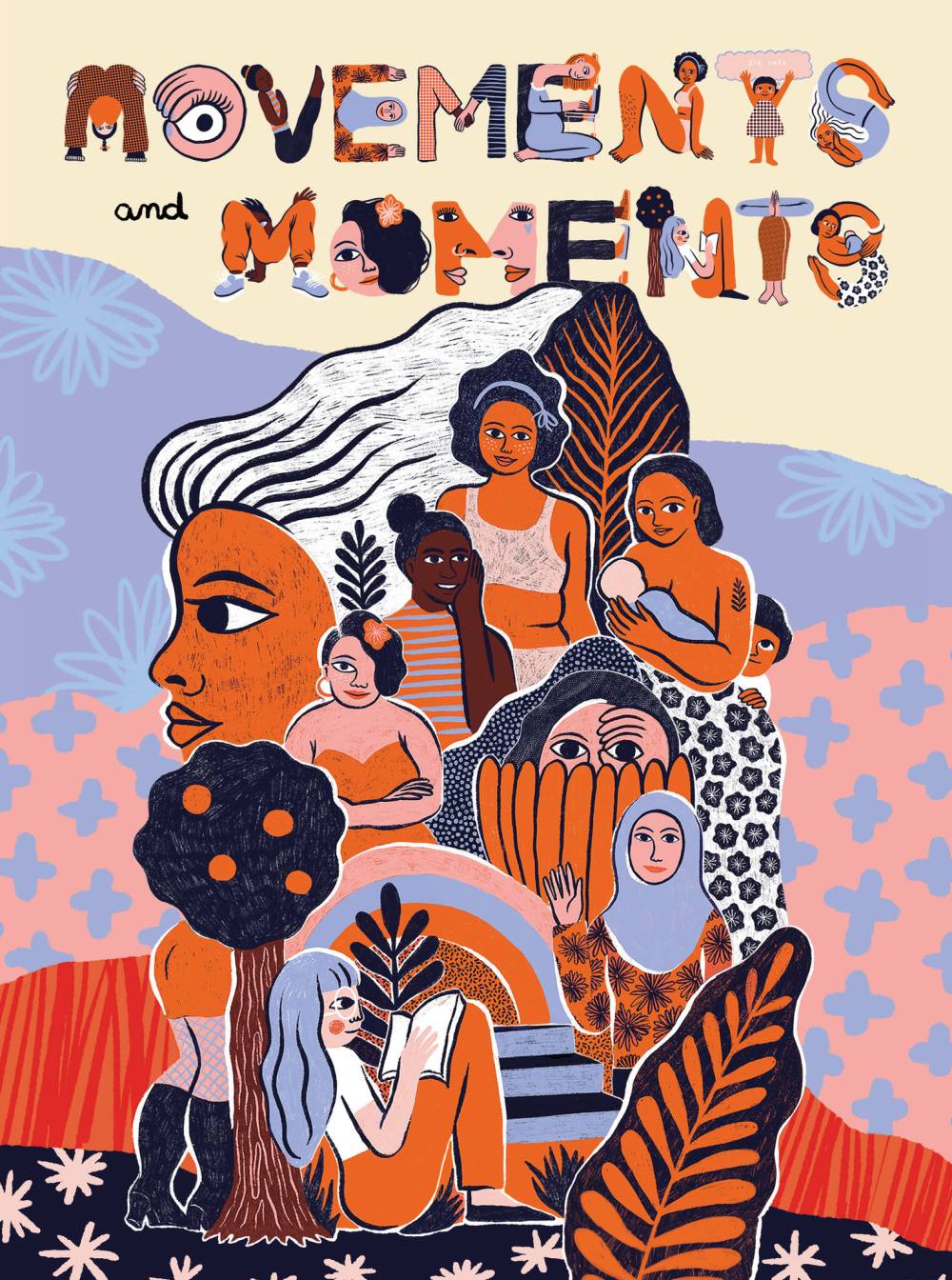
Movements and Moments
Consistent throughout the collection, though, are unique shapes, vivid palettes and compelling character design that invite the reader to bear witness to historical trauma without overlooking the humanity and resilience of those involved.
Though the book as a whole uses the artistic medium of comics to highlight resistance, some narratives centre around music, dance and the written word. Shanti: Beyond the Veil shows how an author is shaped through her desire to give voice to women’s struggles in her small village, and to make these stories, and how they are circulated, accessible too.
She remarks “What is the use of literature that is not accessible to men and women in the villages?” Notably, author/illustrator Bandana Tulachan has also co-founded a comics collective for fellow artists in Nepal.
Meanwhile, Duong Manh Hung and Pham Thu Tran’s Tracing Between Colors of the Highlands showcases how traditional Vietnamese highland songs and instruments promote a love of culture and community, which later leads to skill-building and cultural advocacy through music education.
And Times Will Pass, by trans artist Chandri Narayanan, is a personal, autobiographical comic that contemplates hope and community through art and dance. “All of us loving ourselves is a revolution,” she affirms.
Other stories explore land defenders and environmental resistance movements, drawing on the link between land and livelihoods to show how colonialism and capitalism destroys both of these simultaneously. Ecuadorian story Mama Dulu, by Citlalli Andrango, depicts the long history of the Kitchwa people’s struggle to reclaim stolen land, to which they are also bound by indentured servitude. Here, artist Cecilia Larrea’s arresting use of caricature and colour is especially effective in portraying the abuses of labour that occur, and the additional discrimination faced by Indigenous women workers, both of which are disregarded by the government.
Nina Martinez’s Let the River Flow Free: Women Defenders of the Cordillera traces the events leading up to a spontaneous (and provocative) protest by women villagers in the Northern Philippines, as they strive to save their river from a hydroelectric dam project that will also displace them.
Similar content is explored in Consuelo Terra and Greta Di Girolamo’s story Millaray Huichalaf: The Protectress of the Sacred River, about the Mapuchi communities in Chile affected by a new hydroelectric plant. These two accounts detail an injustice faced by many other Indigenous communities worldwide, and are compelling examples of the entire collection’s global reach.
With a broad range of narratives and diverse art styles, Movements and Moments is an immersive graphic anthology that amplifies women’s grassroots efforts within marginalized communities. It is also a vital archive of life writing, historical events and language and culture preservation.
Nyala Ali writes about race and gender in contemporary narratives.