Review: ‘Pathogenesis’ offers different lens on history

Advertisement

Advertise with us

“Pathogenesis: A History of the World in Eight Plagues,” by Jonathan Kennedy (Crown)

Read this article for free:


or

Already have an account? Log in here »

To continue reading, please subscribe:

Subscribe and receive a limited-edition Free Press branded hat or tote.

Digital Subscription

One year of digital access for only $205*

  • Enjoy unlimited reading on winnipegfreepress.com
  • Read the E-Edition, our digital replica newspaper
  • Access News Break, our award-winning app
  • Play interactive puzzles

*First annual payment billed as $205.00 + GST for one year. This annual subscription will automatically renew at $233.00 + GST every 52 weeks (10% off the regular annual price of $259.35). Offer available to new and qualified returning subscribers only. Cancel any time.

To continue reading, please subscribe:

Add Free Press access to your Brandon Sun subscription for only an additional

$1 for the first 4 weeks*

  • Enjoy unlimited reading on winnipegfreepress.com
  • Read the E-Edition, our digital replica newspaper
  • Access News Break, our award-winning app
  • Play interactive puzzles
Start now

*Your next Brandon Sun subscription payment will increase by $1.00 and you will be charged $17.95 plus GST for four weeks. After four weeks, your payment will increase to $24.95 plus GST every four weeks.

Hey there, time traveller!
This article was published 18/04/2023 (1237 days ago), so information in it may no longer be current.

“Pathogenesis: A History of the World in Eight Plagues,” by Jonathan Kennedy (Crown)

Great historical changes are often conceived of as being brought about by the genius and tenacity of great men, or occasionally women, but Jonathan Kennedy argues in his book “Pathogenesis: A History of the World in Eight Plagues,” that germs are largely responsible for everything from the decline of the Neanderthals to the current poverty of sub-Saharan Africa.

His quick history of the world from the Paleolithic to the present day offers a different lens to view many of the big events of the past. Some of Kennedy’s conclusions are mere speculation, like his idea that deadly plagues in the Roman empire led to the swift rise of Christianity. In the midst of so much death, he argues, the new religion offered a more enticing view of the afterlife than paganism.

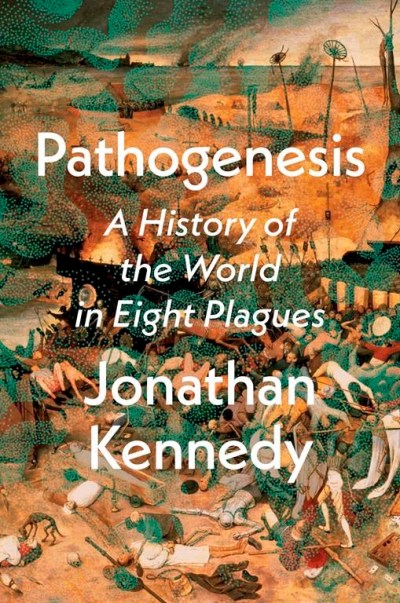
This cover image released by Crown shows
This cover image released by Crown shows "Pathogenesis: A History of the World in Eight Plagues" by Jonathan Kennedy. (Crown via AP)

Most of his observations are bolstered by more historical research and are more convincing. In showing how pathogens helped the Spanish conquer Central and South America, Kennedy explains that European diseases including smallpox and measles killed or incapacitated most of the native population, which had no immunity to the previously unknown germs. One outbreak in 1545 alone is estimated to have killed up to 80% of the Indigenous peoples of Mesoamerica.

The death and destruction also accelerated their religious conversion as many of the remaining Indigenous peoples, along with the Spanish, saw it as proof that the Christian God was superior, Kennedy argues.

On the other side of the Atlantic, Kennedy explains how resistance to infectious disease — especially the malaria and yellow fever prevalent in parts of sub-Saharan Africa — boosted the slave trade. Disease-resistant Africans were less likely to die on the new world plantations than Europeans, and much of the native population had already been wiped out. The subsequent association of Africans with slavery contributed to the ideology of white supremacy that continues to impact the way African Americans are treated today, Kennedy argues.

The presence of malaria and yellow fever also prevented Europeans from colonizing the African interior, but only for a time. That changed when quinine was discovered to help prevent death from malaria. But because the rates of death and disease were still high, the colonies attracted desperate and ruthless individuals with a desire to make a quick fortune and get out. It was disease, Kennedy argues, that helped create the harshly extractive colonial economies in places like the Congo, the repercussions of which are still felt in the extreme poverty of those countries.

Poverty, including in wealthy countries like the United States, is a sort of modern plague, killing millions each year with both infectious disease and non-communicable diseases like diabetes, Kennedy argues in the final chapter. These poverty-associated health problems, in turn, have been associated with higher death rates during the COVID-19 pandemic.

Kennedy ends with a passionate plea for public health expenditures to eliminate disease. Relying on examples of successful public health campaigns throughout the book, he argues that such an investment will both improve human lives and bolster economies.


Report Error Submit a Tip

More Stories

Dynacare labs quickly reach capacity ahead of strike

Nicole Buffie 5 minute read Preview

Dynacare labs quickly reach capacity ahead of strike

Nicole Buffie 5 minute read Yesterday at 3:06 PM CDT

Patients were being turned away from several Dynacare locations Saturday morning as people packed the labs in hopes of getting their blood collection done before workers strike.

By 10:30 a.m. the lobby at the Dynacare at 1581 Regent Ave. was standing-room only and walk-up patients were being turned away as the wait time for those lucky enough to get in creeped past two hours.

One woman got in right before workers cut off walk-ins at 10 a.m. after travelling to two other locations.

“I was driving by at 7:15 this morning and there was already a line-up to the road, so I was like ‘nope, not going there’ so I went to the one on Sterling Lyon (Parkway) and it was closed, and then I went to the one at St. Vital Mall and there had a line zig-zagging all the way through the corridors so I gave up and came back,” said Joanna, who declined to give her last name.

Read
Yesterday at 3:06 PM CDT

Manitoba doctor denies working to revive Carberry ER in response to recruitment lawsuit

Erik Pindera 4 minute read Preview

Manitoba doctor denies working to revive Carberry ER in response to recruitment lawsuit

Erik Pindera 4 minute read 9:40 AM CDT

A Manitoba doctor has denied he was working as a recruiter after an Ontario doctor accused him of misleading him about a position at the Carberry hospital.

Dr. Klevis Iliriani, who worked at the hospital in Carberry from May to August 2024, filed his statement of claim in Court of King’s Bench earlier this year.

Iliriani, who lives in an Ottawa suburb, has alleged recruiters negligently misrepresented the job at the Carberry hospital and breached the terms of his contract, which resulted in less pay than promised.

His court filing names defendants Dr. Dave Maharajh and Barry Banek as the recruiters.

Read
9:40 AM CDT

Today’s horoscope

Georgia Nicols 4 minute read 2:00 AM CDT

MOON ALERT: There are no restrictions to shopping or important decisions today. The moon is in Cancer.

ARIES (March 21-April 19)

Relations with parents and authority figures might be strained. Resist the urge to be too pushy. Likewise, avoid other people who are pushy. Your best choice is to work hard and get better organized. Fortunately, relations with partners are good.

TAURUS (April 20-May 20)

Review: ‘Pathogenesis’ offers different lens on history

Travis Loller, The Associated Press 3 minute read Preview

Review: ‘Pathogenesis’ offers different lens on history

Travis Loller, The Associated Press 3 minute read Tuesday, Apr. 18, 2023

“Pathogenesis: A History of the World in Eight Plagues,” by Jonathan Kennedy (Crown)

Great historical changes are often conceived of as being brought about by the genius and tenacity of great men, or occasionally women, but Jonathan Kennedy argues in his book “Pathogenesis: A History of the World in Eight Plagues,” that germs are largely responsible for everything from the decline of the Neanderthals to the current poverty of sub-Saharan Africa.

His quick history of the world from the Paleolithic to the present day offers a different lens to view many of the big events of the past. Some of Kennedy's conclusions are mere speculation, like his idea that deadly plagues in the Roman empire led to the swift rise of Christianity. In the midst of so much death, he argues, the new religion offered a more enticing view of the afterlife than paganism.

Most of his observations are bolstered by more historical research and are more convincing. In showing how pathogens helped the Spanish conquer Central and South America, Kennedy explains that European diseases including smallpox and measles killed or incapacitated most of the native population, which had no immunity to the previously unknown germs. One outbreak in 1545 alone is estimated to have killed up to 80% of the Indigenous peoples of Mesoamerica.

Read
Tuesday, Apr. 18, 2023

For newcomer pizza purveyors, it’s all about crafting solid foundations

David Sanderson 7 minute read Preview

For newcomer pizza purveyors, it’s all about crafting solid foundations

David Sanderson 7 minute read Yesterday at 2:00 AM CDT

A recent poll conducted by an Internet-based market-research firm determined that close to 20 per cent of people eschew their leftover pizza crust.

Some argued that the residual crust lacks flavour. Others submitted that it’s too hard or crunchy to enjoy sans toppings. Given that information, what are we to make of Crusty Craft Pizza, a five-month-old takeout spot whose owners are so confident in their European-style pizza crust that they’ve chosen to highlight it in their business moniker?

Whenever somebody informs them they don’t like pizza crust, their response is, well, they haven’t tried theirs, says Oleksii Samokvhal, who together with his wife, Iryna Mehedyn, opened Crusty Craft Pizza in early April, at 1311 Day St. in Transcona.

“It’s thin in the middle, with raised edges we hand-form ourselves,” says Mehedyn, a native of Ukraine who, like her Kyiv-born husband, relocated to Winnipeg to escape the conflict in their home country.

Read
Yesterday at 2:00 AM CDT

(Un)friendly competition

Ken Wiebe 6 minute read Preview

(Un)friendly competition

Ken Wiebe 6 minute read Yesterday at 5:26 PM CDT

REGINA – Jermarcus Hardrick knows exactly what kind of battle he is in for on Sunday in the 61st edition of the Labour Day Classic.

The Saskatchewan Roughriders right tackle has ample experience lining up opposite Winnipeg Blue Bombers defensive end Willie Jefferson, both as teammates and opponents during the past decade and change.

In this pivotal matchup between Prairie rivals jockeying for position in the CFL West Division, this head-to-head battle in the trenches figures to be must-see TV.

“Willie is one of my best friends, one of the best players in the league. It’s amazing to see what he’s doing on film, what he’s always done on film,” said Hardrick, who spent eight seasons with the Blue Bombers before joining the Roughriders in 2024 as a free agent. “With the way that you know he plays and what he can do to a team with his energy and knowing that’s on the other side from you all game, that’s a big challenge that you look forward to.

Read
Yesterday at 5:26 PM CDT