East meets West
First World War fiction offers finely drawn questions of identity, freedom
Advertisement
Read this article for free:
or
Already have an account? Log in here »
To continue reading, please subscribe:

Digital Subscription
One year of digital access for only $205*
- Enjoy unlimited reading on winnipegfreepress.com
- Read the E-Edition, our digital replica newspaper
- Access News Break, our award-winning app
- Play interactive puzzles
*First annual payment billed as $205.00 + GST for one year. This annual subscription will automatically renew at $233.00 + GST every 52 weeks (10% off the regular annual price of $259.35). Offer available to new and qualified returning subscribers only. Cancel any time.
To continue reading, please subscribe:
Add Free Press access to your Brandon Sun subscription for only an additional
$1 for the first 4 weeks*
- Enjoy unlimited reading on winnipegfreepress.com
- Read the E-Edition, our digital replica newspaper
- Access News Break, our award-winning app
- Play interactive puzzles
*Your next Brandon Sun subscription payment will increase by $1.00 and you will be charged $17.95 plus GST for four weeks. After four weeks, your payment will increase to $24.95 plus GST every four weeks.
Read unlimited articles for free today:
or
Already have an account? Log in here »
Hey there, time traveller!
This article was published 29/04/2023 (1250 days ago), so information in it may no longer be current.
Critics have justly described Jamie Chang’s fourth novel The Porcelain Moon as “a rare jewel in a sea of wartime fiction.”
The Taiwan-born, B.C.-based Chang, whose other writing includes The Library of Legends and Three Souls, moves the story quickly from China to First World War France. A number of themes are deftly whisked together, including the cultural divide between China and the West, individuals craving recognition, generational differences, intergenerational trauma and the role of women in society. And it is all wrapped up by several complicated love stories.
As the war is winding down in 1918, Pauline Deng runs away from her uncle Louis’s home and antique business in Paris in an attempt to avoid an arranged marriage which Louis and his First Wife, who still lives in Shanghai, have planned for her. Since Uncle Louis won’t listen to her because she is just a woman, Pauline seeks the help of her more modern cousin, Theo, who is also trying to avoid an arranged marriage and a return to Shanghai.

Ayelet Tsabari photo
Author Janie Chang’s other novels include The Library of Legends and Three Souls.
Pauline wanted to earn wages like Theo and recognition that she was valuable to the store and her uncle. Theo has no interest in the store, in part because of a learning disability which makes mathematics hard for him. In defiance of his uncle’s wishes, Theo takes a job as an interpreter for the Chinese labourers (France imported about 40,000, Britain 100,000) who were there as non-combatant labour to get supplies to troops and dig and clear trenches. They had been promised work safely behind the front lines, but the reality is that front lines shift.
While working with this group at Noyelles-sur-Mer, Theo meets and falls in love with Celine, a married French woman from the genteel poverty of a declining aristocracy. Her abusive husband, Jean Paul, is the son of the town whore, who hopes to improve his status through marriage into what is left of the aristocracy.
An interpreter’s work often involves smoothing over cultural differences. Some are humorous, some are potentially deadly, such as misunderstandings clearing trenches where workers receive no warning about unexploded munitions. “There’s so much those boys don’t know.”
Theo spells out the full nauseating horror of war in a description of the “soul-destroying” work of clearing trenches: “I ignored the bloated corpses of rats… The stench that rose up as the day wore on was horrible… A decomposed arm stuck out from the trench wall dangling at the elbow… His corpse had been trampled over and buried under dirt and debris.”
Through subtle descriptions, Chang makes her points about the emerging generational gap in China. When the family arrives in Paris, for example, Pauline is delighted. “There was no one here who would scold or beat her… She was only twelve years old, but here she was the head housekeeper.”
First Wife, on the other hand, “had no desire to leave the comforts of her courtyard home for the hardships of life in a foreign land. How could she lead a decent and proper life in Europe?”
The Chinese are proud of their 4,000-year-old civilization, but in a letter from Theo to Pauline, the author quietly zeroes in on a key weakness. Theo describes a chess game and conversation he had with one of the labourers, who used to be a teacher in China: “What impresses him most about the West is that everyone can read… he realizes now what a weak country China is compared to Western nations.” On the other hand, he is sure things will improve in China: “It might take a hundred years, but what was a hundred years compared to four thousand years of civilization.”
The problem with the ancient civilization is that its feudal mindset did not equip the Chinese to defend themselves against the mercantile greed of the West, supported and advanced by well-equipped armies. Camille’s father was one of these soldiers. “He had been told they would be fighting barbarians. But everything he saw, the architecture and gardens, the exquisite craftsmanship, the private libraries, told him otherwise. They were plundering a civilized society.” But that civilization was “One whose emperors had refused to allow in new ideas and new inventions for hundreds of years. A country unable to stand against Western firepower and Western alliances.”
When Camille’s father dies, her husband’s abusive personality comes to the fore. She realizes the abuse comes because he knows no other way, treated like garbage all his life as the son of the town’s whore. When the abuse reaches a point Camille can no longer stand, she begins to plot an escape.
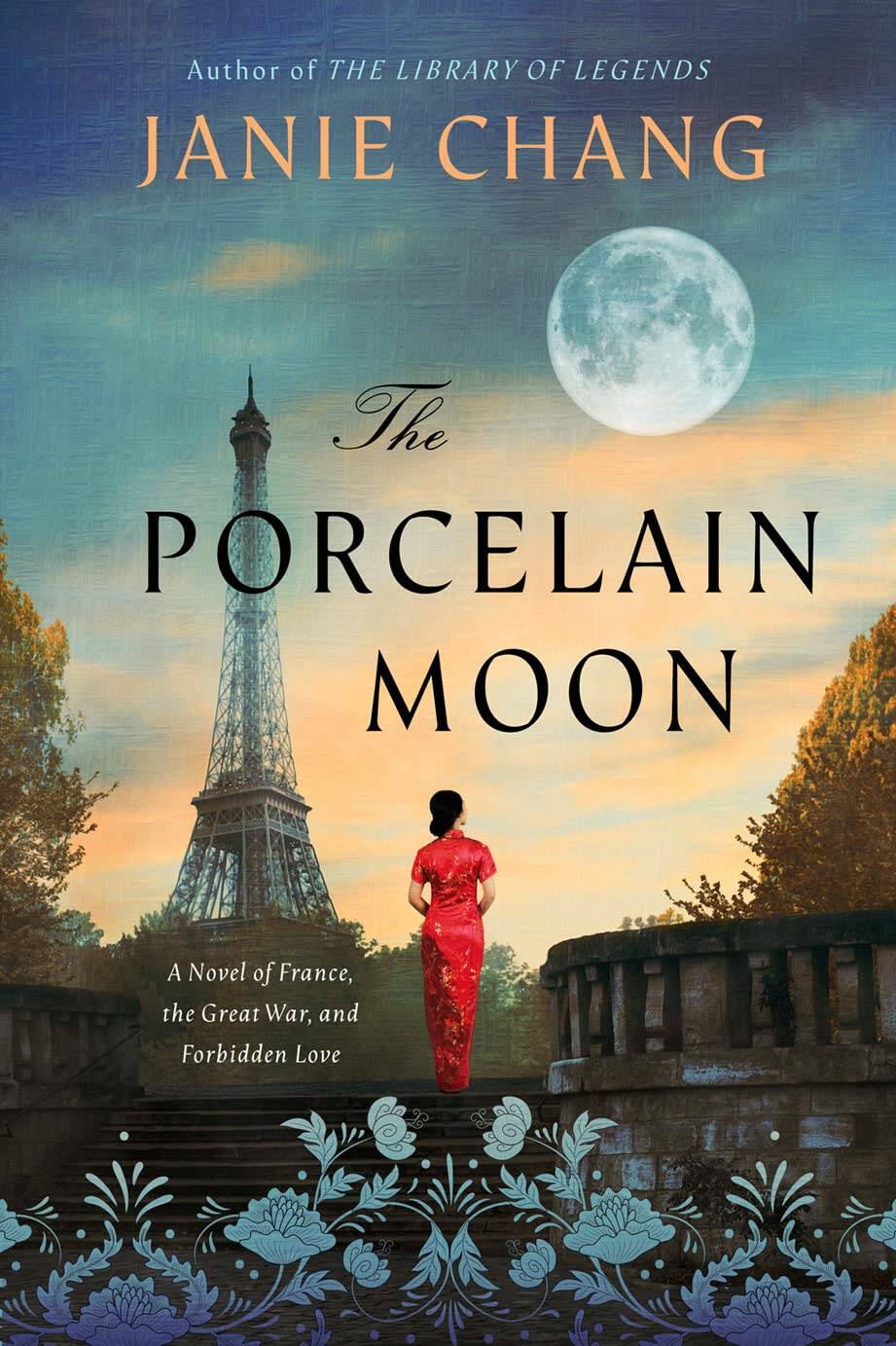
The Porcelain Moon

Henri, a journalist friend of Theo, accompanies Pauline on her trip to Noyelles-sur-Mer as she searches for Theo. Pauline winds up staying with Celine and the women soon realize they are both concerned about the same man.
Wise words from Celine’s late grandmother, a countess, hover over these complex relationships: “Loving is what makes you happy, not being loved.”
Eventually, all the principal characters make their way back to Paris for a surprise Cinderella-type ending. Flipping back through the pages, however, there were clues dropped along the way.
Chang’s subtle but powerful development of themes and characters will keep readers glued to the book, not wanting to put it down long enough to top up a glass of sherry.
Gordon Arnold is a Winnipeg writer.