Coppers take on Glaswegian gangs, IRA

Advertisement
Read this article for free:
or
Already have an account? Log in here »
To continue reading, please subscribe:

Digital Subscription
One year of digital access for only $205*
- Enjoy unlimited reading on winnipegfreepress.com
- Read the E-Edition, our digital replica newspaper
- Access News Break, our award-winning app
- Play interactive puzzles
*First annual payment billed as $205.00 + GST for one year. This annual subscription will automatically renew at $233.00 + GST every 52 weeks (10% off the regular annual price of $259.35). Offer available to new and qualified returning subscribers only. Cancel any time.
To continue reading, please subscribe:
Add Free Press access to your Brandon Sun subscription for only an additional
$1 for the first 4 weeks*
- Enjoy unlimited reading on winnipegfreepress.com
- Read the E-Edition, our digital replica newspaper
- Access News Break, our award-winning app
- Play interactive puzzles
*Your next Brandon Sun subscription payment will increase by $1.00 and you will be charged $17.95 plus GST for four weeks. After four weeks, your payment will increase to $24.95 plus GST every four weeks.
Read unlimited articles for free today:
or
Already have an account? Log in here »
Hey there, time traveller!
This article was published 02/09/2023 (1131 days ago), so information in it may no longer be current.
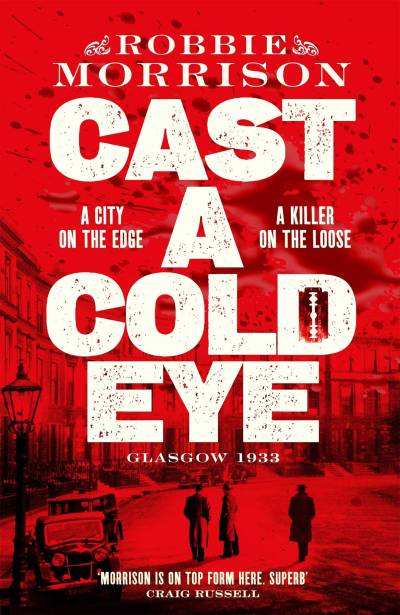
The streets of 1933 Glasgow are a mean place, full of slash-you-with-a-razor punk gangs, abysmal poverty, foul toxin-laced air, nowhere futures, the physical and mental devastation that crawled back out of the trenches — and is now a battleground for the IRA and the British government’s death squads.
And all that’s keeping a precarious lid on civilization are the likes of police inspector Jimmy Dreghorn and his sergeant, Bonnie Archie McDaid.
It would be long odds indeed if you wanted to place a bet on the city’s chances of survival, if betting weren’t illegal — like so many other vices carried out openly by villains galore.

The book opens with Dreghorn and McDaid discovering a body on a decrepit narrowboat, a man executed with one bullet to the back of his head.
For all the violence, guns are rare in Glasgow. Any bets it will be the last such murder?
We first met the two coppers in Edge of the Grave, a masterful piece of grit announcing that Robbie Morrison was joining the ranks of amazing Scottish murder mystery authors: Sir Ian Rankin, Val Mcdermid, Alex Gray, Stuart MacBride.
Jimmy’s a wee but feisty man, a boxer, a lapsed Catholic in a Protestant police force, his romantic relationship history a disaster. Archie’s huge, a former Olympic wrestling medallist, renowned bagpiper, loving husband, loving father, who likes nothing more than a villain starting a punchup.
They’re up against corrupt coppers, corrupt politicians, vicious gangsters and, ultimately, the state.
Cast a Cold Eye is a superb murder mystery, let there be nary a doot — sorry, doubt — but it’s so much more. Despite the despair, despite the poverty, the basic decency of so many people shines through, showing us why Morrison loves Glasgow for all its flaws.
The IRA is in Glasgow, but for what purpose? We know industrial dynamite has gone missing, we know there are guns in the hands of people who shouldn’t have them. Sectarian hatred is rampant.
Readers who may have known vaguely about the Easter Rising in Dublin and the executions that followed will get a subtle education in the ongoing strife that divided Ireland for much of the 20th century, the Troubles in the north, the south’s fight against the British and the civil war among the Irish.
It was the beginning in 1933 of the Irish Sweeps, when every block seemed to have someone surreptitiously selling tickets on a lottery betting on horse races — completely illegal, a dream of a way out of the Depression, the proceeds to benefit hospitals in Ireland, the tickets sold not only in Glasgow and Dublin, but in Canada and the U.S. as well.
Could it be that the IRA is taking a cut? And using it to buy weapons? Who could have seen that coming?
What seems to be a mysterious murder turns into far more when Dreghorn and McDaid get told to back off their investigation. Menacing men in dark suits and big black cars have arrived from London, ostensibly from the Home Office, but some working for organizations that don’t officially exist, given a licence to kill in defence of the realm.
Readers will learn about the Black and Tans — unemployed English veterans recruited as Imperial stormtroopers by His Majesty’s secret police and sent into Ireland in 1920 to rain havoc down on the oppressed populace. Not Britain’s finest hour.
Could the murders have anything to do with — no, wait, no spoilers.
And the IRA atrocities that we all know will surely come to Glasgow, that could never really be the work of — no, again, no spoilers.
Robbie Morrison spent 20 years writing comic books before he decided to give murder mysteries a try. Well done, Robbie, well done. Keep them coming, lad.
Retired Free Press reporter Nick Martin will be sure on his next time in Glasgow to do as Jimmy Dreghorn does and spend far more time in the Kelvingrove Museum.
Nick Martin
Former Free Press reporter Nick Martin, who wrote the monthly suspense column in the books section and was prolific in his standalone reviews of mystery/thriller novels, died Oct. 15 at age 77 while on holiday in Edinburgh, Scotland.
Our newsroom depends on a growing audience of readers to power our journalism. If you are not a paid reader, please consider becoming a subscriber.
Our newsroom depends on its audience of readers to power our journalism. Thank you for your support.
Nick Martin
Former Free Press reporter Nick Martin, who wrote the monthly suspense column in the books section and was prolific in his standalone reviews of mystery/thriller novels, died Oct. 15 at age 77 while on holiday in Edinburgh, Scotland.
Our newsroom depends on a growing audience of readers to power our journalism. If you are not a paid reader, please consider becoming a subscriber.
Our newsroom depends on its audience of readers to power our journalism. Thank you for your support.
Advertisement Advertise With Us
Advertisement Advertise With Us