Power play
Taliban’s return to rule requires open, direct engagement from U.S., author argues
Advertisement
Read this article for free:
or
Already have an account? Log in here »
To continue reading, please subscribe:

Digital Subscription
One year of digital access for only $205*
- Enjoy unlimited reading on winnipegfreepress.com
- Read the E-Edition, our digital replica newspaper
- Access News Break, our award-winning app
- Play interactive puzzles
*First annual payment billed as $205.00 + GST for one year. This annual subscription will automatically renew at $233.00 + GST every 52 weeks (10% off the regular annual price of $259.35). Offer available to new and qualified returning subscribers only. Cancel any time.
To continue reading, please subscribe:
Add Free Press access to your Brandon Sun subscription for only an additional
$1 for the first 4 weeks*
- Enjoy unlimited reading on winnipegfreepress.com
- Read the E-Edition, our digital replica newspaper
- Access News Break, our award-winning app
- Play interactive puzzles
*Your next Brandon Sun subscription payment will increase by $1.00 and you will be charged $17.95 plus GST for four weeks. After four weeks, your payment will increase to $24.95 plus GST every four weeks.
Read unlimited articles for free today:
or
Already have an account? Log in here »
Hey there, time traveller!
This article was published 09/09/2023 (1117 days ago), so information in it may no longer be current.
In this informative and challenging book, Hassan Abbas argues that the only way to save the Afghan people from a humanitarian disaster is for the United States and its allies to replace boycotts with open and direct engagement with the de facto Taliban government.
Abbas, distinguished professor of international relations at the National Defence University in Washington, D.C., is careful to differentiate “engagement” from “endorsement.” Engagement attempts to provide a deeper understanding of the Taliban’s interests, unlike endorsement which means supporting their ideals.
Abbas makes no attempt to sugar-coat those ideals. He emphasizes that the Taliban believe they are chosen by God to implement divine rule in Afghanistan by establishing a state based on Islamic law. Under this law, women are of no use other than being wives and rearing children. Among other restrictions, they are not entitled to education after grade 6, must wear the chador in public and cannot travel certain distances unless accompanied by a male relative.
Ebrahim Noroozi / The Canadian Press files
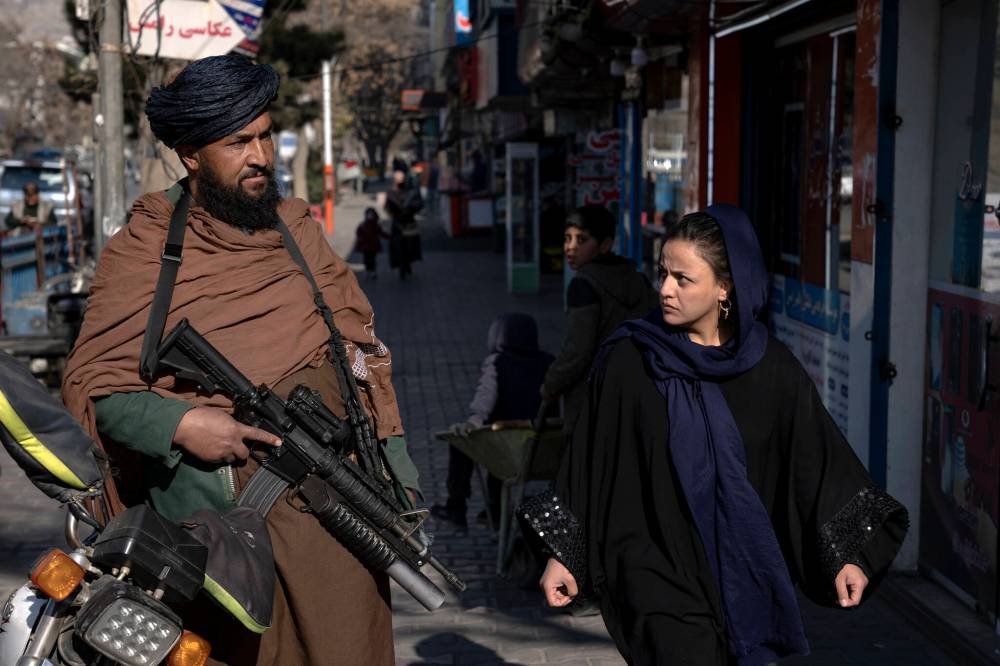
In this December 2022 photo, a Taliban fighter stands guard as a woman walks past in Kabul, Afghanistan.
The first rule of warfare is “know your enemy.” Where western countries see a united Taliban monolith, Abbas sees factions broadly united by religion but often at odds politically. Based in Kandahar, Mullah Hibatullah Akhundzada is the supreme religious leader, rigid in his extreme view of Islam. In Kabul, younger, tech savvy and image-conscious leaders predominate. Battle-hardened warlords rule the countryside. Within the bounds of their loyalty to Hibatullah, all jockey with each other for power.
Abbas pins his hopes on the younger leadership in Kabul. Many of them had participated in the Trump-initiated negotiations in Doha from September 2018 to February 2020. The American negotiators expected ill-educated warriors, unable to string a sentence together. To their detriment, they found themselves facing well-educated, disciplined, eloquent opponents comfortable with digital-era public relations.
The Taliban negotiators were well aware that Trump would do anything to get out of Afghanistan, even if it meant sacrificing its pro-American government. Knowing that all they had to do was give Trump cover, they pretended to hold progressive views, told the Americans what they wanted to hear and walked away with a sweetheart deal.
Once the Taliban had taken power, they found themselves trying to rule a country financially isolated by America, with a banking system in ruins and over 20 million people at risk of malnutrition. Understanding their desperate need for international recognition and assistance, the younger leaders attempted to project an image of tolerance for women and minorities, only to have their efforts undermined by the misogynistic pronouncements of Hibatullah.
Assad concedes that all Taliban take their unity and cohesion seriously. Whatever their desire to create a more moderate image, disloyalty is not an option for these younger pragmatists. They share the overall ambition to impose on Afghanistan what they see as God’s rule. The rest is tactics.
Nevertheless, Abbas’s book is essential reading for an understanding of the importance of Afghanistan in international affairs. Helped by useful maps and charts, he explains the origins of the Taliban religion, the leaders and their factions and the convoluted relations among the Taliban government and Pakistan, Saudi Arabia, India, China, Russia and Turkey as well as the more extreme Islamic militant organizations.

Return of the Taliban
Unfortunately, his hope that engagement might result in a more moderate response from the Taliban seems like wishful thinking. He argues that they demonstrated give and take at Doha. However, the give was all on the American side, while the Taliban agreed to power sharing arrangements with the Afghan government that they had no intention of honouring.
Abbas is finally reduced to an argument that abandons morality for realpolitik. He reminds us that western countries are happy to do business with other states that have ferocious human rights records, some not too different from the Taliban. Without engagement with the Taliban, is there any other hope of making things better for ordinary Afghans?
In the race between education and catastrophe, Winnipegger John K. Collins can’t decide where to place his bet.