‘Keeping that truth alive’ Acquisition of former Brandon Indian Residential School grounds will help educate future generations, premier says
Read this article for free:
or
Already have an account? Log in here »
To continue reading, please subscribe:

Digital Subscription
One year of digital access for only $205*
- Enjoy unlimited reading on winnipegfreepress.com
- Read the E-Edition, our digital replica newspaper
- Access News Break, our award-winning app
- Play interactive puzzles
*First annual payment billed as $205.00 + GST for one year. This annual subscription will automatically renew at $233.00 + GST every 52 weeks (10% off the regular annual price of $259.35). Offer available to new and qualified returning subscribers only. Cancel any time.
To continue reading, please subscribe:
Add Free Press access to your Brandon Sun subscription for only an additional
$1 for the first 4 weeks*
- Enjoy unlimited reading on winnipegfreepress.com
- Read the E-Edition, our digital replica newspaper
- Access News Break, our award-winning app
- Play interactive puzzles
*Your next Brandon Sun subscription payment will increase by $1.00 and you will be charged $17.95 plus GST for four weeks. After four weeks, your payment will increase to $24.95 plus GST every four weeks.
Read unlimited articles for free today:
or
Already have an account? Log in here »
Premier Wab Kinew says a former Brandon-area campground acquired by the province will help educate future generations about the horrors of residential schools.
“We live in an era where people are trying to deny what happened in residential schools,” Kinew said during a Tuesday afternoon visit to Turtle Crossing Campground, near the former Brandon Indian Residential School. “It’s an important part of our national history, and keeping that truth alive.”
Kinew officially announced the province’s plan Tuesday, in partnership with the City of Brandon, to acquire and protect the site where the bodies of more than 50 Indigenous children are located.
Tim Smith/The Brandon Sun
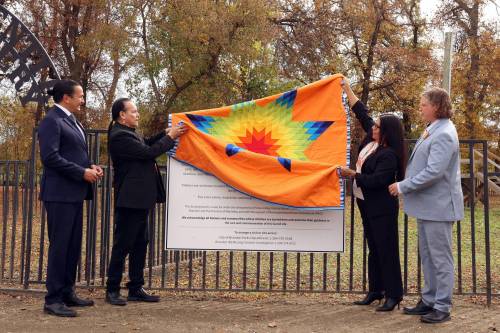
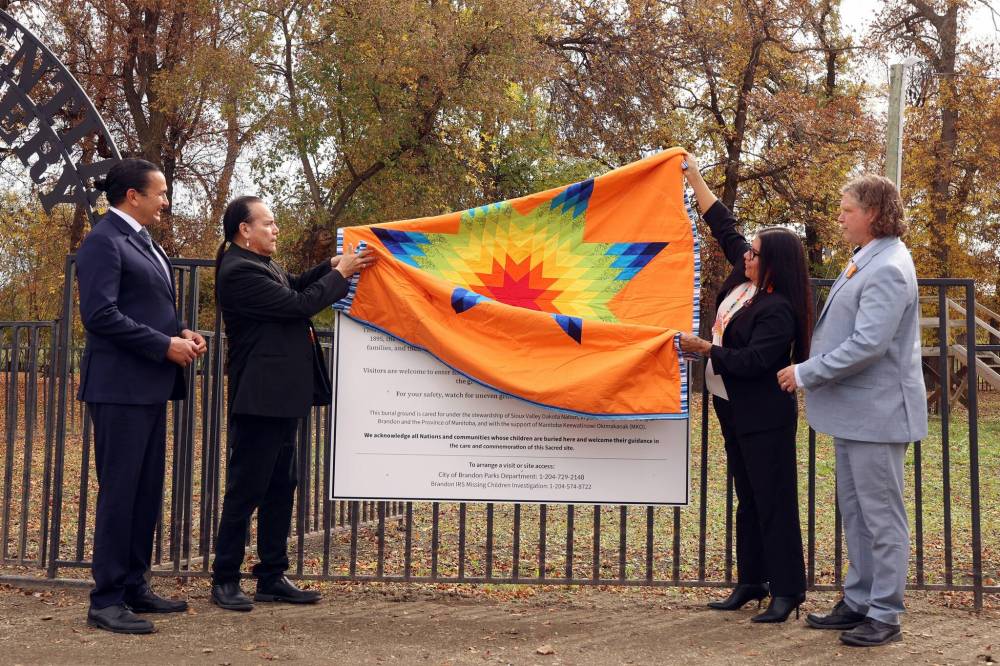
Manitoba Premier Wab Kinew, Manitoba Keewatinowi Okimakanak Grand Chief Garrison Settee, Sioux Valley Dakota Nation Chief Jennifer Bone and Brandon Mayor Jeff Fawcett remove a star blanket to unveil a sign at the Brandon Residential School Cemetery at the former Turtle Crossing Campground, Tuesday.
The premier said the property has “huge national significance” for education about residential school history because it is one of the “most documented” in the country. He carried photographs, and some 20th century newspaper clippings from the Brandon Sun around the site Tuesday.
Kinew will attend a ceremony Wednesday, the National Day for Truth and Reconciliation, at the site of the former Brandon Indian Residential School.
The graves of at least 56 children who attended the school are located at the campground, Sioux Valley Dakota Nation First Nation has said, pointing to a geophysical study conducted by an archaeology firm in 2018.
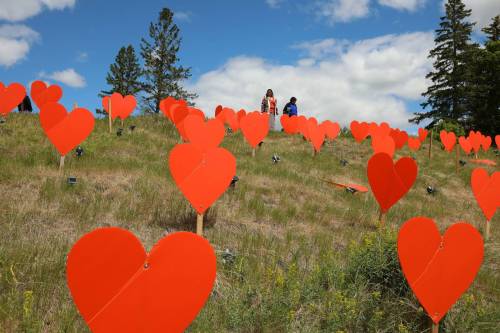
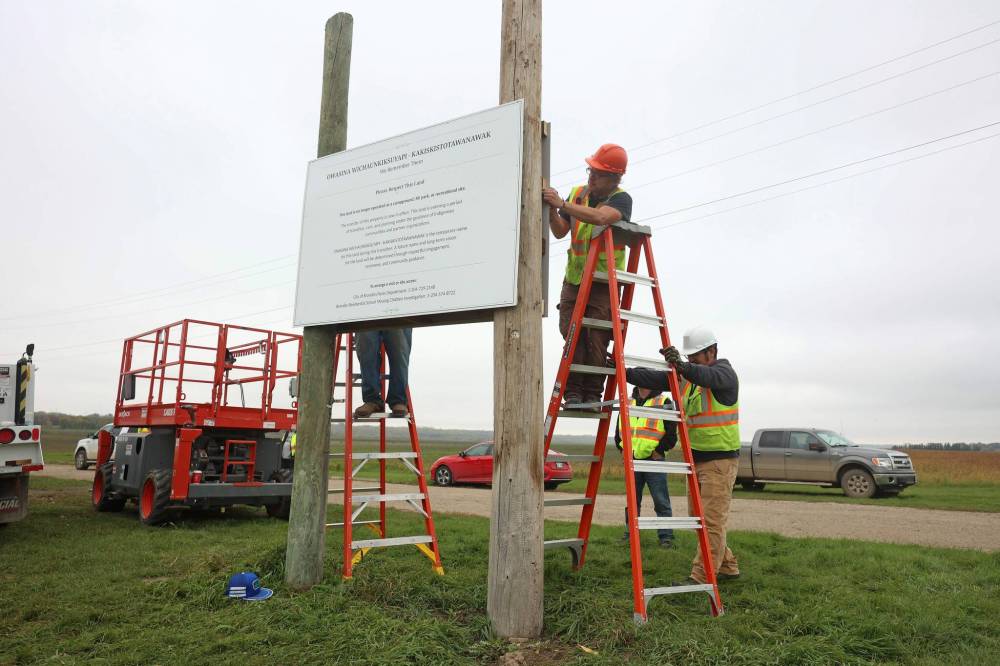
Signs were erected at the former campground Tuesday morning declaring the property is “no longer operated as a campground, RV park, or recreational site.” The sign said that the property is now in a period of transition, care and planning under the guidance of Indigenous communities and partner organizations.
Investigation at the site, which will be spearheaded by Sioux Valley First Nation, will be Indigenous-led, its chief said.
“Technical expertise and community knowledge will guide the work, with respect for the children, their families and this sacred site at every stage,” said Sioux Valley Chief Jennifer Bone in a news release.
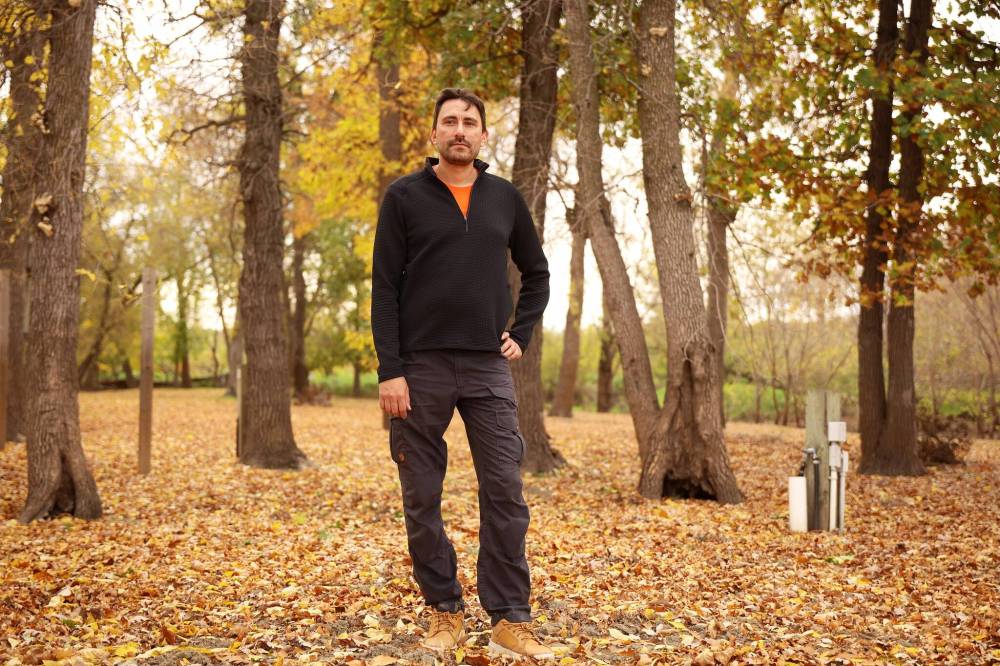
Chris Mancuso, principal investigator with the First Nation’s Brandon Indian Residential School Missing Children Investigation, said the first goal is to identify the “true” boundaries of the cemetery, which is currently a fenced space within the former Turtle Crossing Campground.
Tim Smith/The Brandon Sun
Workers with the City of Brandon install signs at the entrance to the former Turtle Crossing Campground.
The researcher expects to discover additional signs of burials outside the cemetery’s limits, leading the cemetery to be expanded.
Technologies such as ground penetrating radar, magnetism and electromagnetics, which are non-invasive, will be used at the site to investigate the boundaries of the cemetery, he said.
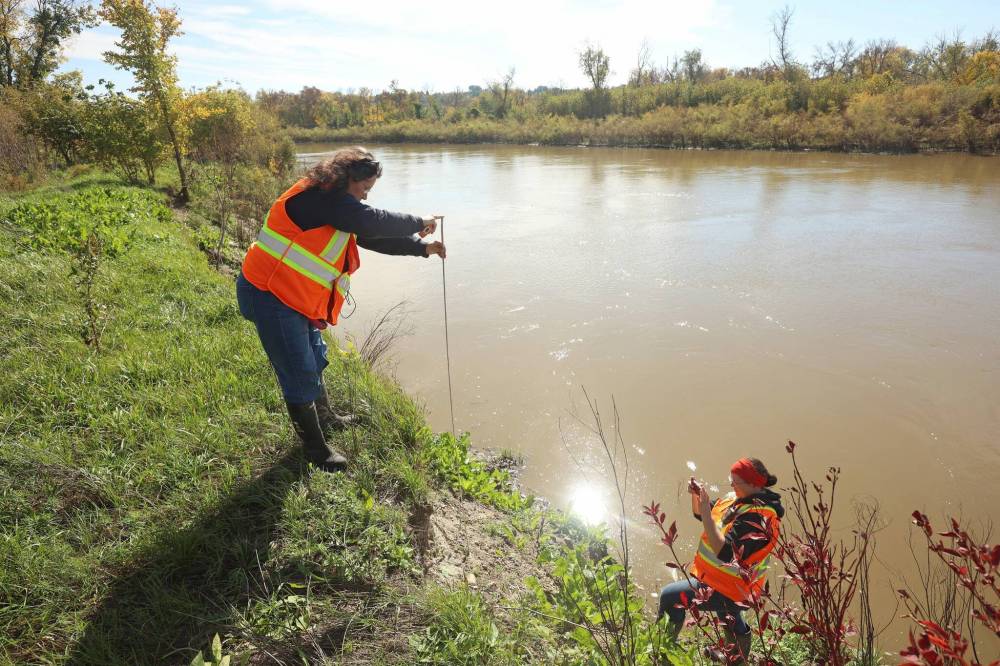
Sioux Valley has a two-year budget drawn up for research at the site, spanning all four seasons, and work started Tuesday, he said. An archaeologist walked the property and tagged characteristics, such as fence post holes and utility infrastructure, to prepare for future ground research at the site.
Mancuso said the purchase of the land will improve research by enabling it.
“It allows access,” Mancuso said. “For the technical investigation, we need to be physically on site with our tools. And the investigation is not just a one day search. So, having sustained access gives the chance to protect this cemetery.”
Randell Wasicuna, a councillor with Sioux Valley, called the move a “victory.”
“This has been a long-time coming and it’s been a long-battle with the owner and I think it’s great to finally have this move forward, as it has been stalled for almost a decade,” Wasicuna said. “It’s a huge relief.”
Tim Smith/The Brandon Sun
Christopher Mancuso, principal investigator for the Brandon Residential School Missing Children Investigation, says he expects to discover additional signs of burials outside the cemetery’s limits, leading the cemetery to be expanded.
He hopes the work in Manitoba, and partnerships between First Nations and government, sets an example — and precedent — for other communities and the federal government.
An interview request with Canada’s Minister of Crown-Indigenous Relations Rebecca Alty was not accommodated Tuesday.
At the campground site, there have been longstanding concerns from Indigenous leaders and community members that people were camping on the resting place of children victimized by colonialism.
The school, which was located about five kilometres northwest of Brandon, operated from 1895 to 1972. It used a grave site near the Assiniboine River until 1912, with grave markers removed in 1921 so the area could be transformed into a park.
The City of Brandon sold the park privately in 2001, and in 2007, it was acquired by Mark Kovatch and his wife, Joan.
The former owner said he made efforts to raise awareness about the graves at the site over the years and took issue with others saying he was limiting access, noting he installed a fence around the site.
He would not disclose how much the province paid for the campground.
Tim Smith/The Brandon Sun
Provincial archeologist Suyoko Tsukamo and regional archeologist for Westman with the province Ashley Daciuk conduct a baseline survey of the former Turtle Crossing Campground, Tuesday.
“I wish them well. That’s all I can say,” he said.
Brandon’s mayor, who visited the site Tuesday, said the path towards reconciliation has been a team effort between governments and First Nations.
“I believe that there’s a great opportunity for the region and for the community to build on it now,” said Fawcett. “… I know for a fact being out there with leaders today, there’s a great sense of relief and a great sense of optimism in talking about the past and moving into the future.”
Daryl Hapa, another councillor with Sioux Valley First Nation, said he regularly thinks about students at the school — including his late father.
“It was heartbreaking,” Hapa said of the stories he was told by his father.

He is pleased the territory will be under Indigenous control and hopes families will learn more.
“Hopefully, we’ll get all of these children’s names (and get) them back home to their communities,” he said. “Families will have some piece of mind that all these children who attended these residential schools haven’t been forgotten.”
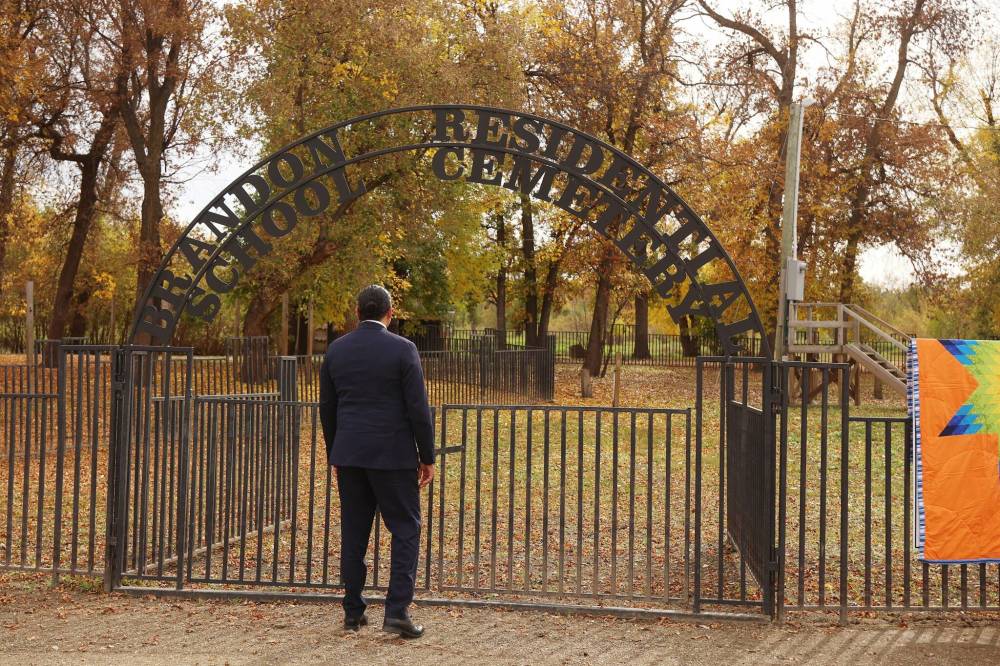
Tim Smith/The Brandon Sun
Manitoba Premier Wab Kinew walks along the Brandon Residential School Cemetery at the former Turtle Crossing Campground along Grand Valley Road on Tuesday.
Bone said the announcement was meaningful to the community as Sioux Valley has been working on its residential school project since 2012.
“This is years of work and advocacy, not even just Sioux Valley, but Manitoba Keewatinowi Okimakanak and the City of Brandon,” Bone said. “The announcement is a huge step towards reconciliation.”
morgan.modjeski@freepress.mb.ca

Morgan Modjeski
Reporter
Signal
Morgan Modjeski is a news reporter and multimedia producer for the Free Press. Read more about Morgan.
Every piece of reporting Morgan produces is reviewed by an editing team before it is posted online or published in print — part of the Free Press‘s tradition, since 1872, of producing reliable independent journalism. Read more about Free Press’s history and mandate, and learn how our newsroom operates.
Our newsroom depends on a growing audience of readers to power our journalism. If you are not a paid reader, please consider becoming a subscriber.
Our newsroom depends on its audience of readers to power our journalism. Thank you for your support.