Increase in metal mining brings elements of danger
Advertisement
Read this article for free:
or
Already have an account? Log in here »
To continue reading, please subscribe:

Digital Subscription
One year of digital access for only $205*
- Enjoy unlimited reading on winnipegfreepress.com
- Read the E-Edition, our digital replica newspaper
- Access News Break, our award-winning app
- Play interactive puzzles
*First annual payment billed as $205.00 + GST for one year. This annual subscription will automatically renew at $233.00 + GST every 52 weeks (10% off the regular annual price of $259.35). Offer available to new and qualified returning subscribers only. Cancel any time.
To continue reading, please subscribe:
Add Free Press access to your Brandon Sun subscription for only an additional
$1 for the first 4 weeks*
- Enjoy unlimited reading on winnipegfreepress.com
- Read the E-Edition, our digital replica newspaper
- Access News Break, our award-winning app
- Play interactive puzzles
*Your next Brandon Sun subscription payment will increase by $1.00 and you will be charged $17.95 plus GST for four weeks. After four weeks, your payment will increase to $24.95 plus GST every four weeks.
Read unlimited articles for free today:
or
Already have an account? Log in here »
Hey there, time traveller!
This article was published 28/10/2023 (1083 days ago), so information in it may no longer be current.
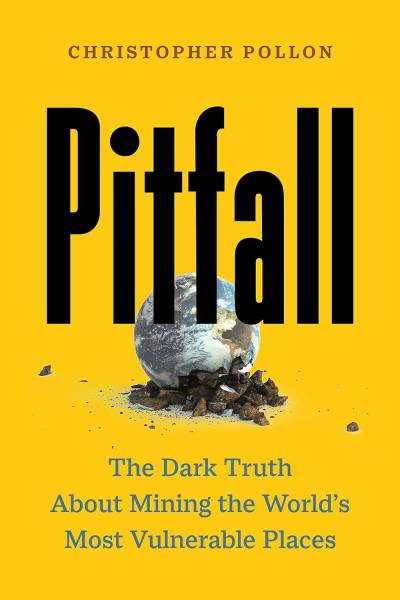
As more and more technology is replaced by renewable sources, metal, which makes “most technology, industry, and lifestyle comforts possible,” Christopher Pollon notes, will become increasingly essential to human existence.
Procuring ever more metal is at the heart of the conflicts described in pessimistic detail by the Vancouver independent journalist in his new book.
Cobalt, copper and lithium, as well as many rare earth elements crucial to batteries for electronics and vehicles, demand huge expenditures of energy and labour. Seductive profits attract investment — and corrupt governments — in developed and developing countries.
While Canada and other modernized nations move to less and less carbon-intensive technologies, the metals necessary for that transition are being wrenched from the earth with increasing difficulty. These efforts cause almost unimaginable damage to the environment, and to the societies and people living near thousands of mines worldwide.
Pollon focuses mostly on the global south, “low- and middle-income nations in Africa, Asia, Oceania and Latin America,” where mines are operated by a dizzying cast of companies and corporations, almost half of which have Canadian connections.
Pollon has written for National Geographic, the Walrus and the Globe and Mail, and is a contributing editor at the Tyee. His 2016 book The Peace in Peril examined potential consequences of the Site C dam on the Peace River. He chose the overwhelming subject of mining after the 2014 collapse of the tailings dam at Mount Polley, B.C.
Criss-crossing the global south, Indonesia and Papua New Guinea, the Democratic Republic of the Congo (DRC), Australia, Chile, Guatemala and many more, Pollon exposes the difficulties of mining and the resulting “sacrifice zones,” where environmental destruction continues to affect governments, international entities, local societies and people.
Mind-boggling descriptions rely on facts, not sensationalism, for effect, but are altogether chilling.
Huge consortiums, wealthy speculators and the vast majority of “artisanal” or individual miners (who produce about 10 per cent of the world’s metal) all play their part in the destructive tradeoffs. The whole book discusses nuanced complications — pitfalls — of modern lifestyles.
Chinese involvement — owners of 80 per cent of cobalt mines in DRC and 80 per cent owners of Indonesian nickel smelters — is probably only partly understood, as mining problems within that country cannot be adequately investigated.
DRC cobalt mining problems are worrisome; nickel is one alternative. However, Indonesian coal power for “the process required to create battery-grade nickel from low-grade Indonesian ore is raising serious questions about what it really means to be green,” Pollon writes.
“Building out just the first generation of a fully transitioned clean energy society will require almost five billion tons of copper alone,” he notes. “Meeting such targets is not possible… but the real danger will come when the world’s mining companies, emboldened by their new role as climate saviours, try to do it nonetheless.”

Pollon also notes possible futures of mining, some of them still virtually science fiction: robots working deeper and deeper in the earth and under the sea, eventual mining of the moon or asteroids.
However, such developments would require more educated supervision, and throw desperate workers out of currently inadequate jobs, continuing to devastate impoverished people financially, if not physically.
Pollon does mention the possibility of “degrowth” as a mitigation of environmental damage inflicted by mining. However, arresting growth in developed countries would also halt progress in poorer parts of the world like the global south.
One possible solution, or dystopian outcome, would be urban mining: reclaiming metal and other resources already produced. Pitfall indicates that intensified reuse, recycling and other social changes cannot come too soon.
Bill Rambo is a retired teacher living in Landmark.