Fierce foes
Diefenbaker, Pearson proved worthyopponents in the House of Commons — and helped shape the country in the process
Advertisement
Read this article for free:
or
Already have an account? Log in here »
To continue reading, please subscribe:

Digital Subscription
One year of digital access for only $205*
- Enjoy unlimited reading on winnipegfreepress.com
- Read the E-Edition, our digital replica newspaper
- Access News Break, our award-winning app
- Play interactive puzzles
*First annual payment billed as $205.00 + GST for one year. This annual subscription will automatically renew at $233.00 + GST every 52 weeks (10% off the regular annual price of $259.35). Offer available to new and qualified returning subscribers only. Cancel any time.
To continue reading, please subscribe:
Add Free Press access to your Brandon Sun subscription for only an additional
$1 for the first 4 weeks*
- Enjoy unlimited reading on winnipegfreepress.com
- Read the E-Edition, our digital replica newspaper
- Access News Break, our award-winning app
- Play interactive puzzles
*Your next Brandon Sun subscription payment will increase by $1.00 and you will be charged $17.95 plus GST for four weeks. After four weeks, your payment will increase to $24.95 plus GST every four weeks.
Read unlimited articles for free today:
or
Already have an account? Log in here »
Hey there, time traveller!
This article was published 18/11/2023 (1034 days ago), so information in it may no longer be current.
In the 1957 Canadian federal election, the long-governing Liberals were unexpectedly defeated by the Progressive Conservatives. The PCs were led by a Prairie populist in the form of John Diefenbaker. It was a minority victory, but nevertheless a victory. After Liberal leader “Uncle Louis” St. Laurent stepped down, Lester Pearson won the party’s leadership in January 1958.
With great hubris, in the House of Commons Pearson called for Diefenbaker’s governing PCs to step aside and allow the Liberals to govern. Instead, Diefenbaker called an election. In March 1958, Pearson’s Liberals were thumped in a historic landslide in which Diefenbaker’s PCs won 208 of 265 House of Commons seats.
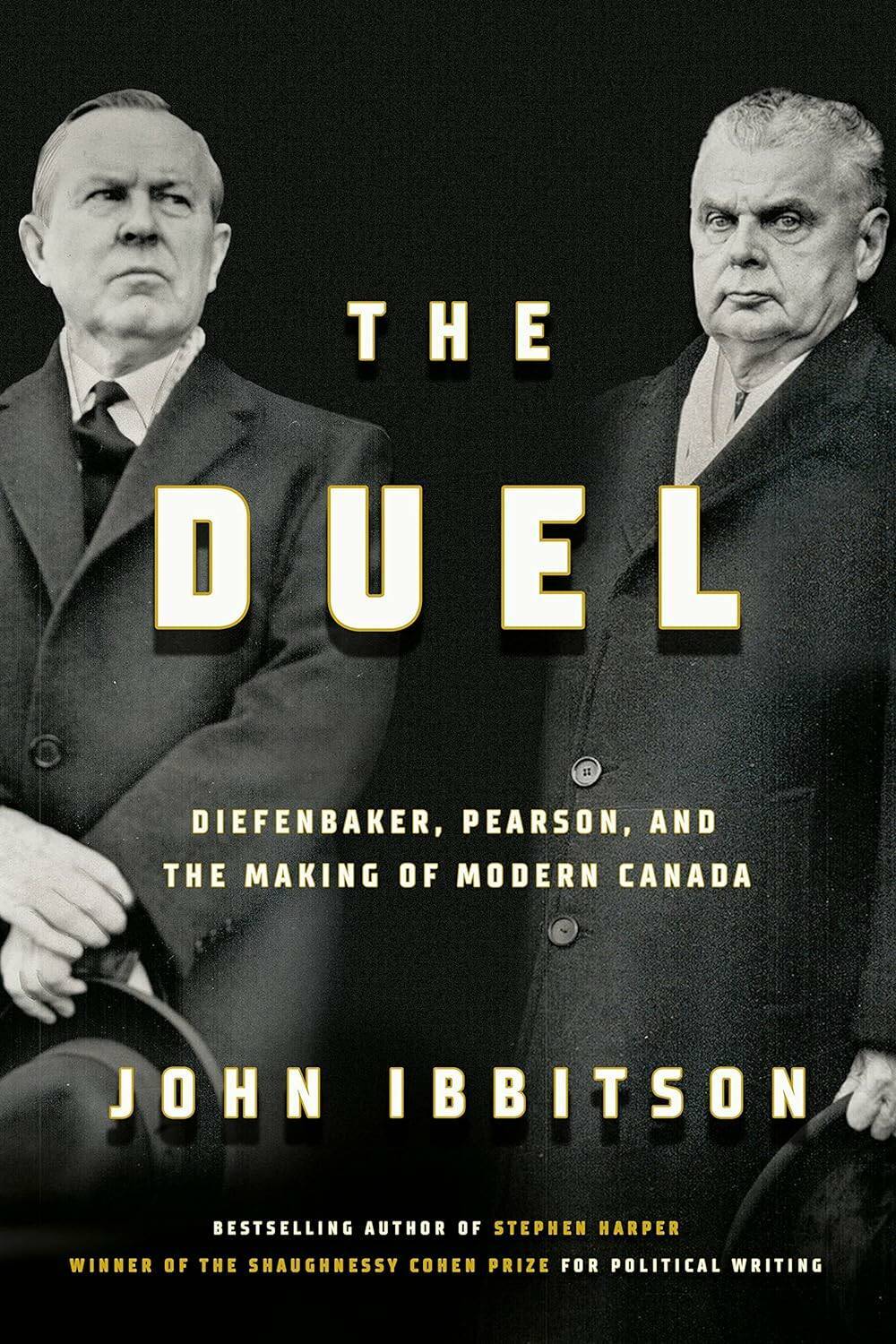
It would be the first of many duels between the two leaders that John Ibbitson captures well in The Duel: Diefenbaker, Pearson, and The Making of Modern Canada. Ibbitson is a journalist with the Globe and Mail and has written numerous political works, including Stephen Harper and Promised Land: Inside the Mike Harris Revolution.
The Canadian Press files
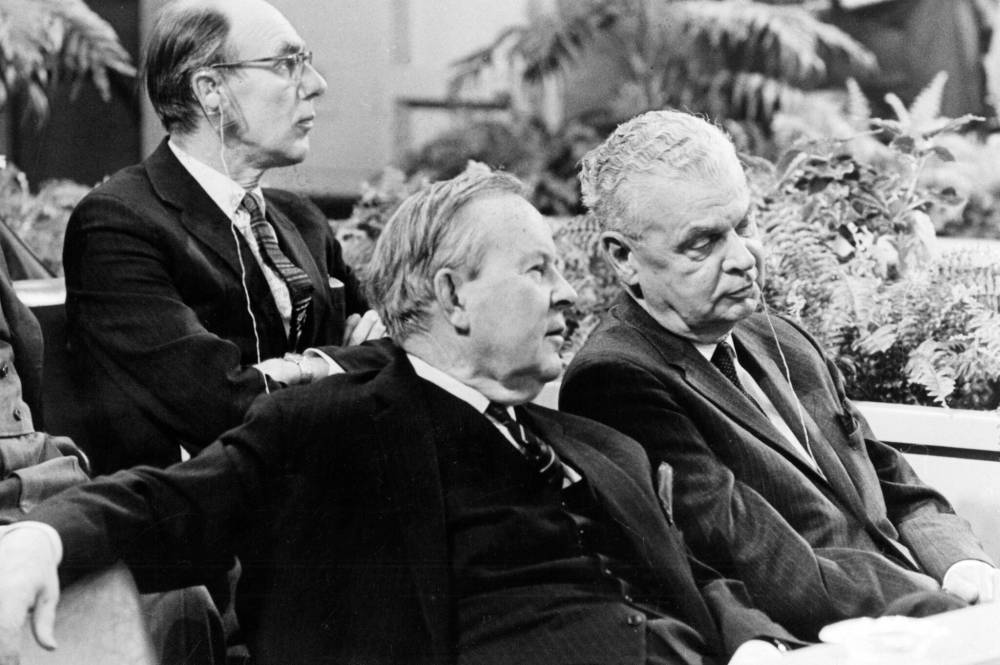
In this 1969 photo, former prime ministers John Diefenbaker (right) and Lester B. Pearson… TK
The personalities of Diefenbaker and Pearson could not have been more different. Diefenbaker was born in Ontario and raised in Saskatchewan. As a child and then later in his adult life, he often felt like an outsider due to his German name in a country that had fought Germans in two relatively recent world wars. He developed an empathy with those on the margins of society and built a career as a criminal lawyer who could win cases deemed by others as hopeless, as chronicled by Garrett Wilson and Kevin Wilson in 1988’s Diefenbaker for the Defence.
The young lawyer hungered for political office, running unsuccessfully in the 1925 and 1926 federal elections, the 1929 Saskatchewan provincial election and the 1933 Prince Albert mayoral election. He became leader of the provincial Conservatives in Saskatchewan but was unable to win his seat in 1938.
He snapped his losing streak in 1940 by winning the federal Saskatchewan riding of Lake Centre. Once he reached the House of Commons, he was not willing to sit still, as he unsuccessfully ran for the federal party leadership in 1942 and 1948, thereby gaining a reputation as a gadfly to the party elite. With the party in a low state of morale, having been shut out of power since 1930, the PCs took a gamble and chose Diefenbaker as their new leader in 1956.
In contrast to Diefenbaker’s problematic climb to power, Pearson faced few obstacles. After attending Oxford University, he began teaching at the University of Toronto before leaving to climb the ranks of the civil service within the Department of External Affairs.
Switching to politics, he was elected to the House of Commons on his first try in 1948. He was quickly appointed to the federal cabinet as secretary of state for External Affairs. In 1957, when Israel, Britain and France invaded Egypt for control of the Suez Canal, Pearson played a central role in resolving the crisis, for which he was awarded the Nobel Peace Prize. With this illustrious record, when Louis St. Laurent stepped down, it was inevitable the Liberals would choose Pearson to lead the party.
Fred Chartrand / The Canadian Press files
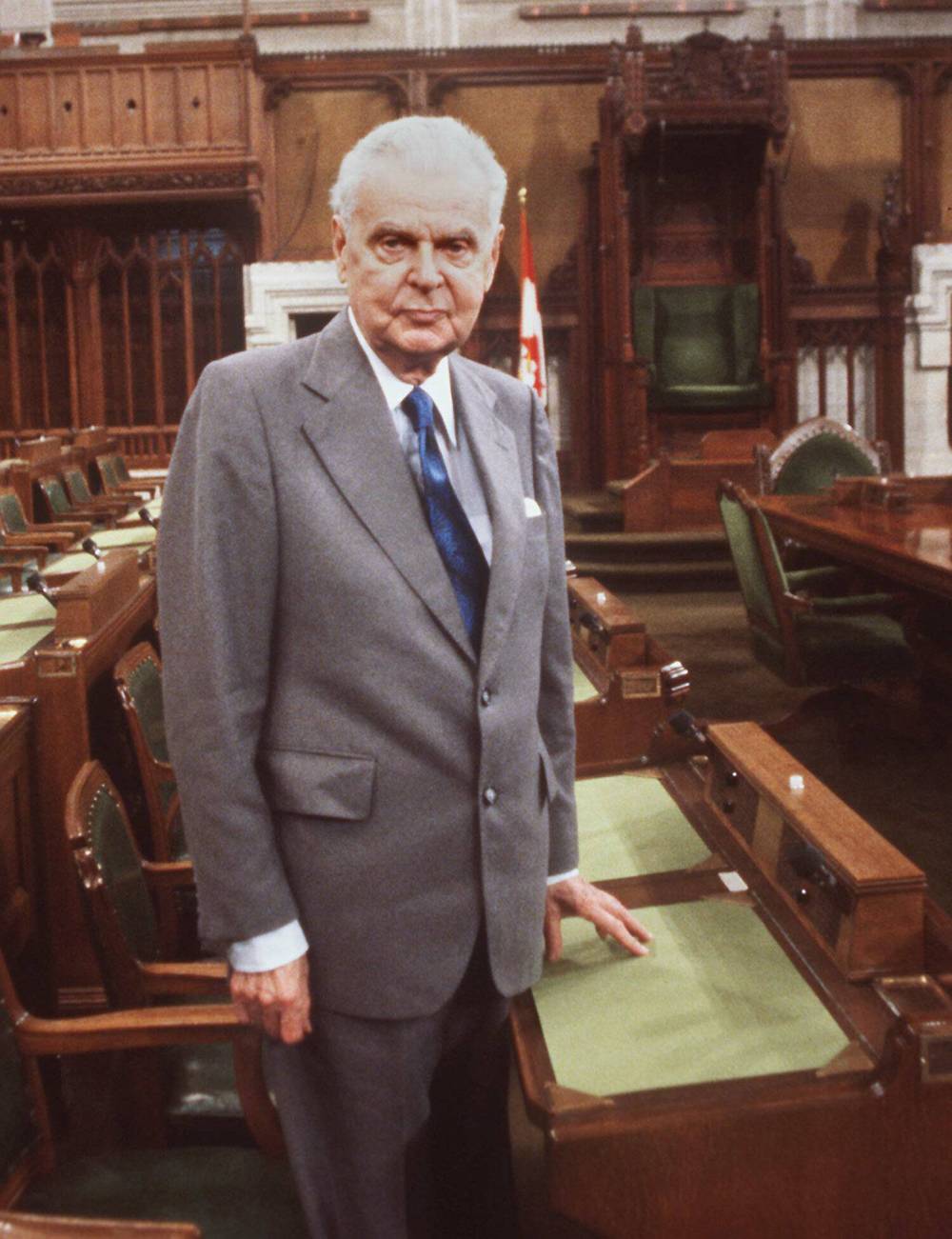
Diefenbaker poses for a photo in the House of Commons in 1973.
Pearson’s first battle with Diefenbaker in 1958 reduced the Liberals to a mere 48 seats. However, in 1962, the party performed better by winning 99 seats, reducing the PCs to a minority. It would be the last time Diefenbaker would become prime minister.
Pearson’s Liberals went on to win the federal elections of 1963 and 1965, albeit with minorities. Diefenbaker remained leader of the opposition until 1967, when he stepped down as leader in the face of a rebellious caucus. He foolishly ran for the leadership in the ensuing race only to lose against Robert Stanfield (Duff Roblin, Manitoba’s ex-premier, came in second).
For The Duel, Ibbitson relies on such works as Denis Smith’s Rogue Tory, John English’s two-volume Pearson biography Shadow of Heaven and The Worldly Years as well the three-volume autobiographies of both Diefenbaker (One Canada: The Memoirs of the Right Honourable John G. Diefenbaker) and Pearson (Mike: The Memoirs of the Rt. Hon. Lester B. Pearson). He also brings to the subject an extensive amount of archival digging conducted at the University of Saskatchewan’s Diefenbaker Centre and Library and Archives Canada.
Despite his research, The Duel would have been improved had Ibbitson provided better sourcing for his material. Throughout he provides references for his quotations, but at many points the reader is left guessing about which specific materials the author is using for specific facts and figures.
History has treated Diefenbaker unkindly, largely due to his poor relations with former U.S. president John F. Kennedy, his mercurial temper and self-centredness and an inability to lead his caucus. Peter C. Newman’s nasty yet widely read 1963 book Renegade in Power continues to influence Diefenbaker’s reputation. Both Ibbitson and University of Saskatchewan political scientist John C. Courtney’s recent work Revival and Change: The 1957 and 1958 Diefenbaker Elections, meanwhile, make a strong case for rehabilitating the Tory leader. Diefenbaker’s successes include passing the Canadian Bill of Rights (which was the precursor to Pierre Trudeau’s Charter of Rights and Freedoms), expanding the federal voting franchise to First Nations peoples and resisting the placement of nuclear arms on Canadian soil.
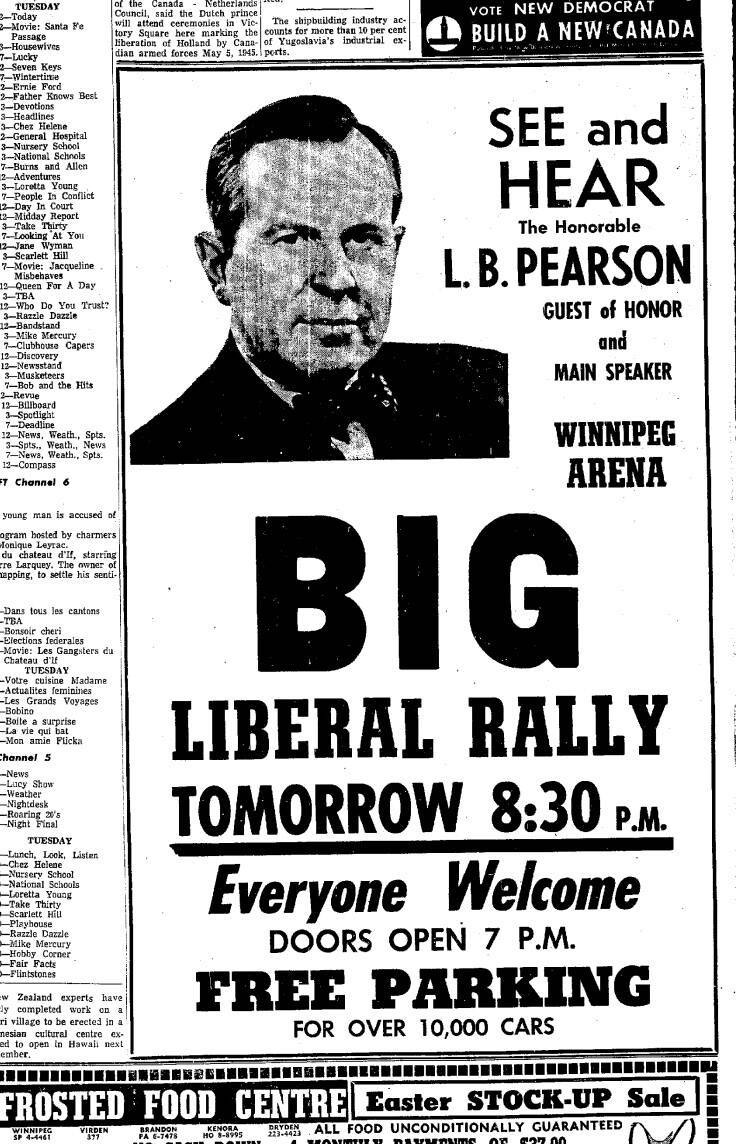
Winnipeg Free Press archives
An ad from the April 1, 1963 Winnipeg Free Press notes the appearance of Lester Pearson at a rally.
Pearson’s record is more widely celebrated. His government’s achievements include introducing universal healthcare (“Medicare”), official bilingualism, a new Canadian flag, Canada’s 1967 Centennial celebrations and Expo ’67. His accomplishments are remarkable when one considers that Pearson did these things while leading two minority governments, never having achieved a majority victory at the polls.
The Duel provides a fine political history and double biography of two important mid-20th century Canadian leaders.
Christopher Adams is an adjunct professor in Political Studies at the University of Manitoba and rector of St. Paul’s College.
The Duel