Think tanks, press releases mar media’s message
Advertisement
Read this article for free:
or
Already have an account? Log in here »
To continue reading, please subscribe:

Digital Subscription
One year of digital access for only $205*
- Enjoy unlimited reading on winnipegfreepress.com
- Read the E-Edition, our digital replica newspaper
- Access News Break, our award-winning app
- Play interactive puzzles
*First annual payment billed as $205.00 + GST for one year. This annual subscription will automatically renew at $233.00 + GST every 52 weeks (10% off the regular annual price of $259.35). Offer available to new and qualified returning subscribers only. Cancel any time.
To continue reading, please subscribe:
Add Free Press access to your Brandon Sun subscription for only an additional
$1 for the first 4 weeks*
- Enjoy unlimited reading on winnipegfreepress.com
- Read the E-Edition, our digital replica newspaper
- Access News Break, our award-winning app
- Play interactive puzzles
*Your next Brandon Sun subscription payment will increase by $1.00 and you will be charged $17.95 plus GST for four weeks. After four weeks, your payment will increase to $24.95 plus GST every four weeks.
Read unlimited articles for free today:
or
Already have an account? Log in here »
Hey there, time traveller!
This article was published 09/12/2023 (1016 days ago), so information in it may no longer be current.
Cecil Rosner has been a stalwart for journalistic integrity at CBC Winnipeg, where he was in charge of that newsroom for years. He’s provided his 40 years of experience in both print and electronic journalism for the next generation of reporters at both the University of Manitoba and Winnipeg, teaching courses in investigative journalism.
His latest book examines the external forces with which the everyday newsroom must grapple in order to get the “story”: corporate propagandists, think tanks, police, pollsters and influencers. Underlying the entire analysis is his ethical pursuit for “truth” — that he still believes in “truth” after four decades in journalism says a great deal about Rosner’s optimism.
It’s not entirely clear who the audience is for this book. Rosner doesn’t exactly explore new ground in this analysis and doesn’t provide much in terms of new academic research himself, instead relying on others who have done the heavy lifting. Indeed, the topics have all been covered before and with much more veracity by researchers such as the late David Taras, W. Lance Bennett, Tamara Small, Alex Marland and others. So, while it may work on a very superficial level as an academic text, it requires a great deal of shoring up and alternate readings to provide a more fulsome overview.
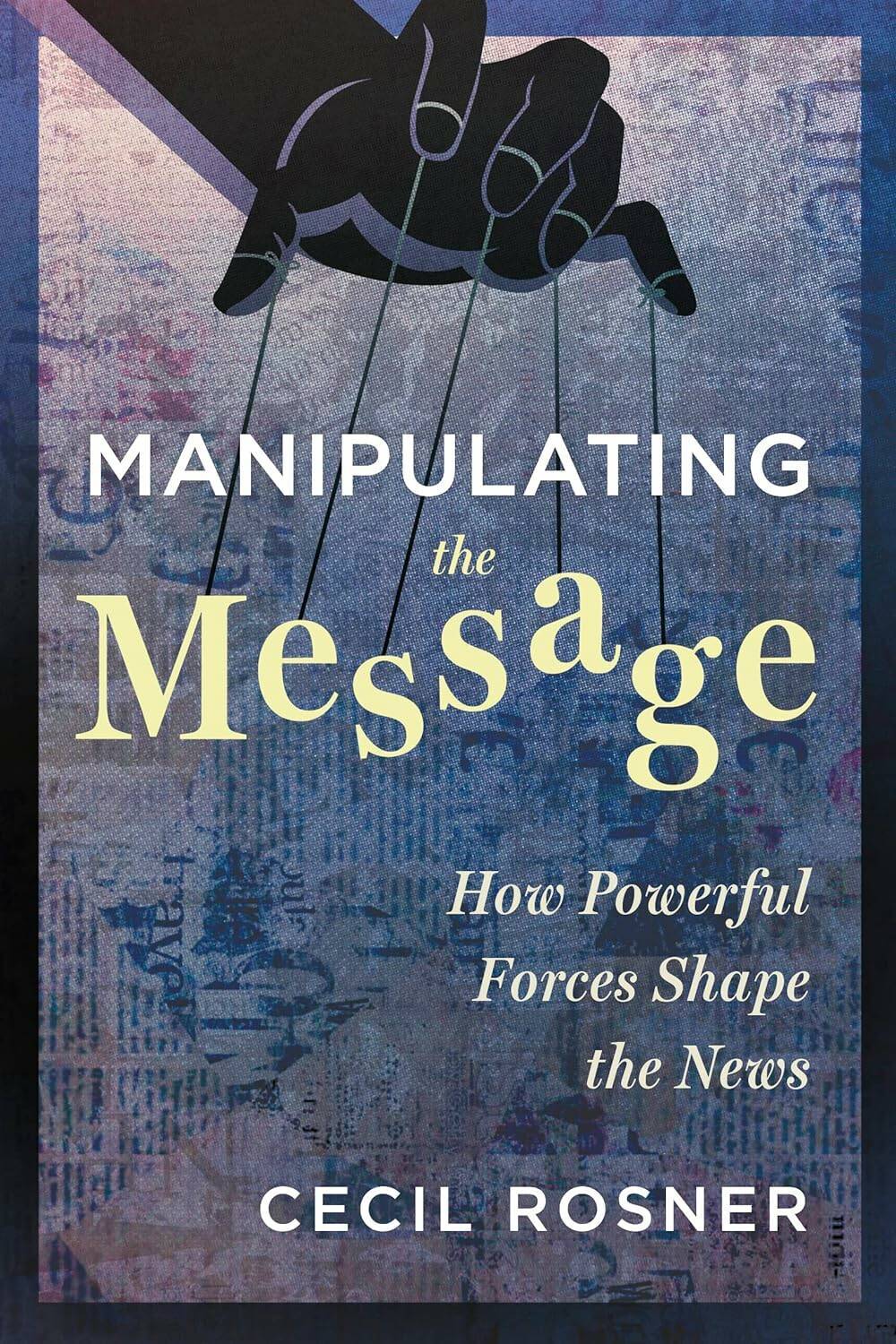
Manipulating the Message
In particular, there needs to be a greater understanding provided into the reality of commercial newsrooms facing ongoing cutbacks while still being forced to meet hourly, if not more frequent, deadlines. Let’s face it — it’s fine to pontificate about relying on press releases from the police until it’s the only information available, and there’s an active shooter in the community.
It’s this context Rosner fails to provide. Yes, in an ideal world, with an unlimited budget, unlimited staff and no deadline, asking more questions and digging deeper is the right way to go. But sometimes journalism is messy and it’s seldom ideal, especially when there’s no public purse backstopping the newsroom budget.
However, for the most part Rosner’s observations are correct. There are too many think tanks pushing their agendas and the media rely on them too much for information. This includes the Frontier Centre for Public Policy and the Fraser Institute, along with the Canadian Centre for Policy Alternatives (CCPA). Interestingly, Rosner’s ideological bent sees him far less critical of the CCPA and the media’s reliance on them than the more conservative Fraser Institute and the ultra-right Frontier Centre.
And yes, the use of polls can be challenging. As several columnists and academics in the Free Press and other newspapers have argued, political polls should be used carefully and the release of them timed judiciously so that results don’t in fact suppress voter turnout or jeopardize the results.

But the CBC and all other media do rely on them because that’s what makes people pay attention. It’s the story that gets the audience’s clicks and if you don’t have an audience, it doesn’t matter how much investigative work you do.
Embedded journalists in the military and the reliance on yet another think tank to ensure academic research into defence is slanted, is another nugget from Rosner that shows how “truth” is manipulated. Yet, once television cameras went to Vietnam, Canadian audiences became fiercely aware of just how much the military has manipulated the news.
Manipulating the Message will help the average news consumer look at news with a bit more of a jaded eye. But in an era of “news deniers” it’s not clear if having more jaded news consumers helps. And if truth be told, there’s not much substantive proof that news consumers in Canada have ever been taken in by any news stories for very long. Most of the cases Rosner discusses as problematic — such as the Access Toyota pricing scheme or the Sky City development — eventually get “outed” one way or another.
However, Manipulating the Message can work as a cautionary tale for those just starting out in journalism. It is clearly a utopian version of what commercial journalism is really about. Like a news release, this book should be read with a bit of a cynical eye.
Shannon Sampert has worked in media since the 1970s and as a professor, studied the relationship between media and politics. She now works as a media consultant and professional editor and writer.