The beauty of constraint
Imposed literary structure in Heti’s new work makes for a profound, non-linear delight
Advertisement
Read this article for free:
or
Already have an account? Log in here »
To continue reading, please subscribe:

Digital Subscription
One year of digital access for only $205*
- Enjoy unlimited reading on winnipegfreepress.com
- Read the E-Edition, our digital replica newspaper
- Access News Break, our award-winning app
- Play interactive puzzles
*First annual payment billed as $205.00 + GST for one year. This annual subscription will automatically renew at $233.00 + GST every 52 weeks (10% off the regular annual price of $259.35). Offer available to new and qualified returning subscribers only. Cancel any time.
To continue reading, please subscribe:
Add Free Press access to your Brandon Sun subscription for only an additional
$1 for the first 4 weeks*
- Enjoy unlimited reading on winnipegfreepress.com
- Read the E-Edition, our digital replica newspaper
- Access News Break, our award-winning app
- Play interactive puzzles
*Your next Brandon Sun subscription payment will increase by $1.00 and you will be charged $17.95 plus GST for four weeks. After four weeks, your payment will increase to $24.95 plus GST every four weeks.
Read unlimited articles for free today:
or
Already have an account? Log in here »
Hey there, time traveller!
This article was published 10/02/2024 (963 days ago), so information in it may no longer be current.
Alphabetical Diaries is a monumental achievement, not in terms of size — the book itself could be read in a day, if not in one sitting — but in terms of incubation and its potential effect on the reader.
It’s taken Sheila Heti 14 years to compile and edit this book, a project that began in the restlessness that followed the international success of her 2010 genre-bending novel, How Should a Person Be?, considered a modern classic and often compared to HBO’s TV series Girls, and for which Heti was named one of “The New Vanguard” by the New York Times.
Since then, the Toronto-based author has continued to create formally inventive, surprising works of fiction, including the Giller-nominated Motherhood, a feminist rumination on whether or not to become a mother; and, most recently, the Governor General Award-winning Pure Colour, a curious, whimsical account of art, grief, love and the search for meaning.

Margaux Williamson photo
Throughout her career, Sheila Heti has continuously created formally inventive, surprising works of fiction.
Alphabetical Diaries, Heti’s eleventh book, is a compilation of a decade’s worth of her personal diaries — over 500,000 words — that she entered into an Excel spreadsheet and sorted alphabetically by sentence rather than chronologically, which has produced all manner of jarring, delightful results.
Patterns of thought and themes emerge, many of which show up in her fiction: the interplay of shame and attraction, the soul and the self; sharp observations on friendship and loneliness, art and music; the push-pull of (pitching articles in) exciting New York and L.A. versus (writing grants in) tiring-yet-grounding Toronto.
Sections are arranged alphabetically, with each letter taking on a personality — the declarative Bs (be this, be that); poignant Ds (Dad, DFW); intellectual Es; introspective, meandering Is; single-entry Q and Z (with Zadie Smith’s husband getting the last word).
This Oulipo approach to creating literature is reminiscent of Christian Bök’s Griffin prize-winning Eunoia, in which the experimental poet limited himself to one vowel for each of five chapters. Alphabetical Diaries similarly embodies a mathematical beauty — in this case a commitment to constraints imposed on an otherwise deeply personal text.
So what does it sound like? Here’s a sequence from the As: “A lot of changes are happening. A lot of fear, but of what? A lot of people in their twenties get an addiction. A lot of talk about couples and dating, but the more I think about it, the more I think I’ve been in a pretty sweet situation this past month, not dating. A man must part company with the inferior and the superficial. A man of discretion. A man to love.”
Despite the imposed alphabetization, there is flow. Incidents and insights are released from linearity, the stamp of time. What a relief it is to examine oneself freed from entrenched notions of development, to notice and form meaning in a new way.
How Should a Person Be? hit a wild nerve that continues to resonate. Many turn to Motherhood to assist them with the life-decision struggle of whether or not to become a mother. Pure Colour may join Joan Didion’s The Year of Magical Thinking as the literary go-to in comforting those who’ve lost a loved one.
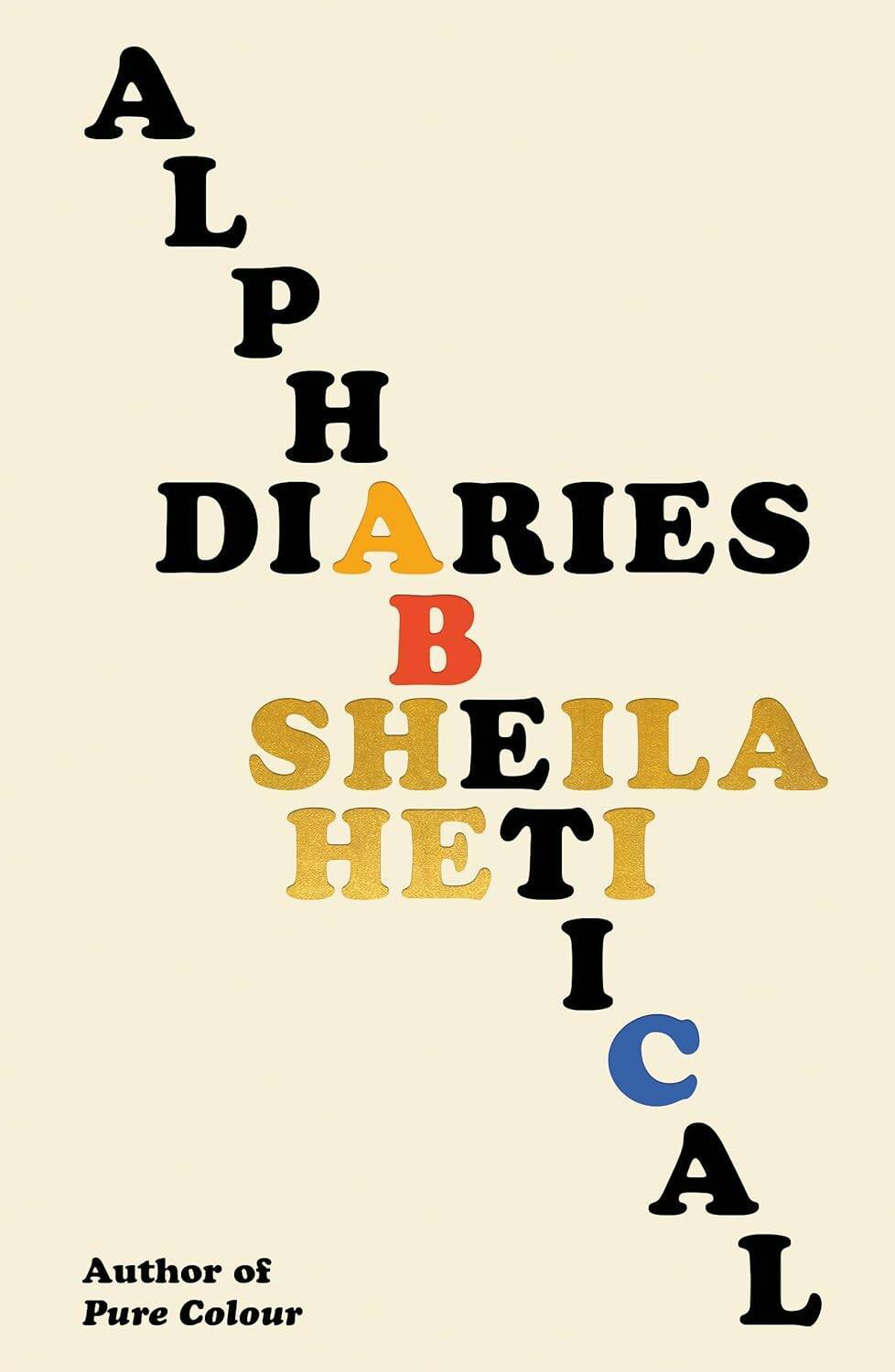
Alphabetical Diaries
And Alphabetical Diaries, this meticulous work of art, offers us a new way of seeing ourselves — and the self — and in so doing provides an empowering and encouraging response to its own first entry: “A book about how difficult it is to change, why we don’t want to, and what is going on in our brain.”
Thank you, Sheila Heti.
Sara Harms is a Winnipeg editor.