Missionary’s plight among Huron, Iroquois probed
Advertisement
Read this article for free:
or
Already have an account? Log in here »
To continue reading, please subscribe:

Digital Subscription
One year of digital access for only $205*
- Enjoy unlimited reading on winnipegfreepress.com
- Read the E-Edition, our digital replica newspaper
- Access News Break, our award-winning app
- Play interactive puzzles
*First annual payment billed as $205.00 + GST for one year. This annual subscription will automatically renew at $233.00 + GST every 52 weeks (10% off the regular annual price of $259.35). Offer available to new and qualified returning subscribers only. Cancel any time.
To continue reading, please subscribe:
Add Free Press access to your Brandon Sun subscription for only an additional
$1 for the first 4 weeks*
- Enjoy unlimited reading on winnipegfreepress.com
- Read the E-Edition, our digital replica newspaper
- Access News Break, our award-winning app
- Play interactive puzzles
*Your next Brandon Sun subscription payment will increase by $1.00 and you will be charged $17.95 plus GST for four weeks. After four weeks, your payment will increase to $24.95 plus GST every four weeks.
Read unlimited articles for free today:
or
Already have an account? Log in here »
Hey there, time traveller!
This article was published 15/06/2024 (853 days ago), so information in it may no longer be current.
In 1649 Jean de Brébeuf, French Jesuit missionary to the Huron Indigenous people of Canada (then New France), was captured, ritually tortured and killed by the Hurons’ arch enemy, the Iroquois.
In 1930, Pope Pius XI canonized him a saint of the Catholic Church.
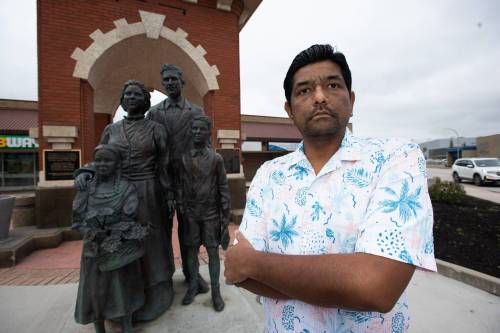
Author Mark Bourrie admires Brébeuf’s courage, but deems his missionary work less than sainted.

Supplied photo
Mark Bourrie
Bourrie is fast becoming the dean of Canadian literary non-fiction.
Armed with a law degree, a master’s degree in journalism and a PhD in history, he has the chops to write popular Canadian history that’s both academically sound and eminently readable. His two previous books, Bush Runner: The Adventures of Pierre Radisson (2020) and Big Men Fear Me (2022) were either winners or nominees for several book awards.
The Huronia of Crosses in the Sky’s subtitle is the region of Ontario once occupied by the Hurons. It was a historically fluid domain but, roughly, was located between lakes Simcoe, Ontario and Huron.
Brébeuf, in Bourrie’s telling, was a haunted man — a priest of immense drive and talent, but also one single-mindedly seeking martyrdom.
Near the end of his life, he was given to grotesque apocalyptic visions that cause Bourrie to conclude he was well nigh clinically insane.
“The stress of six years of Huron hostility caused Brébeuf to lose his mind,” he writes. “He’d had religious visions since joining the Jesuits, but never the way they came, day after day in 1640.”
The book’s very title is drawn from one of Brébeuf’s more benign visions, in which he “saw a giant, glowing cross coming up from the horizon and moving through the sky from the south, the direction of the Iroquois country.”
In Bourrie’s analysis, the Hurons as an Indigenous nation were doomed by two principal events.
The first was the Christianization by the Jesuits of a large portion of the Huron population, the majority in particular villages, which created a divide between Catholic converts and “traditionalists” who clung to their native values and faith. They became a fractured people, chronically engaged in internal religious and cultural conflict.
The second was the technological superiority of their enduring enemy, the Iroquois.
The six nations of the Iroquois confederacy obtained massive quantities of guns from Dutch colonists in what’s now New York state and, to a lesser extent, the English colonists of New England. In battle, Huron bows and arrows proved no match for Iroquois firearms. The French, on the other hand, were sparing with trading for guns, refusing to arm their Huron allies unless and until they converted to Catholicism.
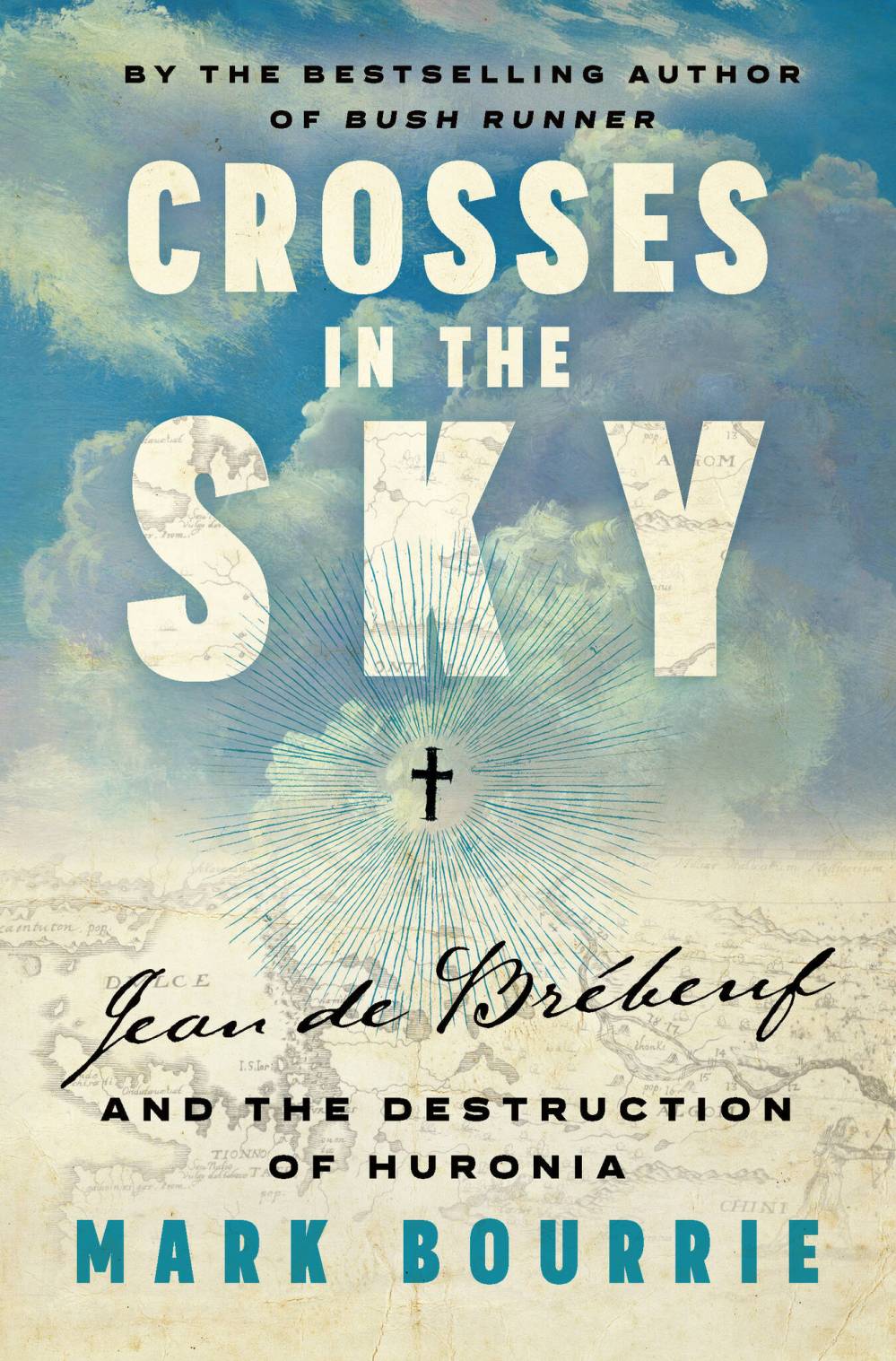
Crosses in the Sky
Moreover, the relationship between the French and the Hurons was ever dicey and evolving. The French/Huron alliance, such as it was, was at its core commercial, not military and not religious, according to Bourrie.
“The idea of a special bond between the French and Hurons, forged in war, is a myth,” he writes. “The Hurons could (and would) trade with anyone who ran the Quebec post, whether they were French or English or even Iroquois.”

Bourrie has a knack for packaging historical detail in a fluid narrative.
Moreover, his account is deftly organized. Chapters feature capitalized topical subheadings that act as entrée to what’s covered in text that follows, while the text itself is helpfully supplemented by an abundance of photos and reproductions of maps, drawings, portraits and relics.
Bourrie also manages to be panoramic in his historical descriptions of Huronia while concurrently focusing on biographical details of Brébeuf’s missionary work.
This treatment of the problematic legacy of both the cleric and his religious order is top drawer.
Douglas J. Johnston is a Winnipeg lawyer and writer.