History of compass points a wide-ranging joy to navigate

Advertisement

Advertise with us

Have you ever wondered which way is up?

Read this article for free:


or

Already have an account? Log in here »

To continue reading, please subscribe:

Subscribe and receive a limited-edition Free Press branded hat or tote.

Digital Subscription

One year of digital access for only $205*

  • Enjoy unlimited reading on winnipegfreepress.com
  • Read the E-Edition, our digital replica newspaper
  • Access News Break, our award-winning app
  • Play interactive puzzles

*First annual payment billed as $205.00 + GST for one year. This annual subscription will automatically renew at $233.00 + GST every 52 weeks (10% off the regular annual price of $259.35). Offer available to new and qualified returning subscribers only. Cancel any time.

To continue reading, please subscribe:

Add Free Press access to your Brandon Sun subscription for only an additional

$1 for the first 4 weeks*

  • Enjoy unlimited reading on winnipegfreepress.com
  • Read the E-Edition, our digital replica newspaper
  • Access News Break, our award-winning app
  • Play interactive puzzles
Start now

*Your next Brandon Sun subscription payment will increase by $1.00 and you will be charged $17.95 plus GST for four weeks. After four weeks, your payment will increase to $24.95 plus GST every four weeks.

Hey there, time traveller!
This article was published 30/11/2024 (681 days ago), so information in it may no longer be current.

Have you ever wondered which way is up?

Well, there’s a long history of differing opinions on the subject before current acceptance of the four cardinal points of the compass, with north holding the top spot, so you’re not alone historically speaking.

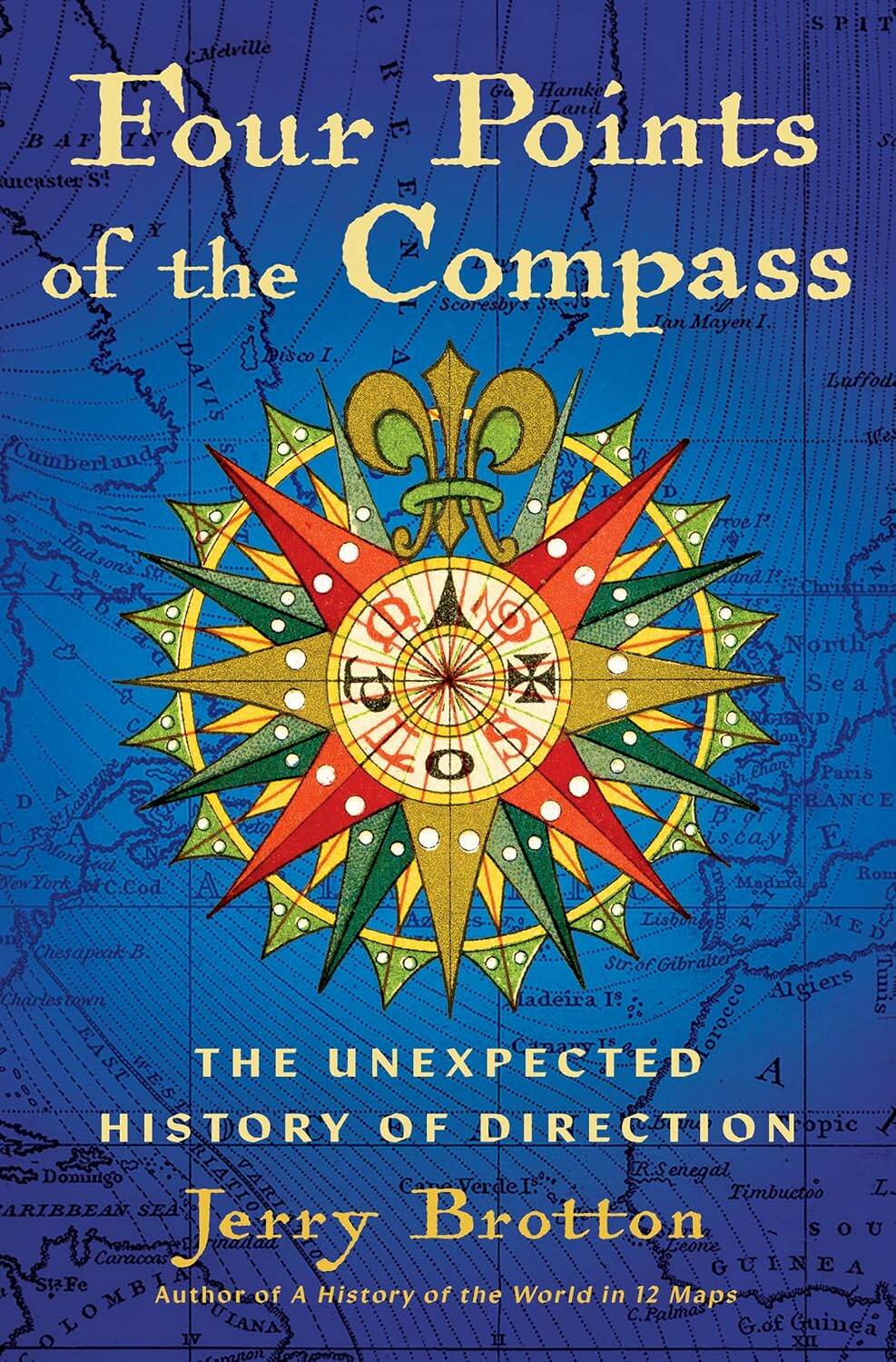
Jerry Brotton, bestselling author of A History of the World in 12 Maps, takes readers on a wide-ranging, well-researched tour of “these four apparently simple and universally accepted terms (that) are far more subjective and specific to time, place, language and culture than we might realize.”
Four Points of the Compass

Four Points of the Compass

Four Points of the Compass is full of geographical, political and cultural lore: descriptions of ancient trade routes and exploration; colonization; religious influence on map making; and the development of the four cardinal directions as embodiment of political and economic strife — east versus west, north versus south.

Throughout history, the top spot has often depended on differing religious and political beliefs; for example, early Islam had south on top, as Mecca and Medina were in that direction, while classical Chinese cosmology celebrated south, based on more political and imperial expectations.

There was a view that the north could embrace darkness and evil as well as peace and plenty that would endure throughout time and across cultures on both hemispheres, Brotton explains.

The simplest answer why north came out on top is twofold, he writes. The classical Greek practice using geometry to imagine and project the global Earth onto a two-dimensional plane surface put north on top. And the introduction of the magnetic compass as an aid to maritime navigation led first to ship charts, and then most word maps, being oriented to north.

And in a too-common historical practice, as European powers colonized Africa, Asia and the Americas in the 16th century, Indigenous mapping practices using cardinal directions other than north were erased or absorbed into a world picture, dictated by Europeans at the expense of all other traditions, with north at the top.

The four directions took on more pronounced cultural and political meanings as west became the West, a European and American democratic political and cultural juggernaut opposed to an east that had become the East, comprised of totalitarian Soviet and Chinese societies. Rudyard Kipling’s 1889 poem The Ballad of East and West, with the opening “Oh, East is East, and West is West, and never the twain shall meet,” sums it up.

North and South had their difference as well, with residents of the northern hemisphere looking down on the southerners as lazy ne’er-do-wells compared to the industrious northerners. That idea of northern supremacy was twisted into a genocidal political program with Hitler’s claim of a superior Nordic population ready to rule the world.

Brotton has produced a readable, informative book encompassing all the historical, geographical, cultural and political foundations of what most people simply take for granted — the four points of the compass.

The wide-ranging compendium is a welcome combination of thorough and succinct, detailing the lengthy history without weighing down the narrative.

As much as he proclaims the sanctity of the four points, Brotton argues that with the use of mobile devices, fewer of us know how to find north and south, east and west simply by looking at the sky or using a compass, adding: “What is the cost to who we are, if we lose our sense of where we are?”

Again, have you ever wondered which way is up?

Chris Smith is a Winnipeg writer.

Report Error Submit a Tip

More Stories

Police looking into robbery of children captured on video

Morgan Modjeski 3 minute read Preview

Police looking into robbery of children captured on video

Morgan Modjeski 3 minute read Friday, Oct. 9, 2026

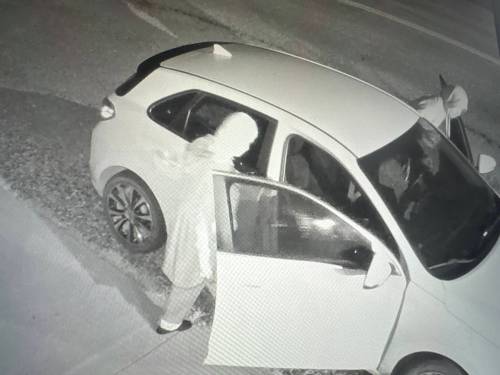
The Winnipeg Police Service said it is aware of a video circulating online that appears to show two children robbed while walking home from the library.

The mother of the siblings said the Sept. 26 incident, which happened in the area of Andrews Street and Magnus Avenue at around 7:30 p.m., has left her children afraid and her feeling guilty.

“I should have been there with them. I felt horrible,” said Brittany Beaudet. “I would have been out the door if I knew any sooner to help them out.”

In the 40-second video, the two children, 14-year-old Mason and nine-year-old Kenzie, are approached by a man wearing a black shirt, black pants and white shoes.

Read
Friday, Oct. 9, 2026

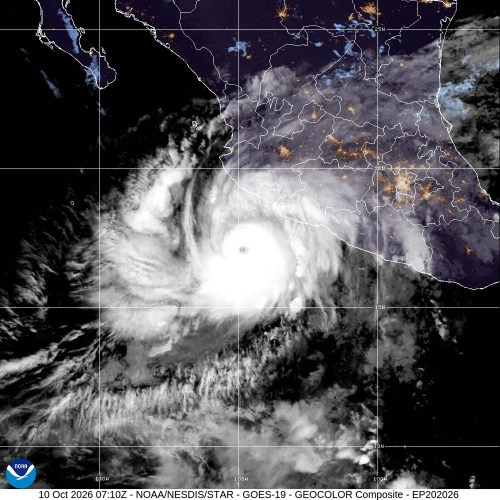
Puerto Vallarta boards up as Hurricane Simon hits Category 4 strength

The Associated Press 3 minute read Preview

Puerto Vallarta boards up as Hurricane Simon hits Category 4 strength

The Associated Press 3 minute read Updated: Yesterday at 9:51 PM CDT

PUERTO VALLARTA, Mexico (AP) — Simon has strengthened into a powerful Category 4 hurricane as it barrels toward Mexico’s coast.

The National Hurricane Center in Miami said Saturday that Simon’s maximum sustained winds increased to 150 mph (240 kph). A storm of that strength or greater is considered a major hurricane.

The center said it expected Simon “to be near or just inland” of Mexico's west-central coast on Sunday. The hurricane could bring as much as 10 to 20 inches (25-50 cm) of rain over parts of southwestern Mexico, with some areas in the states of Michoacan, Colima and Jalisco receiving up to 30 inches (76 centimeters).

“This rainfall will produce life-threatening flooding and mudslides, especially in areas of steep terrain,” the center warned in a bulletin that also urged residents to take immediate action to prepare as tropical-storm conditions were expected to arrive Saturday afternoon.

Read
Updated: Yesterday at 9:51 PM CDT

Collaros turns back the clock in crucial win over Stamps

Taylor Allen 7 minute read Preview

Collaros turns back the clock in crucial win over Stamps

Taylor Allen 7 minute read 7:14 PM CDT

It was around this time seven years ago that the Winnipeg Blue Bombers officially became Zach Collaros’s team.

Making his first start in blue and gold after being acquired via trade, Collaros ran backwards to escape a collapsing pocket before rolling to his right and firing a perfect pass to Darvin Adams in the back corner of the south end zone during a home game against the Calgary Stampeders.

The play marked the beginning of the Collaros era in Winnipeg.

And a similar play Saturday night, once again against the Stampeders, served as a reminder that the 38-year-old pivot isn’t done just yet.

Read
7:14 PM CDT

Protein crests current appetite wave

Laura Rance-Unger 4 minute read Preview

Protein crests current appetite wave

Laura Rance-Unger 4 minute read Yesterday at 2:01 AM CDT

Holiday feasts often reflect the latest fads and trends influencing how we eat.

This Thanksgiving’s table is likely to feature more Canadian content than it might otherwise as a point of national pride.

In the recent past, the carb-free craze has made cauliflower a substitute for the mashed potatoes on some family spreads. Some have gone meatless, while others have added more. Still others offer gluten-free, dairy-free or fat-free alternatives.

Nowadays, it seems consumers can’t get enough protein. Desmond Sobool, deputy chief economist Farm Credit Canada, told a recent economic update for the agri-food sector there are two converging influences in play.

Read
Yesterday at 2:01 AM CDT

A Rocky day on the mayoral campaign trail for Kevin Klein

Malak Abas 12 minute read Preview

A Rocky day on the mayoral campaign trail for Kevin Klein

Malak Abas 12 minute read Friday, Oct. 9, 2026

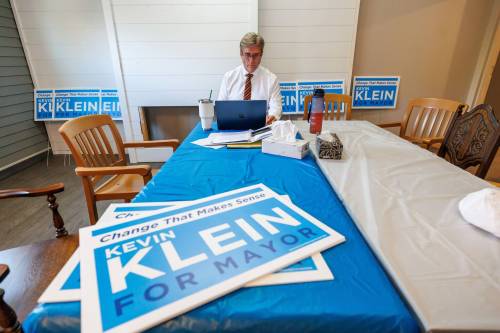
Kevin Klein acknowledges it’s hard to foresee what he’ll wake up to each morning in the final weeks of a mayoral campaign.

But the seasoned politician, who has served as both a city councillor and a provincial cabinet minister, couldn’t have predicted the events — what he describes as “drama” — that unfolded last Sunday.

Fellow mayoral candidate Mike Vogiatzakis accused Klein’s campaign team of offering him a job to drop out of the race, while a guest writer’s column in the Winnipeg Sun that questioned the deaths of Indigenous children at residential schools, just days after the National Day for Truth and Reconciliation, sparked condemnation from a prominent Indigenous organization. (Klein is the CEO of the Klein Group, the company that owns the Sun. He has maintained he is not involved in its operations while running for mayor.)

The Free Press had already been scheduled to join Klein on the campaign trail Monday, intending to document a day in the life of the front-running candidate to unseat incumbent Scott Gillingham, before the controversies hit.

Read
Friday, Oct. 9, 2026

Towing company hands stolen car back, but not to owner

By Matthew Frank 4 minute read Preview

Towing company hands stolen car back, but not to owner

By Matthew Frank 4 minute read Friday, Oct. 9, 2026

A Manitoba man says he is dumbfounded after his car was stolen, impounded by a Winnipeg towing company and given back — to someone that wasn’t him.

Cody Lamb lives in the western Manitoba community of Douglas, about 18 kilometres east of Brandon, but spends weeks away from home working on oil rigs in Alberta.

The 24-year-old says on Sept. 11, while away for work, he heard from his girlfriend who told him his car wasn’t in their driveway. Lamb reported the car stolen to Brandon RCMP the same day.

After filing the report, he heard from Steinbach RCMP on Oct. 1 that his car was recovered that day in the community of Mitchell, roughly five km west of Steinbach.

Read
Friday, Oct. 9, 2026