Actor’s memoir a meditation on grief
Advertisement
Read this article for free:
or
Already have an account? Log in here »
To continue reading, please subscribe:

Digital Subscription
One year of digital access for only $205*
- Enjoy unlimited reading on winnipegfreepress.com
- Read the E-Edition, our digital replica newspaper
- Access News Break, our award-winning app
- Play interactive puzzles
*First annual payment billed as $205.00 + GST for one year. This annual subscription will automatically renew at $233.00 + GST every 52 weeks (10% off the regular annual price of $259.35). Offer available to new and qualified returning subscribers only. Cancel any time.
To continue reading, please subscribe:
Add Free Press access to your Brandon Sun subscription for only an additional
$1 for the first 4 weeks*
- Enjoy unlimited reading on winnipegfreepress.com
- Read the E-Edition, our digital replica newspaper
- Access News Break, our award-winning app
- Play interactive puzzles
*Your next Brandon Sun subscription payment will increase by $1.00 and you will be charged $17.95 plus GST for four weeks. After four weeks, your payment will increase to $24.95 plus GST every four weeks.
Read unlimited articles for free today:
or
Already have an account? Log in here »
Hey there, time traveller!
This article was published 21/12/2024 (659 days ago), so information in it may no longer be current.
This is a lovely little book, although it is not what you’d expect a memoir about a life in Canadian theatre to be.
Its author, the veteran Toronto-based actor and artistic director Layne Coleman, dishes little backstage gossip.
He offers no insight into artistic or business trends in a perpetually struggling industry. With a couple exceptions, Coleman ignores the hundreds of productions he has been involved with going back to the mid-1970s in Saskatoon.
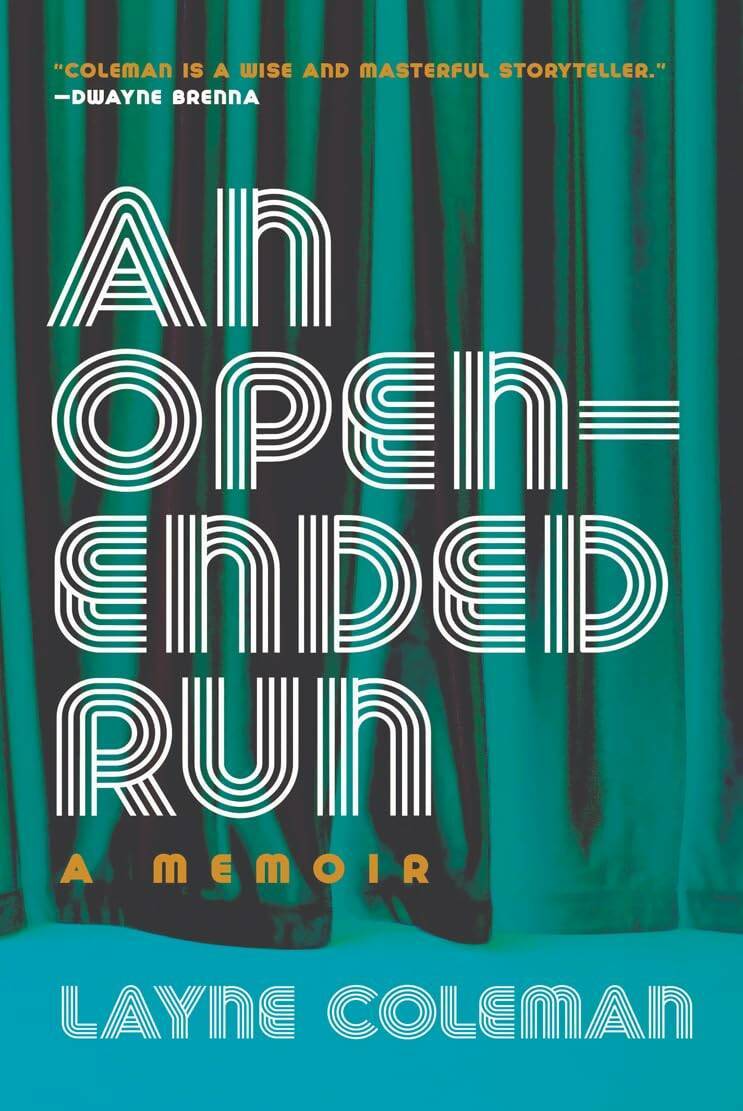
An Open-Ended Run
Instead, he focuses on his inner and personal life. The book is a meditation on his grief over the long-ago death of his wife.
It is also an expression of gratitude for his adult daughter and her family, and a tribute to his bohemian artistic community.
In An Open-Ended Run, Coleman tells his story in 15 chronological chapters. Each one drops into a different period or place, looping backward and forward in time, from his childhood as the youngest of seven on a Saskatchewan farm to recovering from heart surgery in Toronto during the pandemic.
He omits as much as he sets down. Readers are left to infer many details about his battles with drink and drugs, not to mention his successes and failures in his work.
The prose is calm, witty and gentle, infused with a quiet eroticism. The tone is one Leonard Cohen might have adopted were he born to fundamentalist Christians in rural Saskatchewan.
The book, by the way, is part of the Regina Collection, an ongoing series from the University of Regina Press written by Saskies “who have been caught in social and political circumstances beyond their control.”
Coleman, now 74, resisted the Bible school he attended as a youth. He falls into theatre in (of course!) Winnipeg in 1971, after being seduced by a “green-eyed Nordic goddess” who persuades him to volunteer with her on an amateur production of a Harold Pinter play.
Soon after in Saskatoon, he co-founds that city’s estimable 25th Street Theatre, which emphasizes new Canadian plays. Later in Toronto he works with a similar company, Theatre Passe Muraille, and does a 10-year stint there as artistic director beginning in 1997.
In the most riveting chapter, he recounts his fearful prep to play Hamlet for TPM in 1983. His complete trust in his director, the late Clarke Rogers, mingles with his guilt over his lust for Rogers’ Montreal-born girlfriend.
He soon marries the girlfriend, the journalist turned novelist Carole Corbeil. They have a daughter, Charlotte, who grows up to be an actor and playwright herself.
But Corbeil dies of cancer in 2000 when Charlotte is 15, leaving Coleman with both his grief and the responsibility of single parenthood.
Coleman has two bogeymen, repressive Christianity and Toronto theatre critics; the latter “seem to relish mocking people and making them feel small.”
He is aware of the irony. Corbeil was a critic (although a sensitive one who “engaged with the ideas”) and Charlotte, an actor and playwright, is married to the Globe and Mail theatre-turned-TV critic J. Kelly Nestruck.

A lifetime of cigarettes, alcohol and cocaine have taken their toll, but Coleman survives.
He begins with a Proustian memory of eating crackers lathered in cheese as a boy with his older sister. Today he delights in making mac and cheese for his grandsons.
“I sensed my late wife would approve of how I was being a good grandfather,” he writes. “Her approval was all I ever wanted.”
Both thumbs up from this critic as well.
Morley Walker is a retired Free Press editor and writer.
History
Updated on Monday, December 23, 2024 10:47 AM CST: Corrects headline