Macmillan brothers’ publishing path detailed in Literature for the People
Advertisement
Read this article for free:
or
Already have an account? Log in here »
To continue reading, please subscribe:

Digital Subscription
One year of digital access for only $205*
- Enjoy unlimited reading on winnipegfreepress.com
- Read the E-Edition, our digital replica newspaper
- Access News Break, our award-winning app
- Play interactive puzzles
*First annual payment billed as $205.00 + GST for one year. This annual subscription will automatically renew at $233.00 + GST every 52 weeks (10% off the regular annual price of $259.35). Offer available to new and qualified returning subscribers only. Cancel any time.
To continue reading, please subscribe:
Add Free Press access to your Brandon Sun subscription for only an additional
$1 for the first 4 weeks*
- Enjoy unlimited reading on winnipegfreepress.com
- Read the E-Edition, our digital replica newspaper
- Access News Break, our award-winning app
- Play interactive puzzles
*Your next Brandon Sun subscription payment will increase by $1.00 and you will be charged $17.95 plus GST for four weeks. After four weeks, your payment will increase to $24.95 plus GST every four weeks.
Read unlimited articles for free today:
or
Already have an account? Log in here »
Hey there, time traveller!
This article was published 03/05/2025 (488 days ago), so information in it may no longer be current.
A pair of 19th-century Scottish brothers sought to raise themselves out of near poverty, turn a buck in the book business and bring affordable — and tendentially Christian — literacy to a broad swath of the British middle and working classes.
They succeeded on all three fronts.
The publishing house they created still stands today, known corporately as Pan Macmillan.
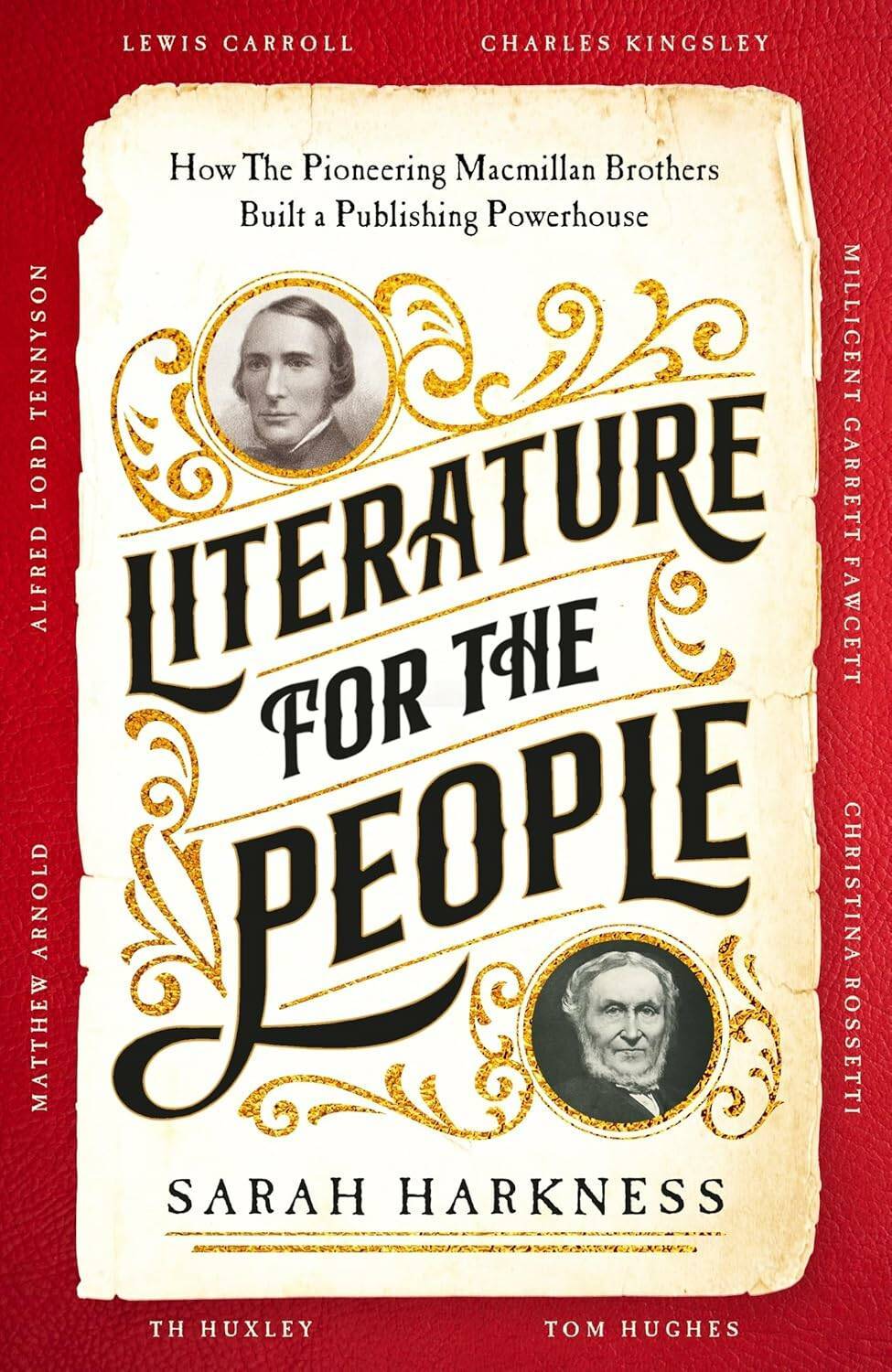
Literature for the People
Sarah Harkness’s Literature for the People is a meticulous — though lacking in élan — chronicle of the genesis of that publishing business.
Harkness’s own genesis as a writer is noteworthy. She worked in senior positions in corporate finance for 20 years, latterly as a partner with accounting firm Arthur Andersen. This is her second crack at biography, having previously authored an account of English Victorian writer and artist Nelly Erichsen (A Hidden Life).
The Macmillan siblings’ overarching motive was, in Harkness’s telling, a marriage of capitalism and religiosity.
“The Macmillan brothers could see that there was an enormous and growing market waiting to be tapped, and that the canny publisher who spotted the right opportunities would not only cater to the inner life of the working man, thus serving a social purpose, but also might make a fortune,” she writes.
They actually began as London booksellers in 1843 but, seeing opportunity, shifted into publishing.
The elder brother Daniel Macmillan did not live to see the firm prosper. He died in 1857. His younger sibling, Alexander, carried on and grew the business over the next nearly four decades.
Where the story shines is post mid-19th-century, when the publishing firm’s books and magazines engaged with contemporary intellectual currents and controversies.
The Macmillan firm’s history intersects with a virtual who’s who of literary, scientific and political pooh-bahs. A mere partial list includes: Thomas Huxley, William Gladstone, Charles Darwin, Alfred Lord Tennyson, Thomas Carlyle, Lewis Carroll, Matthew Arnold, Henry Wadsworth Longfellow and Dante Gabriel and Christina Rossetti.
When Macmillan set up a publishing arm in the United States in the 1860s, it encountered government opposition that echoes down to the Trumpian present.
American customs officials frequently refused to permit release for sale of imported British books for months on end, usually on specious grounds, crippling the firm’s cash flow. And when officialdom did finally release the held books, it slapped on tariffs that made them prohibitively expensive to buy in America.
For all that, Alexander Macmillan eventually prevailed against Yankee protectionism, and the publisher became a success story on both sides of the Atlantic.
Literature for the People’s weakness lies in its academic origins. It grew out of its author’s MA thesis, a 40,000-word dissertation that covered five years in the life of Alexander Macmillan — and it shows.
There are passages in which Harkness relates an event or episode and then buttresses the narrative with a block quotation from correspondence between the brothers or their client authors.
Some of these block quotations are lengthy, far too lengthy, and repetitive of what she’s already just related. This may be appropriate in an academic text or thesis, but in a popular history it’s dead weight.

Still, it does a workmanlike job of what good biography is supposed to do: portray its subjects’ experiences by highlighting as much intimate detail as possible and offering considered analysis of personality. It also deftly explores the brothers’ lives and their firm’s success within the context of the times and larger historical events.
It’s of note that the publisher of this bio is the very firm that it’s about — Macmillan.
It doesn’t appear to be a commissioned work, which, ethically, would have to be disclosed. The acknowledgements at book’s end merely states it was written with “the encouragement and support of the Macmillan family.”
Regardless, it would have been prudent and appropriate for Harkness to expressly underline that the Macmillan descendants and firm exercised no editorial control over its contents.
Douglas J. Johnston is a Winnipeg lawyer and writer.