Palahniuk provides delightfully dark satire

Advertisement

Advertise with us

A new novel from Chuck Palahniuk? If you’re a fan, that’s pretty much all you need to hear.

Read this article for free:


or

Already have an account? Log in here »

To continue reading, please subscribe:

Subscribe and receive a limited-edition Free Press branded hat or tote.

Digital Subscription

One year of digital access for only $205*

  • Enjoy unlimited reading on winnipegfreepress.com
  • Read the E-Edition, our digital replica newspaper
  • Access News Break, our award-winning app
  • Play interactive puzzles

*First annual payment billed as $205.00 + GST for one year. This annual subscription will automatically renew at $233.00 + GST every 52 weeks (10% off the regular annual price of $259.35). Offer available to new and qualified returning subscribers only. Cancel any time.

To continue reading, please subscribe:

Add Free Press access to your Brandon Sun subscription for only an additional

$1 for the first 4 weeks*

  • Enjoy unlimited reading on winnipegfreepress.com
  • Read the E-Edition, our digital replica newspaper
  • Access News Break, our award-winning app
  • Play interactive puzzles
Start now

*Your next Brandon Sun subscription payment will increase by $1.00 and you will be charged $17.95 plus GST for four weeks. After four weeks, your payment will increase to $24.95 plus GST every four weeks.

Hey there, time traveller!
This article was published 01/11/2025 (329 days ago), so information in it may no longer be current.

A new novel from Chuck Palahniuk? If you’re a fan, that’s pretty much all you need to hear.

If you’re unfamiliar with the author or recognize his name as the guy who wrote the book they made that movie Fight Club out of, then here’s what you need to know: Palahniuk is unique. There’s really no one like him writing today.

Palahniuk’s new book, Shock Induction (Simon & Schuster, 240 pages, $25), asks the question: why are high-school students, the best and the brightest, apparently killing themselves? The answer will shock you.

The novel is set in a near future in which the super-rich follow the lives of certain children, pretty much from the moment they’re born, to determine which will eventually be offered jobs — and, in essence, a life of servitude to their wealthy masters.

Yes, it’s satire (gloriously dark satire, in fact), but — and this surely is no accident — Palahniuk’s made-up near future feels an awfully lot like something we’re creating right now. Shifting stylistic and thematic gears without warning, challenging us to keep up with the author’s nimble imagination, Shock Induction is Palahniuk at his best.

Buy on mcnallyrobinson.com

● ● ●

Gareth L. Powell’s Who Will You Save? (Titan Books, 432 pages, $25) is a new collection of short science fiction from two-time Britisch Science Fiction Association award winner.

The book’s 32 stories include both celebrated stories and lesser-known tales, and there’s even some new, never-before-seen material — if you’re a fan of his Embers of War trilogy, for example, you’ll be especially thrilled.

Powell’s writing blends epic-sized world-building with carefully-designed, abundantly human characters (and also some characters who aren’t human, or even technically living beings). Here you’ll visit places billions of years in the future, and places a lot closer to our own time; you’ll travel to far-flung locations, but you’ll also hang out here on dear old Earth (though it’s not the Earth you’ll recognize).

If you’re familiar with Powell’s novels — and, if you like science fiction, you really ought to be — you’ll love this book. If you’ve never read him before, now’s an excellent time to start.

Buy on mcnallyrobinson.com

● ● ●

If you prefer your short fiction with more of a mystery flavour, check out On Fire and Under Water (Rock and a Hard Place Press, 248 pages, $20), edited by Curtis Ippolito. These 15 stories are very different from one another in terms of character and story and writing style. What unites them is a common theme: these are stories about people whose lives are affected, to one degree or another, by the reality of climate change.

No, this is not a treatise on the dangers of climate change. It’s not an eco-screed. But there is a story about a reporter who suspects a series of wildfires was not entirely random. There’s a story about corrupt government officials, and the farmer who will risk his life to stop them. And so on: legitimate crime stories told against a backdrop of an environment in upheaval.

Buy on mcnallyrobinson.com

● ● ●

Hankering for more short fiction? Safe Enough (Mysterious Press, 256 pages, $24) by Lee Child, the creator of the terrifically popular Jack Reacher thrillers, gathers up 20 previously published stories, and here’s the really cool thing: none of them feature Reacher. They’re about killers and cops, FBI agents and assassins, private investigators and ordinary people (some of them good, some of them very bad), and they showcase Child’s gifts as a storyteller.

The stories are written in Child’s usual unadorned style, so they kind of sound familiar, but because he’s not restricted by the rules or structure of a Reacher story, he can do things he doesn’t ordinarily do — one story, The Bone-Headed League, is a riff on Sherlock Holmes, something Child could never have done in a Reacher story. Great stuff.

Buy on mcnallyrobinson.com

Halifax freelancer David Pitt’s column appears the first weekend of every month. You can follow him on Bluesky at @bookman.bsky.social.
Report Error Submit a Tip

More Stories

New series terrific addition to RWB repertoire

Holly Harris 5 minute read Preview

New series terrific addition to RWB repertoire

Holly Harris 5 minute read 2:01 AM CDT

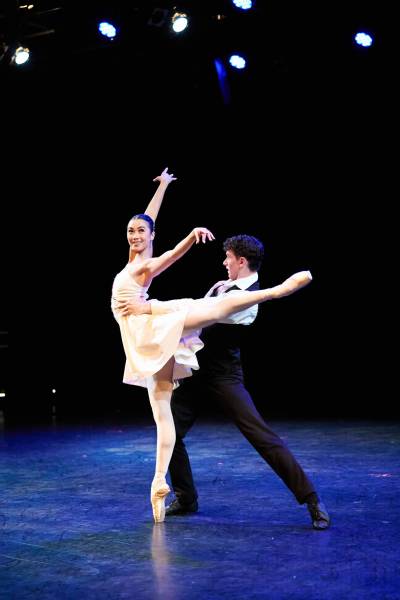
‘See the music, hear the dance,” is a famous quote from quintessential ballet influencer George Balanchine, whose pithy bons mots have defined much of American classical dance since the legendary Russian-born choreographer first blazed a trail with the New York City Ballet.

Local balletomanes were given a golden opportunity to experience both up-close-and-personal Thursday when the Royal Winnipeg Ballet officially kicked off its 87th season with its newly minted Studio Series, which runs until Sunday.

The brainchild of the company’s artistic director, Christopher Stowell, the series features an abridged “concert version” of Balanchine’s seminal Who Cares?, set to a playlist of catchy George Gershwin tunes that make up the backbone of the Great American Songbook.

The Studio Series is the latest initiative taken by Stowell as he settles into his arguably still new position. Some of those endeavours will invariably stumble; others will hit their mark. This venture belongs in the latter category, bringing a 500-plus-year-old art form, often perceived as rarified, to audience members who may be hesitant, shy or just plain intimidated to visit the cavernous Centennial Concert Hall.

Read
2:01 AM CDT

Puzzles Palace

1 minute read Monday, Jul. 27, 2026

To solve our puzzles, please subscribe with this special offer: |

Is a better Winnipeg on the horizon?

Tom Brodbeck, Rebecca Chambers, Niigaan Sinclair and Brent Bellamy 20 minute read Preview

Is a better Winnipeg on the horizon?

Tom Brodbeck, Rebecca Chambers, Niigaan Sinclair and Brent Bellamy 20 minute read Yesterday at 4:00 PM CDT

Four Free Press columnists weigh in on the challenges ahead and how the city can become better.

Read
Yesterday at 4:00 PM CDT

Court hears woman’s statement detailing pain, trauma after boyfriend shot her in the face

Dean Pritchard 6 minute read Preview

Court hears woman’s statement detailing pain, trauma after boyfriend shot her in the face

Dean Pritchard 6 minute read Thursday, Sep. 24, 2026

A.W. thought she had found love with Machuor Akau.

That was before Akau put a loaded Luger handgun to the 26-year-old woman’s head last November and told her he should “kill her now.”

Akau shot her, shattering her jaw and embedding teeth in the bones of her mouth and leaving her fighting for her life.

Now A.W. wakes up every morning in pain and sees the scars on her face and neck.

Read
Thursday, Sep. 24, 2026

Portage Avenue stabbing victim staggered into nearby store for help

Morgan Modjeski and Malak Abas 3 minute read Preview

Portage Avenue stabbing victim staggered into nearby store for help

Morgan Modjeski and Malak Abas 3 minute read Updated: Yesterday at 5:09 PM CDT

A 46-year-old man stabbed on Portage Avenue Wednesday afternoon is in hospital after staggering, bloodied, into a nearby dollar store.

Police said the man was confronted by several people on the 300 block of Portage shortly before 6 p.m. and was stabbed with an unknown weapon. He was helped by people inside the store until police and paramedics arrived.

The man was rushed to hospital in unstable condition but was later upgraded to stable, the Winnipeg Police Service said.

WPS Const. Claude Chancy said Friday that police were still attempting to speak with the victim, and it was not yet clear if the attack was random. No arrests have been made.

Read
Updated: Yesterday at 5:09 PM CDT

Public versus private schooling

John R. Wiens 4 minute read 2:01 AM CDT

A Recent Maggie Macintosh piece (Enrolment up at alternative schools, Sept. 7) and several letters to the editor touted the benefits and values of private schooling. The executive director of the Manitoba Federation of Independent Schools, Andrew Micklefield, emphasized schools of choice and governmental cost-saving. A private, formerly public, schoolteacher emphasized finances, academics and parental support.

None are wrong in their arguments, but they are missing the main reasons for the existence of public schools, which has less to do with money and academics than with inclusion and equality. Nor do they adequately acknowledge the downsides of exclusion and elitism fostered by some aspects of choice and inequality. The increase in numbers of private schools and their attendees is a cause for some public concern.

Micklefield’s assertion is that private schools save the government money. Letter-writer Paulo Borges intimates he saves the province $52,500 ($15,000 each for three home-schooled children and $7500 for one private-school tuition), further suggesting that the savings are not used wisely by governments in supporting public schools.

In the front-page article, Micklefield and others go further to suggest that the main reason parents choose private schools is to receive an education in a Christian setting. That is a very limited rationale and certainly does not include the much larger variety of reasons why people choose private schooling or an even more restricted version of schools of choice, home schooling.