Body’s signals to brain worth heeding for health

Advertisement

Advertise with us

The erosion of the relationship between science communication and the general public became increasingly evident during the COVID-19 pandemic. Part of this is no doubt due to a numbness caused by the popular media barrage of new cancer and disease cures, if not the end of aging itself.

Read this article for free:


By clicking the button above, an account will be created and you will begin to receive some of our recommended newsletters. You may opt out of any newsletter by visiting your Email and Communication Preferences page or by clicking "unsubscribe" at the bottom of any email.

or

Already have an account? Log in here »

To continue reading, please subscribe:

Digital Subscription

One year of digital access for only $1.44 a week*

  • Enjoy unlimited reading on winnipegfreepress.com
  • Read the E-Edition, our digital replica newspaper
  • Access News Break, our award-winning app
  • Play interactive puzzles

*Billed as $5.77 plus GST every four weeks. After 52 weeks, price increases to the regular rate of $19.95 plus GST every four weeks. Offer available to new and qualified returning subscribers only. Cancel any time.

To continue reading, please subscribe:

Add Free Press access to your Brandon Sun subscription for only an additional

$1 for the first 4 weeks*

  • Enjoy unlimited reading on winnipegfreepress.com
  • Read the E-Edition, our digital replica newspaper
  • Access News Break, our award-winning app
  • Play interactive puzzles
Start now

*Your next Brandon Sun subscription payment will increase by $1.00 and you will be charged $17.95 plus GST for four weeks. After four weeks, your payment will increase to $24.95 plus GST every four weeks.

Hey there, time traveller!
This article was published 29/11/2025 (328 days ago), so information in it may no longer be current.

The erosion of the relationship between science communication and the general public became increasingly evident during the COVID-19 pandemic. Part of this is no doubt due to a numbness caused by the popular media barrage of new cancer and disease cures, if not the end of aging itself.

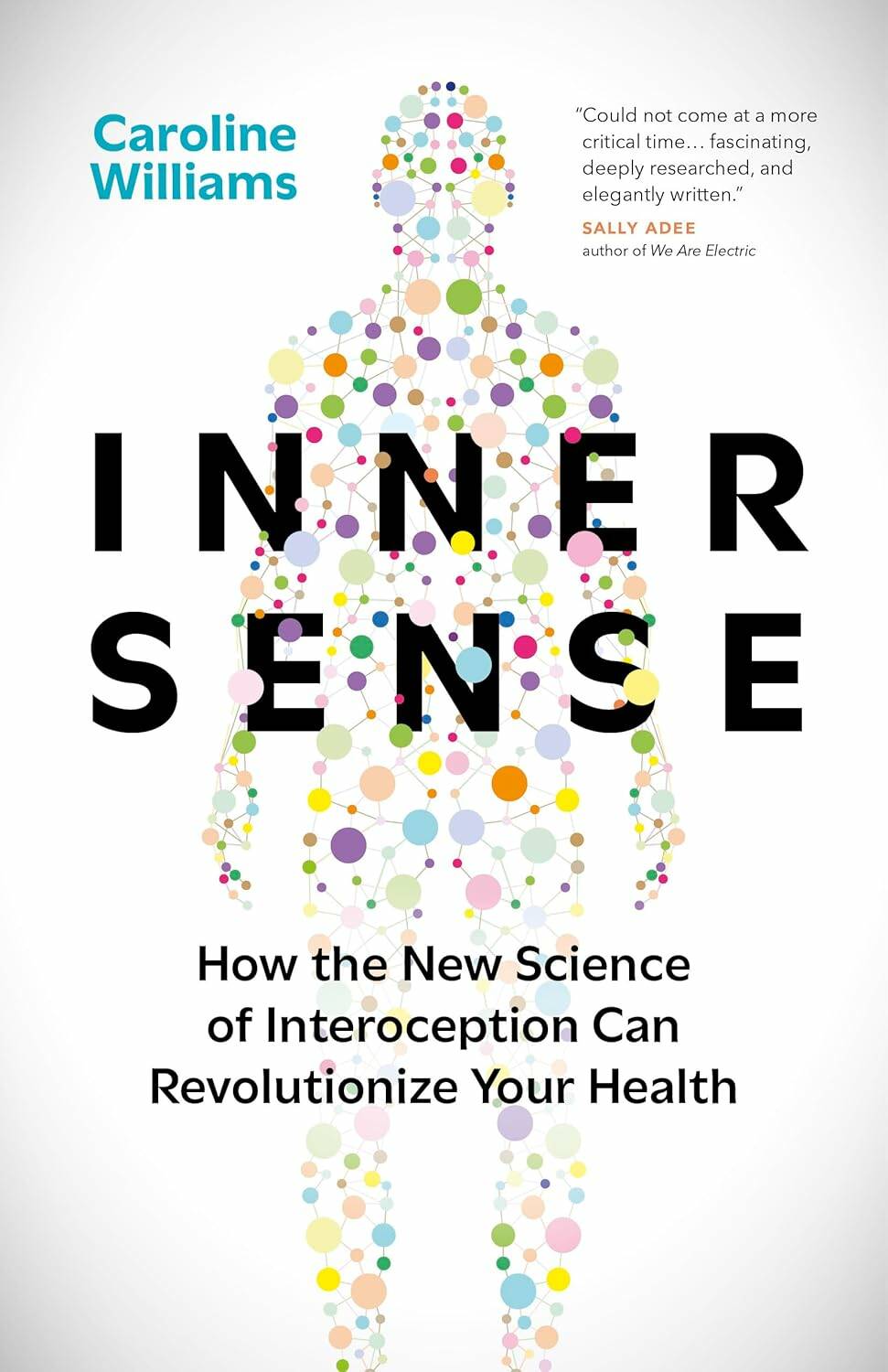
Caroline Williams is a seasoned translator of neuroscience into accessible language. In Inner Sense, her study of interoception traces the history of a niche scientific field as well as potential future vistas.

Interoception refers to signals arising from the body and communicated to the brain — perceptions of fullness, feelings of worry and respiration rates are familiar examples. When heeded and correctly interpreted, interoception keys us to shifts away from homeostasis towards incipient illness and dangers. Williams heralds research into interoception as one of the most significant areas of study to emerge in science and medicine in many years.
Inner Sense

Inner Sense

Interoceptive ability varies by individuals, but is trainable. Improvements can influence our behaviour to foster greater health resiliency and energy and to reduce stress. Research may offer insights into treatments for arthritis, fatigue, depression and many other maladies; these interventions range from developing heart-rate awareness to more invasive surgical procedures.

An accessible writer, Williams articulates the complicated nuance of signaling pathways and digestive physiology into compelling narrative. AI (artificial intelligence) research, she notes, begins with the brain and often ends absent any sense of body, demonstrating an ongoing obliviousness to the body’s interdependent nature.

Whatever its strengths, Inner Sense feels like it was written too early and too narrowly. Despite promises of an accessible health revolution, concrete advice oscillates between easy fixes and a strange, privileged valorization of technology. We’re encouraged to take a bath, laugh, eat whole foods, try yoga, to spend more (or less) time with others.

Further afoot from banally familiar health advice, Williams suggests we consider wearable technology to track biometrics. She seems largely unaware of both the cost and imprecision of smart devices when tracking data as basic as heart-rate variability, a marker of stress. Anything truly new is left to an uncertain scientific future.

That the brain and body are interconnected is a keystone of Williams’ pitch. For all the energy expended supporting this thesis, it’s novel in neither the world of science or philosophy. Her lack of awareness of context and even culture bleeds into other areas. Many meditative practices are intimately linked to interoceptive awareness, but they get shorter shrift than, say, costly sensory deprivation tanks.

Buddhism, which has rich cultural histories exploring many of the same key concepts, is never mentioned.

Inner Sense frequently reads like a breathless announcement to a Canadian that recreation may be possible on ice surfaces.

Williams is confident that the nature of the self has been resolved through neuroscience — certainly not a unanimous opinion. Addiction is treated with some delicacy, but the focus on the role of interoception is so strong that history, cultural or personal, is largely effaced.

Inner Sense becomes increasingly scattershot in its final section, identifying the possibility of interoception as critical to avoiding online scammers and navigating conflict. At best Williams is being darkly humorous when she notes its role in surviving climate change so that we’re aware of the need for shade and water in a rapidly warming world.

While interoception is an important area of research, so is understanding complex phenomena within cultural and historical contexts. Science is crucial to meeting present-day challenges, but public communication of its findings, tentative as they be, is imperative.

The near-frantic sales pitch of Inner Sense promises too much and delivers too little. It’s almost enough to quicken the pulse.

Jarett Myskiw is a teacher.

Report Error Submit a Tip

More Stories

Frustration on menu as construction drags on

Kelly-Anne Riess 4 minute read Preview

Frustration on menu as construction drags on

Kelly-Anne Riess 4 minute read Yesterday at 6:41 PM CDT

Nearly four months of construction outside the front door of a longtime Portage Avenue restaurant has driven away customers and left its owner struggling to cover operating expenses.

Read
Yesterday at 6:41 PM CDT

Bibi, the ‘anti-Bibi’ and the ‘wanna-Bibis’

Gwynne Dyer 5 minute read Preview

Bibi, the ‘anti-Bibi’ and the ‘wanna-Bibis’

Gwynne Dyer 5 minute read 2:00 AM CDT

According to the 1970s anarchist slogan, “No matter who you vote for, the government always gets in.”

That’s certainly true for the election in Israel on Tuesday, even if the winner is not Prime Minister Benjamin (Bibi) Netanyahu himself. All the other party leaders, says Israeli journalist Anshel Pfeffer, are just “wanna-Bibis.”

Or rather, all the rest except one. Former general Gadi Eisenkot, the main opposition candidate, is the “anti-Bibi,” Pfeffer says. He’s a working-class hero who joined the army as a private and worked his way up to chief of staff of the Israel Defence Forces (IDF). He retired and went into politics only four years ago, he’s modest and honest, what’s not to love?

Eisenkot certainly stands out among the party leaders in terms of style, but not so much in terms of actual policies. He was realistic enough to know that “total victory’ over Hamas was not likely, but his “Dahiya” strategy of causing “immense damage and destruction” (in Lebanon in the 2006 war) foreshadowed the cataclysm that the IDF has inflicted on Gaza since 2023.

Read
2:00 AM CDT

Police stop sex assault in progress

1 minute read Yesterday at 1:18 PM CDT

Police officers stopped a sexual assault in progress on Stanley Street on Wednesday evening.

A member of the public called 911 after they spotted a suspect assaulting a woman shortly after 7 p.m. on the 300 block of Stanley, the Winnipeg Police Service said.

Patrol officers responded almost immediately and found a suspect in the process of sexually assaulting an unconscious woman just after 7:10 p.m.

Police took the suspect into custody, while paramedics took the woman to hospital in stable condition.

Winnipeg business closure scare leads Hydro to reschedule planned outage

Free Press staff 2 minute read Wednesday, Oct. 21, 2026

Manitoba Hydro has cancelled a planned River Heights neighbourhood outage after a miscommunication led to area businesses fearing unexpected closure.

Hydro had planned to shut down power along Lanark and Renfrew streets between Corydon Avenue and John Brebeuf Place on Friday.

Overhead electrical maintenance work can only be done with the power off, during the day, for safety reasons, Hydro spokesman Peter Chura said. It chose Friday from 9 a.m. to 3 p.m. because St. John Brebeuf School had an in-service day.

However, the affected area houses a strip of businesses including a Royal Bank of Canada, eateries, shops, services such as physiotherapy and a medical centre.

Family history, solo sojourns paved path for celebrated author’s latest novel

Ben Sigurdson 7 minute read Preview

Family history, solo sojourns paved path for celebrated author’s latest novel

Ben Sigurdson 7 minute read 2:01 AM CDT

It’s 1967 and Lee Clarke has just been kicked out of UCLA when he receives his draft letter in the mail. Rather than report for basic training, he hops in a car and sets off across America on an amphetamine-fuelled road trip to bid farewell to his fractured, dysfunctional family before crossing the border into Canada.

Such is the premise for B.C.-born, Portland-based Patrick deWitt’s sixth novel Dodge City, published in September by House of Anansi. He’s in Winnipeg tonight at McNally Robinson Booksellers’ Grant Park location to launch the book.

The 51-year-old deWitt came to prominence with his sophomore novel, 2011’s The Sisters Brothers. The book was a critical and commercial success, winning the author the Governor General’s Literary Award for Fiction, the Rogers Writers’ Trust Fiction Prize and the Stephen Leacock Medal for Humour, and was adapted for the big screen in a film starring John C. Reilly and Joaquin Phoenix.

His 2018 novel French Exit was also adapted for cinema, and his 2023 novel The Librarianist won deWitt the Leacock Medal for the second time. Dodge City is deWitt’s fourth novel to make the Giller Prize long list.

Read
2:01 AM CDT

Alberta sees its way through the fog

Editorial 4 minute read Preview

Alberta sees its way through the fog

Editorial 4 minute read 2:01 AM CDT

“The owls are not what they seem.”

It was a confusing line in a confusing television show, back when television watchers had to wait a week, or sometimes more, for a new episode of a show.

What the owls were — or weren’t — was one small element of the astounding panoply of events in Twin Peaks.

In case this is all flying right over your head, Twin Peaks was a surrealist television show, a mystery/horror/something that premiered in 1990. It had an amazing ability to leave viewers both entertained and, well, hanging.

Read
2:01 AM CDT