Revolt against slavery in the Americas chronicled
Advertisement
Read this article for free:
or
Already have an account? Log in here »
To continue reading, please subscribe:

Digital Subscription
One year of digital access for only $205*
- Enjoy unlimited reading on winnipegfreepress.com
- Read the E-Edition, our digital replica newspaper
- Access News Break, our award-winning app
- Play interactive puzzles
*First annual payment billed as $205.00 + GST for one year. This annual subscription will automatically renew at $233.00 + GST every 52 weeks (10% off the regular annual price of $259.35). Offer available to new and qualified returning subscribers only. Cancel any time.
To continue reading, please subscribe:
Add Free Press access to your Brandon Sun subscription for only an additional
$1 for the first 4 weeks*
- Enjoy unlimited reading on winnipegfreepress.com
- Read the E-Edition, our digital replica newspaper
- Access News Break, our award-winning app
- Play interactive puzzles
*Your next Brandon Sun subscription payment will increase by $1.00 and you will be charged $17.95 plus GST for four weeks. After four weeks, your payment will increase to $24.95 plus GST every four weeks.
Read unlimited articles for free today:
or
Already have an account? Log in here »
Hey there, time traveller!
This article was published 24/01/2026 (253 days ago), so information in it may no longer be current.
Right off the hop, author Carrie Gibson underlines The Great Resistance isn’t yet another book about the conditions of slavery (though its horrors surface throughout), but about slave resistance, mainly armed resistance, in the Americas. Starting in the 16th century, from the United States to the Caribbean islands to South America, slaves fought to regain their freedom.
Gibson is a British-American historian and journalist and author of two previous historical works. Before embarking on a career as a historian, she did stints as a writer/editor for British newspapers the Guardian and the Observer, which accounts for the non-academic flourishes that populate what is, at base, an academic work.
Academic historical writing for mass-market publication must maintain a balanced walk atop an intellectual fence — careful not to fall off into dry-as-dust academic minutiae on one side, or overly simplistic popularization on the other. Gibson steps carefully and doesn’t tumble into either excess.
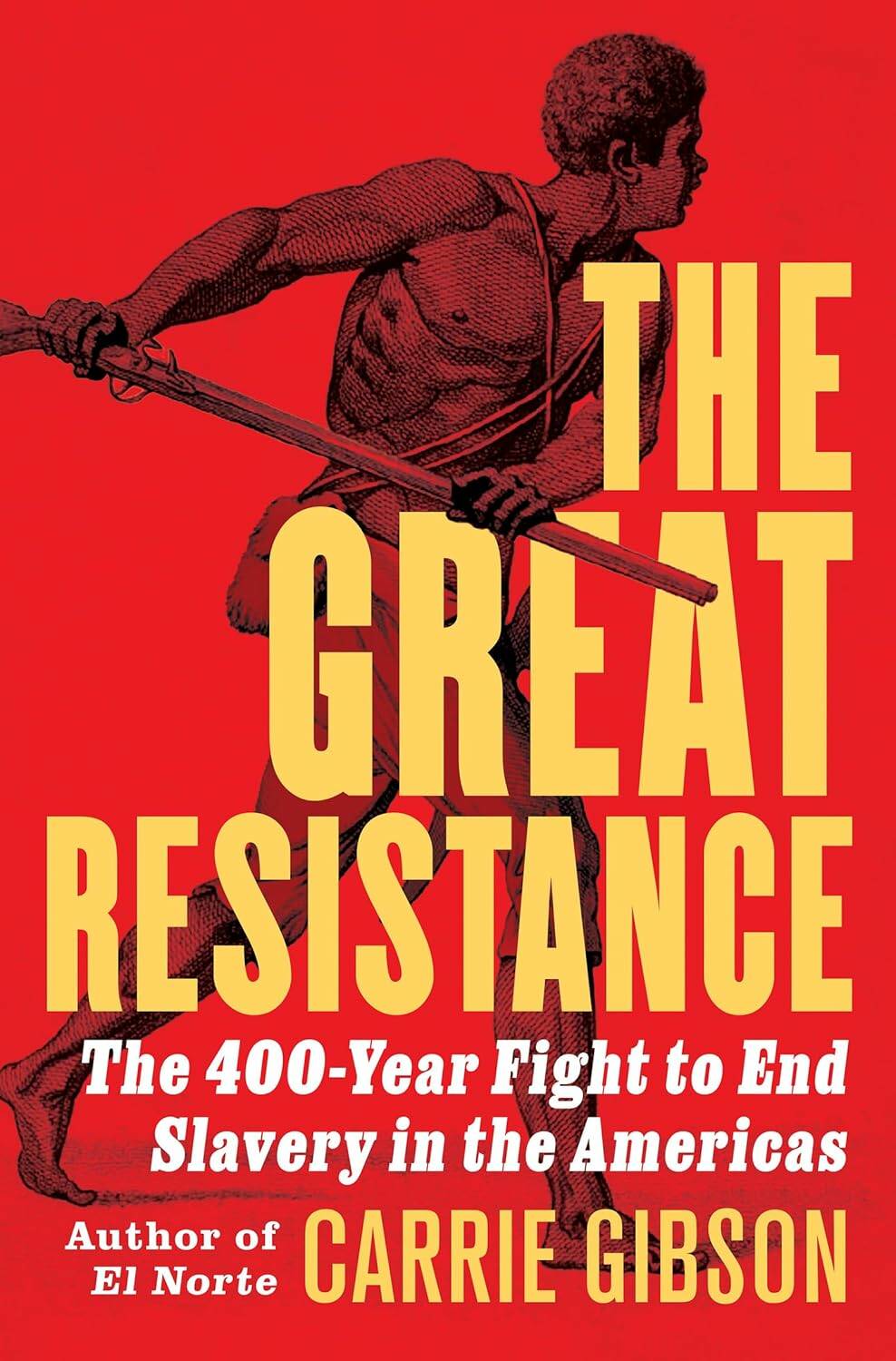
The Great Resistance
The Portuguese were the pioneer major slave traders. But many European powers — Spain, England, France, Holland, even Denmark — took colonial possession of lands in the Americas and thereafter imported slave labour to harvest, depending on climate and soil, sugar, rice, tobacco or cotton. Best estimates place the number of enslaved Africans taken to the Americas over near four centuries at 12 million.
There was such a need for slave labour that frequently, especially on Caribbean islands, the slave population far exceeded the numbers of their white masters. And that numerical advantage, in Gibson’s telling, sowed the seeds of slave revolt — and sometimes, at least temporarily, slave-revolt success.
She counts and records 35 “key revolts” on dozens of islands and in Mexico, Venezuela, Colombia, Ecuador and Brazil. The United States also makes the cut. She chronicles episodes in Louisiana, Virginia, South Carolina and even a 1712 slave insurrection in New York City.
Canada merits but passing reference.
Gibson briefly canvasses the 1775-83 revolution that saw the 13 colonies become the United States of America and the resultant United Empire Loyalist migration north. And kudos to her, she gets Canadian legislative history about slavery right.
“As a former French and now British territory since 1763, Canada did permit slavery throughout, but its roughly 3,000 enslaved people, including those recently brought by white loyalists, were a small fraction of the population,” she writes, noting that “(i)n 1793, Upper Canada (modern Ontario) passed a gradual emancipation law.”
Gibson devotes a singular chapter, aptly titled Quill, to the period’s literature of slavery — contemporary published fiction and non-fiction accounts of slave revolts, European-power military reprisals and executions of rebellious slaves. It’s fascinating, but sometimes grim and gruesome, reading.
There’s academic scrupulosity here. The text comes in at 500 pages and the bibliography, footnotes and summary timeline at book end run to another 100 pages-plus. And it’s all nicely bolstered by a half-dozen helpful 16th-18th century maps.
Though her research is vigorous and detailed, Gibson knows how to make complex topics and scenarios accessible to a general audience.
Having said that, she doesn’t write with quite the brio that the best academic historians — Stephen E. Ambrose and Doris Kearns Goodwin, for example — deploy when bridging the gap between scholarly accuracy and engaging storytelling.
Still, this is top-tier professorial history — lots of reliance on primary sources, inciteful analysis and linkages to broader historical events.
And it frequently captures the human — or more accurately, inhuman — drama of the slave-trade epoch.
Douglas J. Johnston is a Winnipeg lawyer and writer.