Virginia family entangled with thugs

Advertisement

Advertise with us

S.A. Cosby’s thriller King of Ashes (Flatiron Books, 352 pages, $26) might be his best novel, which is a big deal if you know Cosby’s books, because his other ones (Razorblade Tears, for example, a brilliant tale of revenge) are magnificent… like Elmore Leonard-level magnificent.

Read this article for free:


or

Already have an account? Log in here »

To continue reading, please subscribe:

Subscribe and receive a limited-edition Free Press branded hat or tote.

Digital Subscription

One year of digital access for only $205*

  • Enjoy unlimited reading on winnipegfreepress.com
  • Read the E-Edition, our digital replica newspaper
  • Access News Break, our award-winning app
  • Play interactive puzzles

*First annual payment billed as $205.00 + GST for one year. This annual subscription will automatically renew at $233.00 + GST every 52 weeks (10% off the regular annual price of $259.35). Offer available to new and qualified returning subscribers only. Cancel any time.

To continue reading, please subscribe:

Add Free Press access to your Brandon Sun subscription for only an additional

$1 for the first 4 weeks*

  • Enjoy unlimited reading on winnipegfreepress.com
  • Read the E-Edition, our digital replica newspaper
  • Access News Break, our award-winning app
  • Play interactive puzzles
Start now

*Your next Brandon Sun subscription payment will increase by $1.00 and you will be charged $17.95 plus GST for four weeks. After four weeks, your payment will increase to $24.95 plus GST every four weeks.

S.A. Cosby’s thriller King of Ashes (Flatiron Books, 352 pages, $26) might be his best novel, which is a big deal if you know Cosby’s books, because his other ones (Razorblade Tears, for example, a brilliant tale of revenge) are magnificent… like Elmore Leonard-level magnificent.

Cosby writes about the people of rural Virginia, where he was born and still lives. His books feature abundantly human characters in exquisitely rendered settings, the dialogue is pitch perfect and the stories are morally complex.

Here, Cosby introduces us to Roman Carruthers, who made it out of the dying town of Jefferson Run only to be forced to return after his father is critically injured in an automobile accident. He finds his family tangled up with gangsters and in shambles — and there might be no easy way to keep it all from falling completely apart. A splendidly conceived and executed novel.

Buy on mcnallyrobinson.com

● ● ●

All Jack Reacher wanted to do in Baltimore was listen to some good live music. He wasn’t expecting to rescue an elderly couple from a con artist, and he certainly wasn’t counting on getting mixed up with a stranger in some serious danger.

But that’s Jack: if someone’s in trouble and he can help them, then he will. No matter what the risks.

Lee Child and Andrew Child’s Exit Strategy (Bantam, 336 pages, $29), is the 30th Reacher novel. That’s an impressive number, and it’s worth noting that the series shows no signs of slowing down: the authors — originally Lee Child writing solo, and now with his brother, Andrew — keep finding new things for Reacher to do, new villains for him to face.

The villain here is an exceptionally nasty one, too, a retired military contractor with no conscience and a taste for violence, and there are moments when, even though we know he will triumph, we fear for Reacher’s life.

Buy on mcnallyrobinson.com

● ● ●

Bree Winter can’t believe it’s been a decade since her daughter, Melanie, was murdered. The wound is still so raw that, in dark moments, it feels like it just happened. But somehow Bree has managed to rebuild her life and find some manner of happiness.

And then this happens: the man who was convicted of killing Melanie confesses to several murders — but not to her daughter’s. Bree is determined to find out the truth about Melanie’s death, but she’s not prepared for the terrible things she discovers.

Kate White’s I Came Back For You (Thomas & Mercer, 299 pages, $26) is the best kind of psychological thriller: a deeply compelling story with a lead character who absolutely commands our attention and our sympathy, and enough twists to keep even the most experienced reader guessing. Outstanding.

Buy on mcnallyrobinson.com

● ● ●

Have you met Twilly Spree? He’s an independently wealthy, rather eccentric part-time eco-warrior who appeared in Carl Hiaasen’s terrific novels Sick Puppy and Scat. He appears here, too, which all by itself is enough to recommend the book (he really is a delightful character).

But there’s also Dale Figgo, who got kicked out of the far-right wing Proud Boys because he was too nuts for them. He’s got a plan to make a big political statement, but he doesn’t realize he’s being manipulated by a couple of crazy philanthropists.

There’s a serious story to be told about right-wing conspiracists, but this certainly isn’t it. Fever Beach (Vintage Crime/Black Lizard, 384 pages, $26, Hiaasen’s latest novel, is hilarious — comic fiction at its finest, full of wordplay, laugh-out-loud moments of sheer idiocy and a large cast of wondrously loopy characters.

If you’ve never read Carl Hiaasen, you’ve really been missing out.

Buy on mcnallyrobinson.com

Halifax freelancer David Pitt’s column appears the first weekend of every month. You can follow him on Bluesky at @bookman.bsky.social.

Report Error Submit a Tip

More Stories

United Way, other charities fight for dollars as donor base shrinks

Scott Billeck 7 minute read Preview

United Way, other charities fight for dollars as donor base shrinks

Scott Billeck 7 minute read Yesterday at 2:00 AM CDT

Winnipeg’s charitable sector is being squeezed from both sides: demand for help is growing while the pool of donors to meet that need is shrinking.

The imbalance is increasingly being carried by a relatively small group of deep-pocketed donors. Last year, 600 people — about three per cent of United Way Winnipeg’s individual donors — accounted for roughly $8 million, or 55 per cent of individual donations.

The fundraising pitch isn’t getting any easier.

Homelessness and public drug use have become increasingly visible, household budgets remain strained and the problems charities are trying to address can seem so entrenched that donors may reasonably wonder what difference another contribution can make.

Read
Yesterday at 2:00 AM CDT

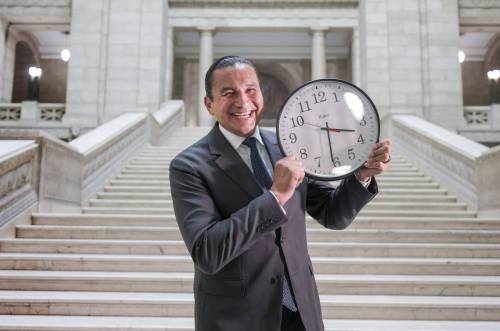
Manitoba abandoning spring, fall clock changes

Carol Sanders 8 minute read Preview

Manitoba abandoning spring, fall clock changes

Carol Sanders 8 minute read Updated: Yesterday at 8:48 AM CDT

Time’s up for the time change in Manitoba.

Manitobans won’t be setting their clocks back an hour in November. The province has decided to permanently stay on daylight time after surveying residents on the twice annual clock adjustment.

“We heard from Manitobans loud and clear — no more changing the clocks in Manitoba,” Premier Wab Kinew said in a news release Thursday.

Most of the 72,000 votes submitted in an online EngageMB survey — 92 per cent — said they would like to see the practice end. The survey asked if they preferred earlier sunrises in winter with standard time or the later sunsets in summer with daylight time. More than half of survey participants (58 per cent) indicated a preference to stay on permanent daylight time; 34 per cent voted to eliminate the time change but stay on standard time.

Read
Updated: Yesterday at 8:48 AM CDT

Family account spiced with magic realism, geopolitical intrigue and a ghost story

Reviewed by Zilla Jones 4 minute read Preview

Family account spiced with magic realism, geopolitical intrigue and a ghost story

Reviewed by Zilla Jones 4 minute read 2:01 AM CDT

Tom Lin’s second novel Babylon, South Dakota moves beyond a historical account of an immigrant family’s struggle, delightfully blending and bending genres.

Lin is a Chinese-born novelist whose family emigrated to the U.S. when he was four years old. His debut novel, The Thousand Crimes of Ming Tsu, won the 2022 Andrew Carnegie Medal for Excellence in Fiction, making him the youngest ever recipient of that award. He earned a PhD in English from the University of California Davis and is currently an assistant professor of English and creative writing at the University of Iowa.

Babylon, South Dakota takes place in an unspecified time period that can be understood to be during the Mao era — likely the 1950s or ’60s. A young Chinese couple, the Hsuis, immigrate to the rural community that gives the book its title. They take the names Saul and Mei and settle on a 160-acre homestead left to them by a distant relative.

Saul’s dream is to breed and sell chrysanthemums from seeds he brought from China, while Mei wants to raise livestock. They speak no English, know nothing of life in the United States, are unprepared for the harshness of winter and the isolation of the farm and bring nothing with them except some gold, which Mei hides around the house for emergencies. Their only link to the outside world is a discarded and marginally functioning TV set, which Saul rescues and rigs up.

Read
2:01 AM CDT

Not falling back means time loop remains unclosed

Jen Zoratti 4 minute read 2:01 AM CDT

I demand restitution. Where’s my hour?

In the traditional fall-back, spring-forward time change set up — you know, ol’ trusty that’s been effect for lo these 63 years — we lost an hour in the spring that we got back in the fall.

That was the social contract: you commit to feeling like you’re on cold medication for a week in March because you know a glorious extra hour of sleep will be returned to you in November. (Unless, of course, you have little kids, but look: we all make our choices.)

Well, that transaction, flawed as it was, isn’t happening this year. That hour you sacrificed to the sun gods in the spring? Gone. Not coming back. We’ve sprung forward and we shan’t be falling back — not in November, and (possibly) not ever. The scale shall remain unbalanced and the loop shall remain unclosed as Manitoba has adopted permanent daylight time.

Canada must not accept another Iranian autocracy

David Matas 5 minute read 2:01 AM CDT

Iran is a state run by a radical government victimizing its citizens and its neighbours. How do we change that? Any regime change that repeats the mistakes of the past is not a solution.

What went wrong in the past which led to the current regime? One answer is the U.K. and American aided coup which led to the ouster in 1953 of a democratically elected government headed at the time by Mohammad Mossadegh and its replacement with an American friendly autocrat, the Shah of Iran, Mohammad Reza Pahlavi.

The Shah imposed his rule through the Iranian National Intelligence and Security Organization — SAVAK, the acronym of its Persian name. SAVAK systematically inflicted torture, arbitrary killings and extra-judicial killings on perceived opponents of the regime. It was only a matter of time before repression of a regime directed to serving foreign interests would be overthrown.

What replaced the regime of the Shah, in 1979, the current regime of the mullahs, is a regime as intolerant and violent as the regime of the Shah and then some. That was not inevitable. But neither was it surprising. The vicious nature of the current regime, following the example set by the Shah, and its hatred for the United States, reacting to the U.S. aided imposition of the Shah, both echoes and reacts to the past. In 1979, the U.S. reaped what it sowed in 1953.

Gillingham in lead with decided voters

Nicole Buffie 6 minute read Preview

Gillingham in lead with decided voters

Nicole Buffie 6 minute read Yesterday at 6:55 PM CDT

A cloud of uncertainty is hanging over Winnipeg as October’s municipal election nears.

Three months after a poll showed more than 40 per cent of Winnipeggers wanted to see someone other than current mayor Scott Gillingham elected, a new Abacus Data poll indicates more than half of Winnipeg voters are undecided heading into next month’s civic election.

Of decided voters, 55 per cent favour Gillingham compared to 23 per cent for former councillor and provincial cabinet minister Kevin Klein and 11 per cent for funeral director Mike Vogiatzakis.

Of all respondents, just over 50 per cent said they were unsure while 13 per cent said they will not vote.

Read
Yesterday at 6:55 PM CDT