Parsing painful truths
Finely drawn Jerusalem plays home toteen’s plight in vivid coming-of-age novel
Advertisement
Read this article for free:
or
Already have an account? Log in here »
To continue reading, please subscribe:

Digital Subscription
One year of digital access for only $205*
- Enjoy unlimited reading on winnipegfreepress.com
- Read the E-Edition, our digital replica newspaper
- Access News Break, our award-winning app
- Play interactive puzzles
*First annual payment billed as $205.00 + GST for one year. This annual subscription will automatically renew at $233.00 + GST every 52 weeks (10% off the regular annual price of $259.35). Offer available to new and qualified returning subscribers only. Cancel any time.
To continue reading, please subscribe:
Add Free Press access to your Brandon Sun subscription for only an additional
$1 for the first 4 weeks*
- Enjoy unlimited reading on winnipegfreepress.com
- Read the E-Edition, our digital replica newspaper
- Access News Break, our award-winning app
- Play interactive puzzles
*Your next Brandon Sun subscription payment will increase by $1.00 and you will be charged $17.95 plus GST for four weeks. After four weeks, your payment will increase to $24.95 plus GST every four weeks.
Read unlimited articles for free today:
or
Already have an account? Log in here »
Seven Heavens Away is the debut novel by Ashraf Zaghal, a Palestinian-Canadian writer born in Jerusalem and holder of a MFA in creative writing from the University of British Columbia. He has previously published four collections of poetry.
The novel is part of a growing body of Palestinian literature, set in Jerusalem in the fall of 2015 and spring of 2016, in a period of relative peace between the 2014 and 2021 wars between Israel and Gaza.
From the prologue, we learn the narrator is leaving their home in Jerusalem and flying to Toronto. The rest of the novel tells us why.

David Chang photo
One of the strengths of Ashraf Zaghal’s novel is the details, both inner and outer, given to a part of the world which many people debate, discuss and feel as if they know.
Aziz is 15 years old, and at the opening of the story he and two friends, Hassan and Mustafa, go for ice cream at a café in the Old City in East Jerusalem. This is a place where Christians, Muslims and Haredi Jews walk the streets together, but the city itself is divided by a line of asphalt, and soldiers patrol. Out of sight of their parents, anonymous in the bustling neighbourhood, the teenagers enjoy an illicit cigarette, flirt with girls and practice their Hebrew.
Their peace is irrevocably shattered when Hassan is shot by Israeli soldiers who are under the mistaken belief that he is about to throw rocks at them.
Hassan’s death upends Aziz’s and Mustafa’s world. They become involved with the Circle of Sincere Hearts, a group of men led by Hassan’s father, Abu-Hassan; group members study the Qu’ran from a fundamentalist or traditional perspective and engage in dangerous acts of resistance.
At the same time, Aziz’s home life becomes more fraught. His father is a violent and domineering man who doesn’t bring home enough money for the family, so Aziz begins working at the café where Hassan was shot. He finds himself attracted to a Jewish waitress, Dafna, which brings him into conflict with Mustafa.
One of Seven Heavens Away’s strengths is the details, both inner and outer, given to a part of the world which many people debate, discuss and feel as if they know. Among the inner details is the importance placed by Palestinian residents of Jerusalem upon Al-Aqsa Mosque, and the pride they take in consuming olives from their olive trees. Outwardly there are sensory details: the sound of daily prayers from the mosque; durbuka music and laughter at family dinners; the warmth of the flame used to heat pots of water; the taste of jelly-filled sufganiyot doughnuts and eggplant cooked with tomato sauce, basil and hot peppers; and the scents of coffee, cigarette smoke, zaatar and cinnamon.
Aziz is a fully drawn and compelling character. Forced to grow up too soon, he is continually pulled in different directions, none of them positive, by the adults in his life. The reader can see the risks he cannot, which sustains the narrative tension. It feels inevitable that Aziz will be arrested, or worse, surrounded as he is by men who see going to jail as a rite of passage.
Zaghal’s prose walks the line between writing suited to young adults and writing for adults; it’s simple and clear enough for youth, but engaging enough for older readers. The author doesn’t make judgments; he trains his pen like a camera onto the chaos and beauty of a city in turmoil and simply records it.
Aziz’s life becomes more complicated, as does the plot, as he wrestles with questions of his family life, his love life, his religious life, his academic career, his part-time job and trying to earn the respect of his peers.
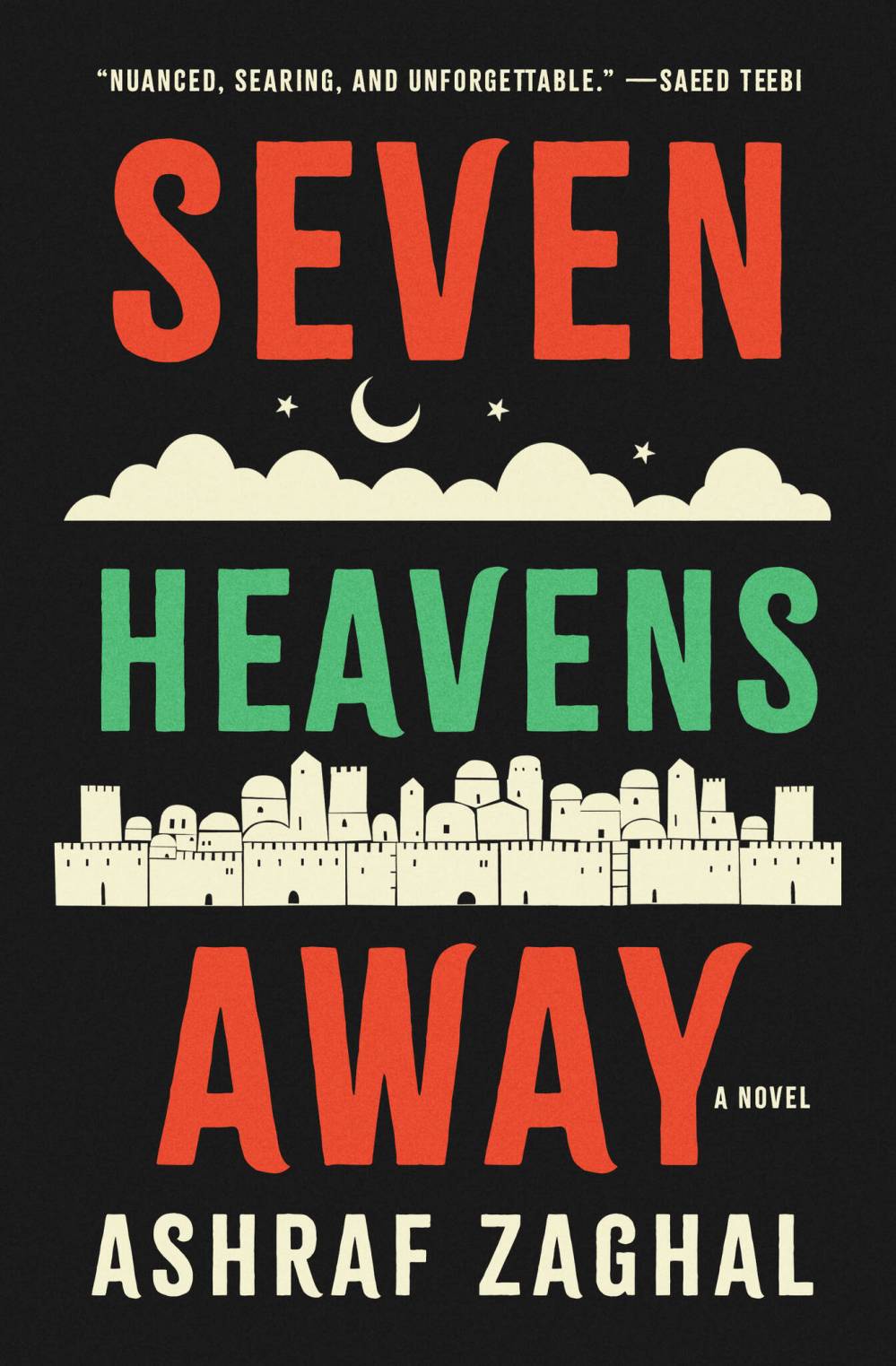
Seven Heavens Away

These are concerns of all teenagers, but are heightened by the political climate he lives in. Every choice he makes is seen as a rejection of a culture or a tradition. A foolish decision can cost him or someone else their life.
Zaghal skilfully weaves together the various storylines while entrancing the reader with the gloriously depicted setting.
While Seven Heavens Away is a coming-of-age story, it is really also a love letter to Jerusalem, both as it was before the most recent conflict we are now living through, and also to what it can be again. The reader is left with a vision of a city beloved by multiple faiths, strung with Christmas lights as the Islamic call to prayer rings out and Jews practice their religion in peace, a place where Arab and Jewish citizens visit the market or work side-by-side in bustling cafés where people of all backgrounds come to eat and socialize.
It is a vision of imperfect people all loving, striving, struggling to survive and learning how to live together.
Zilla Jones is a Winnipeg-based writer of short and long fiction. Her debut novel The World So Wide was published in April 2025.