Ppoignant pilgrimage
Gaston’s American road trip offers insight into bond between father and sons
Advertisement
Read this article for free:
or
Already have an account? Log in here »
To continue reading, please subscribe:

Digital Subscription
One year of digital access for only $205*
- Enjoy unlimited reading on winnipegfreepress.com
- Read the E-Edition, our digital replica newspaper
- Access News Break, our award-winning app
- Play interactive puzzles
*First annual payment billed as $205.00 + GST for one year. This annual subscription will automatically renew at $233.00 + GST every 52 weeks (10% off the regular annual price of $259.35). Offer available to new and qualified returning subscribers only. Cancel any time.
To continue reading, please subscribe:
Add Free Press access to your Brandon Sun subscription for only an additional
$1 for the first 4 weeks*
- Enjoy unlimited reading on winnipegfreepress.com
- Read the E-Edition, our digital replica newspaper
- Access News Break, our award-winning app
- Play interactive puzzles
*Your next Brandon Sun subscription payment will increase by $1.00 and you will be charged $17.95 plus GST for four weeks. After four weeks, your payment will increase to $24.95 plus GST every four weeks.
Read unlimited articles for free today:
or
Already have an account? Log in here »
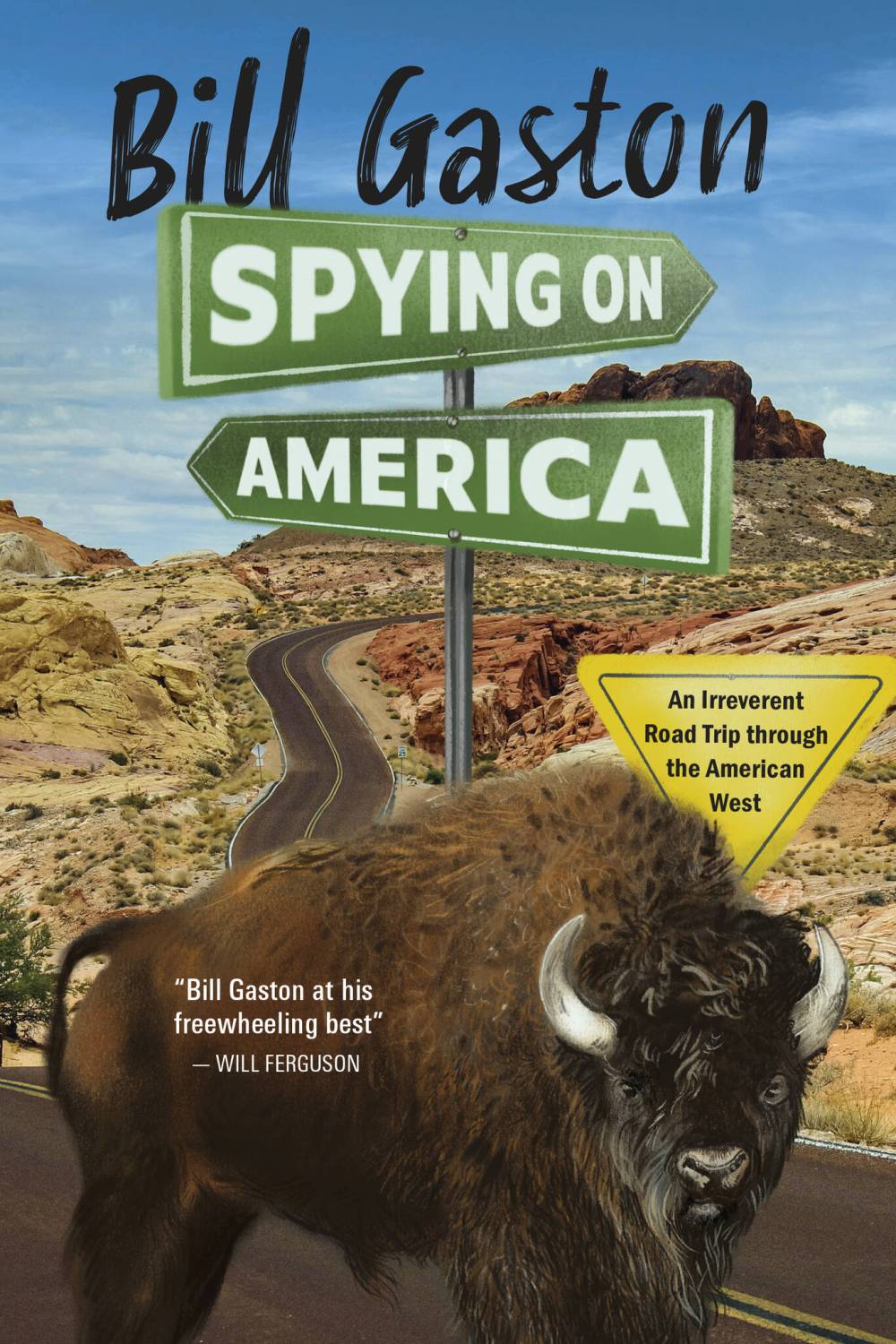
Spying on America is prolific and award award-winning writer Bill Gaston’s second memoir and 20th book — he has 15 novels as well as books of short stories, a play and a book of poems to his name.
The reward that this decades-long apprenticeship bestows is, first and last, the pure pleasure of reading Gaston’s supple, apparently effortless prose — evidence, maybe, of what Canadian poet Al Purdy referred to in a related register as “the crafte so longe to lerne.”
The book’s explicit subject is timely and engaging: as the title signals (as well as the 12-page “Epilogue: Spying on America from the Rearview” — more on this later), this is a covert operation for Gaston and his two adult sons, who embark on an 11-day drive in a rented muscle car from near Vancouver into the U.S. and back.

Jen Steele photography
The richness of Bill Gaston’s memoir gives way to his baring of his feelings about our southern neighbours.
Their purpose and destination? To explore their ancestry: Gaston’s great-great-grandparents are none other than George B. Gaston and Maria Gaston, key American figures in the history of the underground railroad.
Gaston’s end point in his epic drive is Tabor, Iowa, where George and Maria Gaston lived and played their central roles long ago, and where he and his sons are taken on a tour of the Gaston legacy, literal and mythic.
At this level, the memoir is substantial and instructive. But by the time the three Gastons arrive at Tabor, it has become clear that another purpose of the memoir is to explore and reflect on the complex relationships among these three Gastons, father and sons, as they drive across America.
At this level, Spying On America rewards as much or more than on its more explicit pathway.
The Gastons drive through eight American states, on highways, on back roads, on dirt roads. En route they encounter every kind of American (for better and worse), every kind of motel and hotel, every kind of food, every local beer. Always, Gaston’s attractive prose style — distilled and refined over decades, it would seem — works its off-hand, breezy magic.
Often, Gaston is disarmingly funny: here, for example, are a few of his many reflections throughout on family (and on his own writing) as he rolls though the American countryside: “I’ll report something else I’ve learned about my ancestry on my mother’s side. A recent article on the Viking invasion of Britain supplied a list of Danish names which indicated Viking descent. One was Sorensen, so I learned that, through my mother’s mother, Lara Sorensen, I have Viking blood. And because my Viking grandmother married my Jewish grandfather, it seems I have the DNA of a Viking Jew. Not to make light but, imagine, blond braids flying, one uses a two-handed sword to hack into a shanty of quivering English farmers… Once in, one stands before them, angles oneself in the firelight to show one’s best side, flicks a braid back over a shoulder, and starts telling jokes.
“I admit that my writing can be a little like that,” Gaston writes. “Barge into something serious, then try to be funny. I do wish I knew how to make a pen mightier than a sword.”
“Barge into something serious” could stand as Gaston’s overarching instruction to himself. Reading Spying on America is serious fun: useful, instructive fun, and not only as he navigates’ his relationships with his sons.
In The World According to Garp, John Irving writes strikingly of the process of family learning to “unknow each other;” here, Gaston seems bent on countering or reversing that inevitable process as the trio bends over paper maps (Gaston) and iPhone screens (his sons) to find their next waystation.
Spying on America

In the 12-page epilogue, Gaston elaborates on his spy mission “through the rearview mirror.” This section is not completely unexpected, but it’s jarring; he is by turn shocked, angry, outraged and appalled at the U.S. having elected Donald Trump for a second time in 2024, despite the blatant signs of Trump’s malfeasance.
The wonderful richness of the whole memoir — of the journey with his sons in all of its complexities — gives way to Gaston’s baring of his feelings about our southern neighbour. While many thousands (or hundreds of thousands) of Canadians feel similar uncomprehending outrage, the preceding 230-plus pages conveys something rarer, subtler, more compelling.
Set that cavil aside. Over the last 30 years or so, the memoir, in all of its proliferating forms, might well be the kind of narrative that’s calling to the most rapidly growing part of the reading public.
Spying on America is another excellent reason why this should be so.
Neil Besner published his first memoir, Fishing With Tardelli, in 2022.