Coming to terms
Stymied student makes alpha males pay in dark-academia debut
Advertisement
Read this article for free:
or
Already have an account? Log in here »
To continue reading, please subscribe:

Digital Subscription
One year of digital access for only $205*
- Enjoy unlimited reading on winnipegfreepress.com
- Read the E-Edition, our digital replica newspaper
- Access News Break, our award-winning app
- Play interactive puzzles
*First annual payment billed as $205.00 + GST for one year. This annual subscription will automatically renew at $233.00 + GST every 52 weeks (10% off the regular annual price of $259.35). Offer available to new and qualified returning subscribers only. Cancel any time.
To continue reading, please subscribe:
Add Free Press access to your Brandon Sun subscription for only an additional
$1 for the first 4 weeks*
- Enjoy unlimited reading on winnipegfreepress.com
- Read the E-Edition, our digital replica newspaper
- Access News Break, our award-winning app
- Play interactive puzzles
*Your next Brandon Sun subscription payment will increase by $1.00 and you will be charged $17.95 plus GST for four weeks. After four weeks, your payment will increase to $24.95 plus GST every four weeks.
Read unlimited articles for free today:
or
Already have an account? Log in here »
In her debut novel Honey, British writer Imani Thompson takes on the ivory tower of academia, and the mediocre white men and alpha males of the manosphere, with a dose of “good for her” rage.
Yrsa, a Caribbean-descended Briton, is working on a PhD at Cambridge University. She is critiquing the critical framework of Afropessimism, which argues that anti-Blackness is so ingrained in the modern world that there is essentially no way to move past it — and that the only means for liberation for people of colour is violence.
Clearly a brilliant academic, Yrsa nevertheless finds herself stuck, unable to advance her thesis methodology while also receiving a complaint from a white student that she is too harsh.

Francois-Bernard Poulin photo
Imani Thompson’s debut takes genuine risks and leaves the reader grappling with moral repercussions.
At the same time, Yrsa learns her best friend Nina has not only been having an affair with her supervisor, Dr. Richardson, but that he has broken it off and stolen Nina’s research, claiming that publishing her name alongside his will open him up to unacceptable risk. Nina is devastated and unsure what to do, while Yrsa seethes with rage.
Soon after, Yrsa sees Dr. Richardson outside on the university campus. Fairly casually, she knocks a bee into his can of lemonade, thinking at least watching him get stung will be some kind of comeuppance.
But Richardson is deathly allergic to bees, and he dies in front of her. No one suspects Yrsa’s part in the death — and she finds the experience absolutely thrilling.
Then Yrsa reconnects with an old fling, Hugh, and learns that he used her for a sex scoring game he played with his friends (Black Girl Magic, 20 points) and dispatches him as well. As though she’s uncovered a new talent and purpose, she begins sussing out other men like Richardson and Hugh; the mediocre but successful, habitual users of women — alpha male influencers.
The first half of the novel falls pretty nicely into dark satire with touches of violence, borrowing from two prominent subgenres: dark academia and “good for her” horror. Honey is far from the only novel to examine academia as a place built on and espousing ideals of inclusion and higher learning but which clings viciously to existing power structures that further exploit many of the social ills it aims to expose. And readers are likely to connect with Yrsa’s frustration with the success of the bad men around her, as well as the lack of real-world progress of the academic ideas she studies.
Where even her supervisor notes that Yrsa’s academic work seems to have found no way out of the same loop she is critiquing, in the real world she takes action. “Hugh rendered her into an object; a commodity with perceived value; powerless. And she rendered him, dead. It’s theory in action. A new methodology,” Thompson writes.
Yrsa not only moves her academic ideas into a real-world scenario, she rationalizes her own behaviour into that framework. The reader, too, feels some of Yrsa’s vindication.
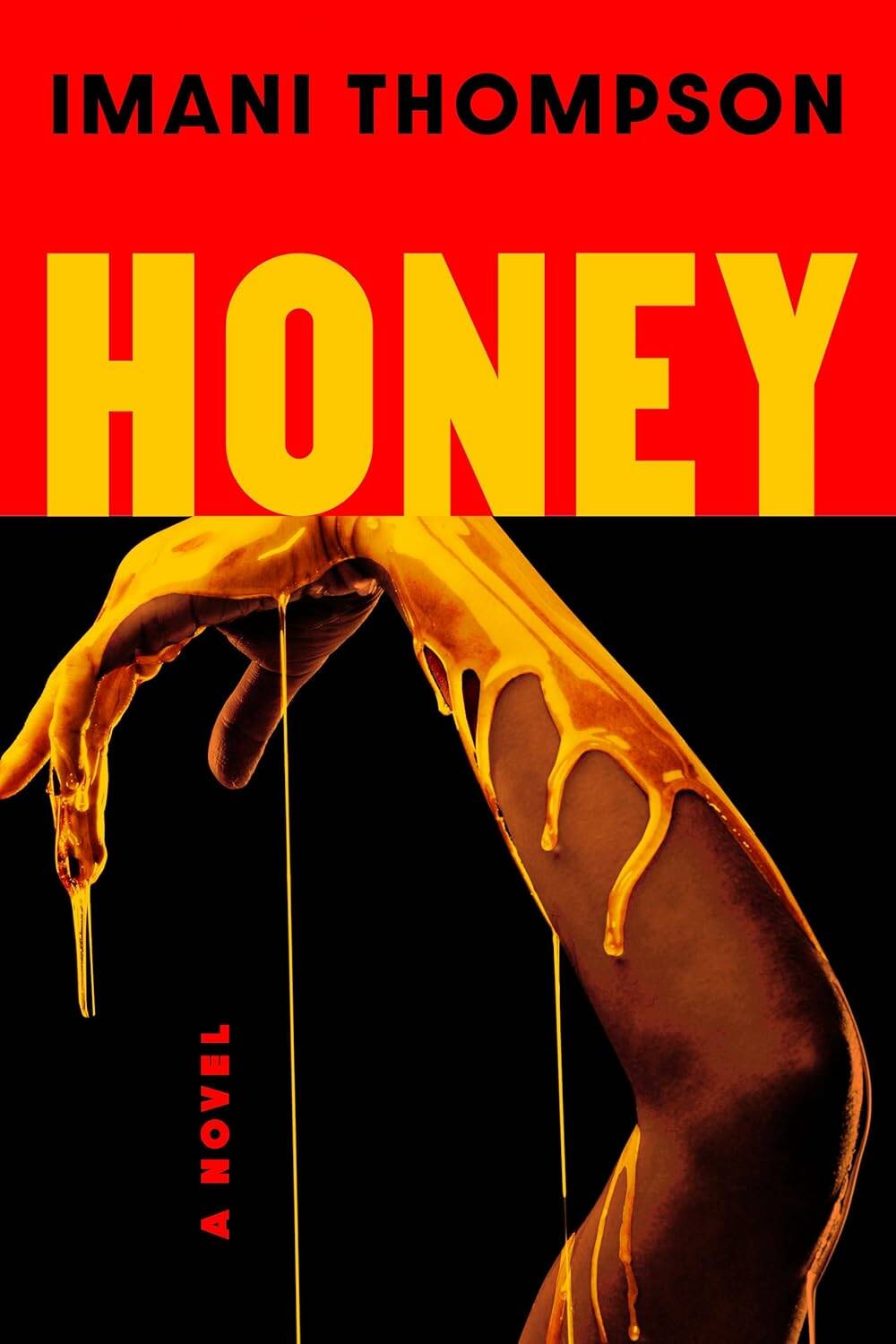
Honey
But as the novel progresses, flaws in Yrsa’s reasoning begin to show, even as her murderous impulse escalates. Earlier traumas begin to surface, and Yrsa’s comfort with dispatching bad actors takes on a different meaning.
While some reviews have found the ending divisive, for this reviewer the last chapter was Honey’s most chilling — what Yrsa is truly capable of, and what she is able to rationalize to herself, is put on full display.
While there are no shortage of dark academia stories out there, especially in the current horror boom, Honey is a standout debut, one that takes some genuine risks and leaves the reader to grapple with the moral implication of cheering Yrsa on.
Keith Cadieux is a Winnipeg writer and editor. His latest story collection Donner Parties and Other Anti-Social Gatherings is out now from At Bay Press. He also co-edited the horror anthology What Draws Us Near, published by Little Ghosts Books.