Balance through imbalance
Dave Eggers’ stunning new novel ruminates on friendship, art and the tension between conception and creation
Advertisement
Read this article for free:
or
Already have an account? Log in here »
To continue reading, please subscribe:

Digital Subscription
One year of digital access for only $205*
- Enjoy unlimited reading on winnipegfreepress.com
- Read the E-Edition, our digital replica newspaper
- Access News Break, our award-winning app
- Play interactive puzzles
*First annual payment billed as $205.00 + GST for one year. This annual subscription will automatically renew at $233.00 + GST every 52 weeks (10% off the regular annual price of $259.35). Offer available to new and qualified returning subscribers only. Cancel any time.
To continue reading, please subscribe:
Add Free Press access to your Brandon Sun subscription for only an additional
$1 for the first 4 weeks*
- Enjoy unlimited reading on winnipegfreepress.com
- Read the E-Edition, our digital replica newspaper
- Access News Break, our award-winning app
- Play interactive puzzles
*Your next Brandon Sun subscription payment will increase by $1.00 and you will be charged $17.95 plus GST for four weeks. After four weeks, your payment will increase to $24.95 plus GST every four weeks.
Read unlimited articles for free today:
or
Already have an account? Log in here »
It’s a funny thing to review a book. There’s an obligation to tell readers what it’s about, to summarize the plot without giving too much away and to evaluate whether it deserves their time. Yet sometimes a book is so wonderful you just want to scream at everyone, “Read this thing now,” and consider it a service rendered. Such is the case with Dave Eggers’ latest novel Contrapposto.
This might sound like an overreaction, but if your goal is to be moved beyond measure and to spend a few hundred wonderfully written pages wrestling with sharply observed questions about art, talent, friendship, ambition, happiness and the meaning of success, then you’ve found your next read.
Eggers is the prolific San Francisco-based author behind numerous works including A Heartbreaking Work of Staggering Genius, You Shall Know Our Velocity and A Hologram for the King. He’s also published short fiction collections, children’s books, co-founded the literary journal/ publishing house/website McSweeney’s and established himself as a respected visual artist. Contrapposto represents the meeting point of his literary and artistic passions.

Mark Davis photo
Dave Eggers has written in a range of genres since his 2000 breakout memoir A Heartbreaking Work of Staggering Genius.
The title of the novel offers the perfect entry point. Contrapposto is the relaxed pose common in classical sculpture in which the body’s weight shifts onto one leg, creating a natural asymmetry. (Think Venus de Milo or Michelangelo’s David.) That balance through imbalance becomes the defining shape of the novel’s central, lifetime-spanning relationship between Robert “Cricket” Dibb and Olympia Argyros.
When they meet, Cricket and Olympia are opposites in almost every way. Cricket’s childhood is marked by abuse, while Olympia grows up in a privileged, if fractured, home. He is introspective, thoughtful and quietly gifted as an artist. She is fearless, charismatic and overflowing with ideas.
Over the long years of their relationship, that quiet/loud dynamic never quite abates, though it carries them through unexpected, sometimes painful turns and across vast geographies. Their union is sometimes playful, sometimes intimate, but always emotionally intense. Through it all, Olympia and Cricket are never quite together, yet never truly apart.
Told through Cricket’s point of view, the novel follows both characters through the decades of artistic lives. While their relationship is beautifully realized, Eggers also uses their friendship to explore larger questions: What is talent worth without imagination? Is craft enough on its own? Is an artist defined by technical ability or by ideas and enthusiasm? Is there a meaningful distinction between an artist and an artisan?
One of the novel’s most compelling thought experiments asks whether someone with extraordinary technical skill who expresses that talent by producing flawless copies deserves more admiration than someone with mediocre technique but transformative ideas. Eggers never offers tidy answers. Instead, he invites readers into an ongoing conversation about where art really resides — in the idea, the execution, or perhaps in the simple act of making something at all.
As one character observes, “The one thing that will always be true… is that the idea matters. You can have all the skill in the world, but without an idea — something that delights or challenges the mind — it probably falls short of being art.”
Yet Contrapposto never feels like a manifesto arguing that ideas trump craftsmanship or that inspiration outweighs labour. If anything, Eggers is fascinated by the uneasy tension between conception and creation. As he later observes of Cricket, “The idea of creation was delicious, pure pleasure, while the execution of that idea was so often an unendurable slog ending in tragic disappointment.”
Few books capture so honestly the push and pull between the exhilaration of imagining and creating something and the possible letdown that comes with seeing it realized. The novel doesn’t resolve that tension so much as suggest that the joy of creating, the search for meaning behind the creation and the feeling of loss on seeing it completed are inseparable parts of an artistic life. Anyone who has ever written, painted, built, composed or simply tried to make something meaningful will likely find themselves nodding along in recognition.
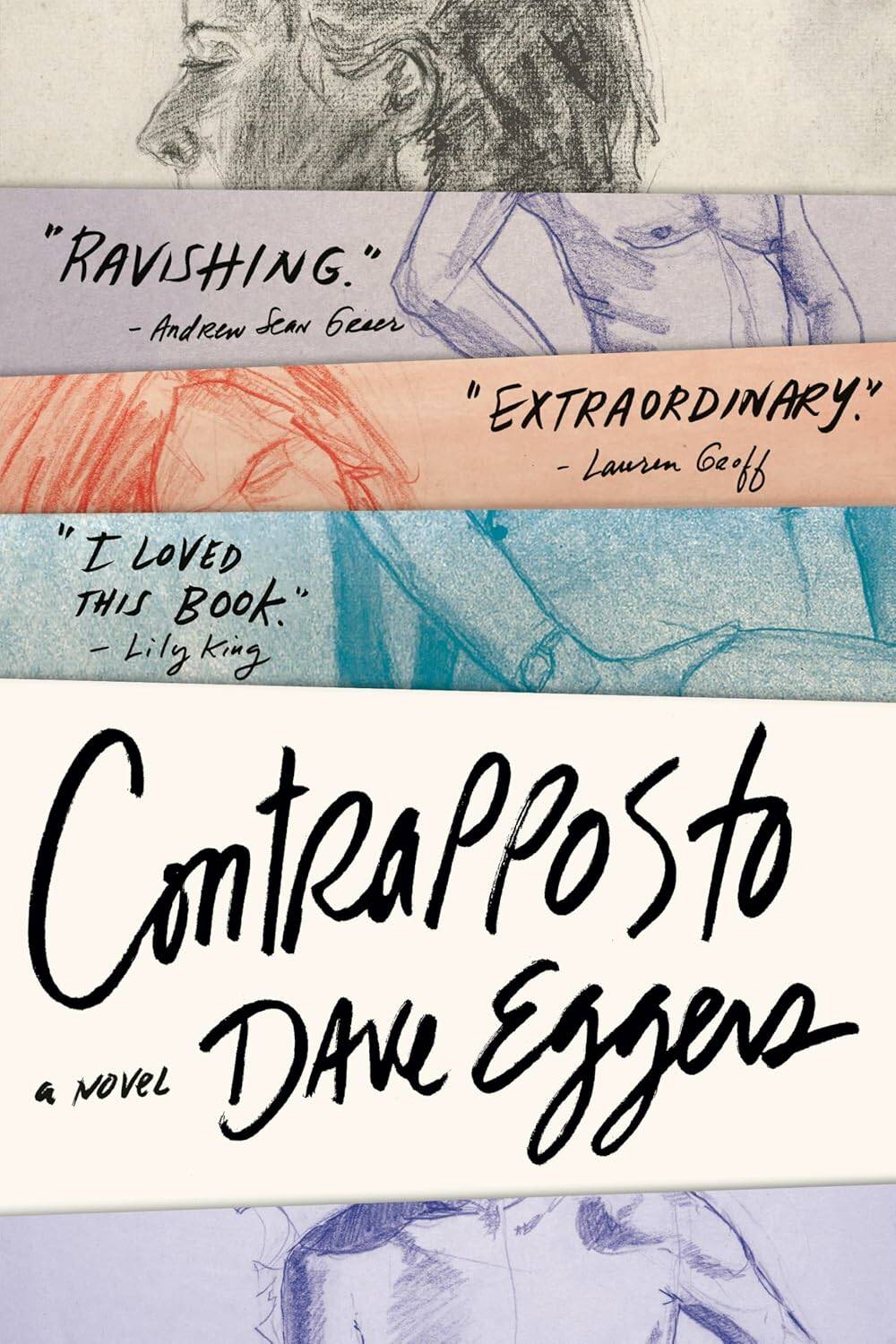
Contrapposto

That’s the remarkable quality of Contrapposto. If you can get onto its wavelength, it feels less like a novel delivering answers than one inviting you into a conversation. It asks what success means — not only in art, but in life. Is success recognition? Money? Mastery? Or is it simply continuing to create because the act itself remains worthwhile?
Eggers writes with warmth, wit and remarkable generosity toward his characters. The book is funny, heartbreaking, insightful and quietly profound. By the end, Cricket and Olympia feel less like fictional characters than people you’ve known your entire life.
Contrapposto isn’t simply a novel about art and artists. It’s a love story about the people we become through the act of creating and through the relationships that shape us.
It’s touching, painful, joyful and wonderfully alive. It left this reader thinking not only about art, but about the reasons we make anything in the first place — including, and especially, friendships. With his latest, Eggers has given us all something lovely and profound — a gift, an astonishment, a delight.
Scott Montgomery is a Winnipeg-based writer and critic with a background in television, comedy and literature.