WEATHER ALERT

Justice denied

RCMP’s many shortcomings chronicled in account of N.S. massacre

Advertisement

Advertise with us

On April 18-19, 2020, 51-year-old denturist Gabriel Wortman murdered 22 people in and near the beachside community of Portapique, N.S.

Read this article for free:

or

Already have an account? Log in here »

To continue reading, please subscribe:

Subscribe and receive a limited-edition Free Press branded hat or tote.

Digital Subscription

One year of digital access for only $205*

  • Enjoy unlimited reading on winnipegfreepress.com
  • Read the E-Edition, our digital replica newspaper
  • Access News Break, our award-winning app
  • Play interactive puzzles

*First annual payment billed as $205.00 + GST for one year. This annual subscription will automatically renew at $233.00 + GST every 52 weeks (10% off the regular annual price of $259.35). Offer available to new and qualified returning subscribers only. Cancel any time.

To continue reading, please subscribe:

Add Free Press access to your Brandon Sun subscription for only an additional

$1 for the first 4 weeks*

  • Enjoy unlimited reading on winnipegfreepress.com
  • Read the E-Edition, our digital replica newspaper
  • Access News Break, our award-winning app
  • Play interactive puzzles
Start now

*Your next Brandon Sun subscription payment will increase by $1.00 and you will be charged $17.95 plus GST for four weeks. After four weeks, your payment will increase to $24.95 plus GST every four weeks.

Hey there, time traveller!
This article was published 14/05/2022 (1519 days ago), so information in it may no longer be current.

On April 18-19, 2020, 51-year-old denturist Gabriel Wortman murdered 22 people in and near the beachside community of Portapique, N.S.

For most of his killing spree, Wortman impersonated an RCMP officer by wearing a Mountie uniform and driving a replica RCMP vehicle. Armed with a Colt carbine rifle, a Ruger mini rifle, a Glock pistol, a Ruger pistol and a Smith & Wesson pistol, he shot all of his victims.

The massacre, to borrow author Paul Palango’s term, ended only when, while stopped at a gas station to refuel, two RCMP officers who’d also pulled in to gas up recognized and then fatally shot him.

Andrew Vaughan / The Canadian Press files
In this 2020 photo, a woman pays her respects at a roadside memorial in Portapique, N.S. after a shooting rampage that left 22 people dead.
Andrew Vaughan / The Canadian Press files In this 2020 photo, a woman pays her respects at a roadside memorial in Portapique, N.S. after a shooting rampage that left 22 people dead.

The attacks remain the deadliest homicidal rampage in Canadian history.

Author Paul Palango is a veteran investigative journalist. He started his career as a reporter with the Hamilton Spectator newspaper in the 1970s and subsequently spent 13 years (1977-1990) as a reporter and editor with the Globe and Mail.

His account of, and investigation into, the mass killing is highly critical of both the RCMP’s initial response to reports of the shooting spree and its post-massacre public stance and proffered version of the tragic events. He doesn’t shy away from using the term “cover-up” to describe the Mounties’ failed performance of their duties — most critically, by not preventing many of the deaths by intercepting Wortman early on — and the force’s subsequent public-relations attempts to put an exculpatory spin on its conduct.

Palango’s book was published concurrently with Nova Scotia’s public inquiry into the killing spree, officially dubbed the “Mass Casualty Commission.” In testimony in April of this year, the province’s chief medical examiner concluded that Wortman, in addition to being fatally shot by the RCMP constables, fired a bullet into his own temple.

Much of the inquiry testimony to date buttresses Palango’s criticisms.

Nova Scotia has a province-wide all-media “Alert Ready” warning system which could — and should — have been utilized to warn the public there was a heavily armed killer masquerading as a Mountie on the rampage. Instead, the RCMP used the online social-media site Twitter.

Most of Nova Scotia, and particularly rural Nova Scotia, isn’t on Twitter, so few heard the warnings. The RCMP’s failure to use its best warning system — a system that may well have saved at least some lives over the two fateful days the shootings lasted — has never been satisfactorily explained.

The RCMP also failed to set up roadblocks once they knew they had a mobile killer driving hither and yon on central Nova Scotia’s few highways and provincial roads.

Nor, according to Palango, did the Mounties summon help from municipal police forces in the nearby towns of Amherst and Truro to bolster their search for the killer. Instead, it sought assistance from New Brunswick RCMP, located several hours’ drive away from the area under attack.

Palango’s most controversial assertion is that Wortman was likely an RCMP informant which at best would be a massive embarrassment to the Mounties and, at worst, compromised their response when the killings started or their subsequent investigation into how and why the rampage occurred — or both.
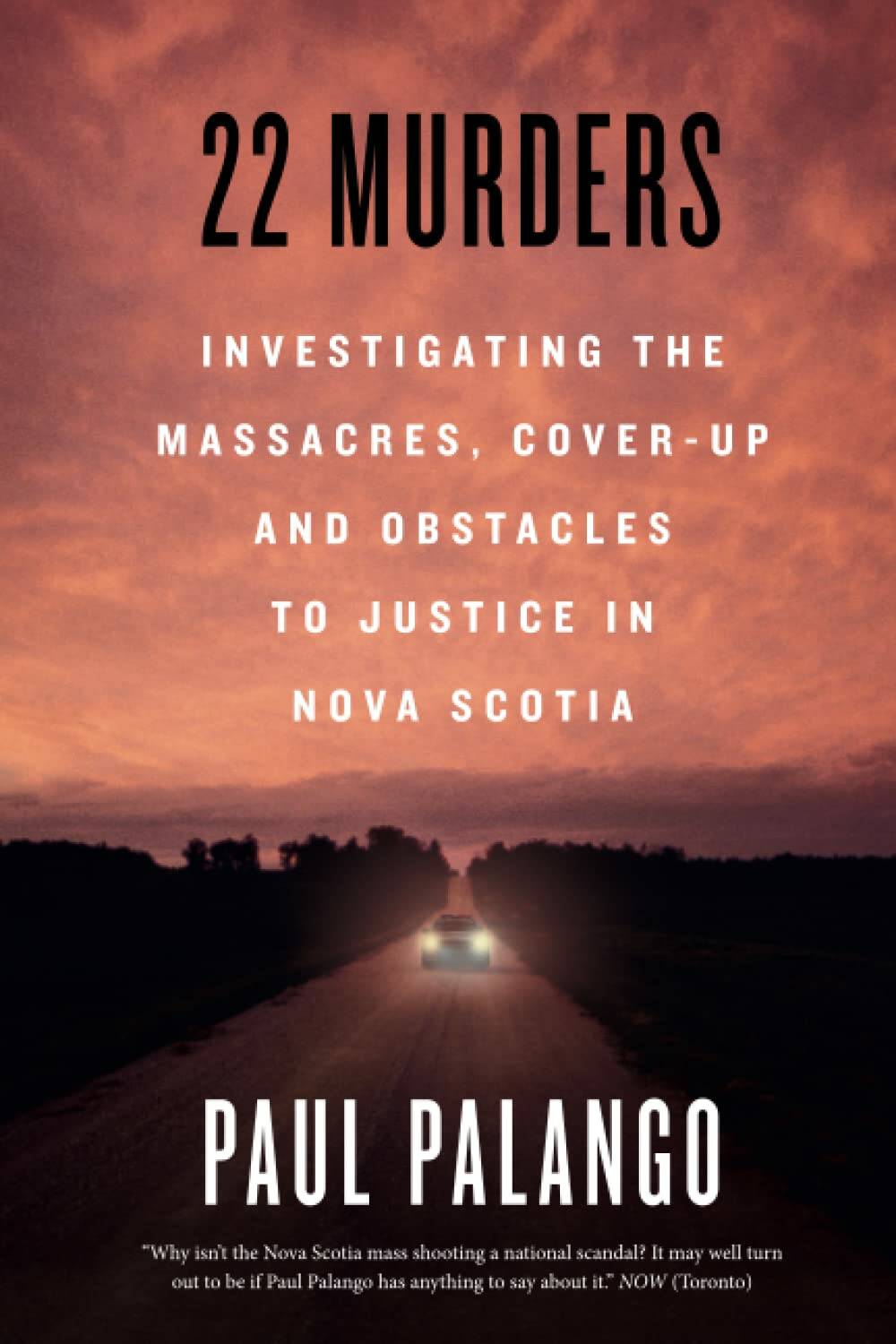
22 Murders
22 Murders

However, the evidence he’s gathered on this point, while intriguing, is largely circumstantial and conjectural. In strict legal terms, it’s what lawyers and judges would call less than probative.

Palango has written three prior books on the Mounties, and he’s forthright about being no fan of the institution and bureaucracy that is the RCMP. And at times he wears this animus on his sleeve.

Still, apart from a sometime tendency to move from grounded evidence to not-so-grounded conjecture, he has amassed a lot of research, and marshalled it well.

His principal object is to prove that 22 people needn’t have died over those two days in April 2020.

And in that object, he succeeds.

Douglas J. Johnston is a Winnipeg lawyer and writer.

Report Error Submit a Tip

More Stories

Convicted arsonist accused in Walmart blaze, caused $10M in damage

Erik Pindera 3 minute read Preview

Convicted arsonist accused in Walmart blaze, caused $10M in damage

Erik Pindera 3 minute read Thursday, Jul. 9, 2026

A convicted arsonist on probation is accused of setting a blaze inside the Walmart at St. Vital Centre on Monday that’s believed to have caused more than $10 million in damage.

“A fire was set in the middle of a busy place,” said Winnipeg Police Service spokesman Const. Claude Chancy.

“It’s a pretty rare incident. We don’t know what the motives were for the suspect committing this act, but (it’s) very lucky that no one was injured or hurt.”

Ronald Marmito Amigo, 47, was arrested by police bail compliance officers on the 300 block of Furby Street on Thursday. He had a small amount of methamphetamine and a lighter on him, police said.

Read
Thursday, Jul. 9, 2026

Police can’t arrest away city drug crisis

Tom Brodbeck 5 minute read 2:02 AM CDT

Winnipeggers have debated how to respond to the city’s worsening drug crisis for years.

There has never been much disagreement that open drug use, trafficking and disorder in public spaces are serious problems. The disagreement has been about how to respond without making a deadly crisis even worse.

The Winnipeg Police Service’s recent 10-day crackdown on open drug use has made one thing abundantly clear: while enforcing the law is entirely appropriate, the operation appears to have been poorly planned and insufficiently co-ordinated with the people who understand the crisis best.

Police have every right — and indeed an obligation — to enforce laws on drug trafficking and other criminal activity. Nobody should expect officers to simply ignore illegal behaviour on city streets.

Province has ‘serious concerns’ with Winnipeg personal care home

Tyler Searle 5 minute read Preview

Province has ‘serious concerns’ with Winnipeg personal care home

Tyler Searle 5 minute read Yesterday at 5:51 PM CDT

The Manitoba government has placed licensing conditions on a Winnipeg personal care home after an inspection uncovered “serious concerns” related to the safety of senior residents.

Health Minister Uzoma Asagwara confirmed the province issued the order against the Extendicare Heritage Lodge — an 86-bed nursing home at 3555 Portage Ave. — effective June 9.

“This is an important oversight tool, and it is not used lightly. Conditions are imposed when there are serious concerns that require enhanced oversight and clear, corrective action,” Asagwara said in a statement.

“Our expectation is simple: Extendicare must meet the standards Manitoba seniors and families deserve. We will continue working with the (Winnipeg Regional Health Authority) to monitor this facility closely and ensure the required improvements are made.”

Read
Yesterday at 5:51 PM CDT

Colourful folk festival campground a hive of creative activity

Eva Wasney 4 minute read Preview

Colourful folk festival campground a hive of creative activity

Eva Wasney 4 minute read Thursday, Jul. 9, 2026

The 51st annual Winnipeg Folk Festival had yet to commence, but festivities in the campground were already in full swing.

The festival campground opened early Wednesday morning and provides a temporary home to more than 6,000 residents during the four-day music festival at Birds Hill Provincial Park.

By Thursday afternoon, the area had been transformed into a sea of colourful tents and trailers. A steady stream of campers could be seen hauling wagons from the parking lot loaded with essentials: coolers and tarps, sleeping bags and sunscreen.

Others brought a little more than the basics.

Read
Thursday, Jul. 9, 2026

Carney’s pick for Manitoba senator called a curious choice

Carol Sanders 5 minute read Preview

Carney’s pick for Manitoba senator called a curious choice

Carol Sanders 5 minute read Thursday, Jul. 9, 2026

Manitoba’s newest representative in the Senate only moved to the province in 2019.

Unlike former Manitoba Senate candidates, Geeta Tucker hasn’t known this province for very long — and that’s raised the eyebrows of some experienced politicians and academics.

Retired Manitoba senator Don Plett said he hadn’t heard of Tucker until this week. The Conservative said he has nothing against her personally, but he questioned whether she knows Manitoba well enough to represent its interests in the chamber of sober second thought.

“I think it is imperative that you have strong roots to the region you’re representing,” Plett said Wednesday.

Read
Thursday, Jul. 9, 2026

MMF buys long-vacant federal lab

Scott Billeck 5 minute read Preview

MMF buys long-vacant federal lab

Scott Billeck 5 minute read Yesterday at 6:00 AM CDT

The Manitoba Métis Federation has taken another major step in its effort to help revitalize downtown Winnipeg by acquiring the former National Research Council property on Ellice Avenue.

The federation has scheduled a news conference today to announce it has purchased the office tower, laboratory and parking lot at 435-445 Ellice Ave. The acquisition expands its downtown footprint to more than one million square feet of owned property and will eventually house about 70 per cent of its 1,300 employees.

The sale ends a years-long legal dispute between the federation and the research council. The federation had sued the federal agency after an earlier agreement to purchase the property collapsed in 2020.

“Everybody’s happy, they’re happy, we’re happy. And now we just got to start the transition of our plan,” federation president David Chartrand told the Free Press Thursday.

Read
Yesterday at 6:00 AM CDT