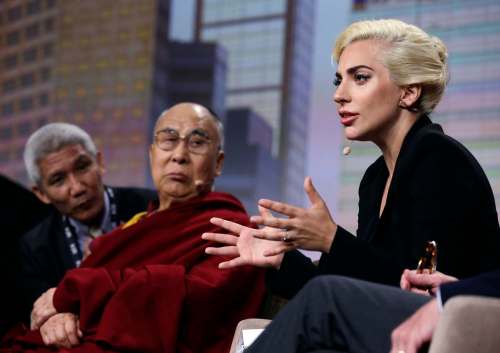
China bans Lady Gaga from its airwaves
Advertisement
Read this article for free:
or
Already have an account? Log in here »
To continue reading, please subscribe:

Digital Subscription
One year of digital access for only $205*
- Enjoy unlimited reading on winnipegfreepress.com
- Read the E-Edition, our digital replica newspaper
- Access News Break, our award-winning app
- Play interactive puzzles
*First annual payment billed as $205.00 + GST for one year. This annual subscription will automatically renew at $233.00 + GST every 52 weeks (10% off the regular annual price of $259.35). Offer available to new and qualified returning subscribers only. Cancel any time.
To continue reading, please subscribe:
Add Free Press access to your Brandon Sun subscription for only an additional
$1 for the first 4 weeks*
- Enjoy unlimited reading on winnipegfreepress.com
- Read the E-Edition, our digital replica newspaper
- Access News Break, our award-winning app
- Play interactive puzzles
*Your next Brandon Sun subscription payment will increase by $1.00 and you will be charged $17.95 plus GST for four weeks. After four weeks, your payment will increase to $24.95 plus GST every four weeks.
Read unlimited articles for free today:
or
Already have an account? Log in here »
Hey there, time traveller!
This article was published 02/07/2016 (3728 days ago), so information in it may no longer be current.
Lady Gaga made a friend last Sunday while angering a nation’s leaders.
Before the Dalai Lama was set to deliver the keynote address at the annual United States Conference of Mayors in Indianapolis, the 81-year-old Buddhist leader met with the 30-year-old pop star.
The Dalai Lama fielded questions Lady Gaga (the stage name of Stefani Germanotta) had sourced from fans on social media. The result was a nearly 20-minute-long conversation, now posted to Facebook and viewed more than three million times, that meandered through suicide, yoga, meditation, and advice on how to face the current horrors of the world. “Whatever happens,” the Dalai Lama said, “hope and self-confidence are essential.”

But to Chinese officials who view the Dalai Lama as a Tibetan separatist — and in December tried to paint him as a supporter of the Islamic State — the meeting was more sinister than it seemed.
“The purpose of his visits and activities in other countries is just to promote his proposal for Tibetan independence,” said Hong Lei, a representative for China’s Foreign Ministry, according to the Associated Press.
For nearly six decades, since a Tibetan revolution against China failed in 1959, the Dalai Lama has been in exile from his homeland. In 2009, the Dalai Lama said China had made Tibetan life “hell on Earth,” according to CNN; in 2011, a Communist party chief reiterated the famous epithet the Dalai Lama is a “wolf in monk’s robes.”
Lady Gaga’s friendliness toward the spiritual leader means she, too, has incurred the Chinese government’s wrath. The State Administration of Press, Publication, Radio, Film and Television now legally forbids Lady Gaga and her music from appearing on Chinese radio or TV. Her downloadable albums will be removed from online stores.

In a translation of a report on Hong Kong newspaper Apple Daily, the Guardian said Lady Gaga had been added to a “list of hostile foreign forces.” This is no insignificant threat, as the musician is arguably the most popular western singer in China, according to the BBC. On social media, Lady Gaga was both applauded for meeting with the Dalai Lama and excoriated by Chinese fans who say she gave them up.
It is not the first time China has censored Lady Gaga. She was subject to a three-year ban that ended in 2014, though that was because her music posed a threat to Chinese “cultural security” rather than because of meeting with political figures.
Nor is she the first popular act from the West to be restricted from Middle Kingdom airwaves for perceived Tibetan sympathies. The Wall Street Journal reported Chinese officials began taking a harder look at western musicians after Icelandic singer Bjork shouted “Tibet! Tibet!” at a Shanghai venue in 2008. A year later, the British band Oasis was banned, perhaps because guitarist Noel Gallagher performed at a Free Tibet concert in 1997. This prompted some Chinese observers, according to the Journal, to begin calling the bans “getting Bjork’d.”
In the past year, artists as diverse as Bon Jovi and Selena Gomez have cancelled concerts in China, possibly for supporting the Dalai Lama — or, in the case of the band Maroon 5, attending his birthday party.
— Washington Post