Wild-looking and sustainable is the trend in garden design

Advertisement

Advertise with us

Whether it's on an enormous estate or outside a little house, the modern garden aims for wild-looking landscapes, native species and seamless transitions to natural surroundings, according to a new book featuring the work of prominent contemporary garden designers.

Read this article for free:


or

Already have an account? Log in here »

To continue reading, please subscribe:

Subscribe and receive a limited-edition Free Press branded hat or tote.

Digital Subscription

One year of digital access for only $205*

  • Enjoy unlimited reading on winnipegfreepress.com
  • Read the E-Edition, our digital replica newspaper
  • Access News Break, our award-winning app
  • Play interactive puzzles

*First annual payment billed as $205.00 + GST for one year. This annual subscription will automatically renew at $233.00 + GST every 52 weeks (10% off the regular annual price of $259.35). Offer available to new and qualified returning subscribers only. Cancel any time.

To continue reading, please subscribe:

Add Free Press access to your Brandon Sun subscription for only an additional

$1 for the first 4 weeks*

  • Enjoy unlimited reading on winnipegfreepress.com
  • Read the E-Edition, our digital replica newspaper
  • Access News Break, our award-winning app
  • Play interactive puzzles
Start now

*Your next Brandon Sun subscription payment will increase by $1.00 and you will be charged $17.95 plus GST for four weeks. After four weeks, your payment will increase to $24.95 plus GST every four weeks.

Hey there, time traveller!
This article was published 30/04/2019 (2713 days ago), so information in it may no longer be current.

Whether it’s on an enormous estate or outside a little house, the modern garden aims for wild-looking landscapes, native species and seamless transitions to natural surroundings, according to a new book featuring the work of prominent contemporary garden designers.

In “Garden Wild: Wildflower Meadows, Prairie-Style Plantings, Rockeries, Ferneries, and Other Sustainable Designs Inspired by Nature” (Rizzoli), photographer Andre Baranowski explores a dozen very different gardens — all of them mostly devoid of manicured lawns and fussy pruning.

The focus, instead, is on sustainability and plant diversity. Featured garden designers include Oehme van Sweden, Fernando Caruncho, Jorge Sanchez and Piet Oudolf.
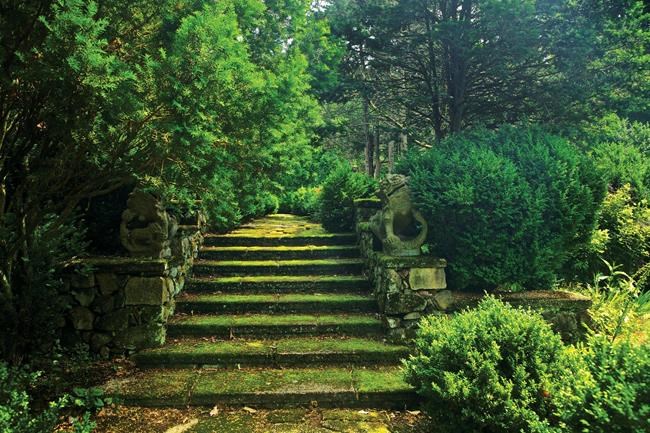
This photo provided by Rizzoli Press shows moss-covered steps guarded by a pair of centuries-old Chinese dragons in Greenwood Gardens, Short Hills, N.J. The photograph is featured in the book
This photo provided by Rizzoli Press shows moss-covered steps guarded by a pair of centuries-old Chinese dragons in Greenwood Gardens, Short Hills, N.J. The photograph is featured in the book "Garden Wild: Wildflower Meadows, Prairie-Style Plantings, Rockeries, Ferneries, and Other Sustainable Designs Inspired by Nature" by Andre Baranowski. (Andre Baranowski/Rizzoli Press via AP)

Each chapter explores a single garden, explaining the designer’s approach, the challenges posed and garden highlights, with an eye to inspiring home gardeners to try their hand at this more natural-looking approach.

“Tons of money still goes into fertilizers and weed killers for traditional-style manicured lawns, but I’m trying to show people that weeds can be quite beautiful. They can be stunning. Gardens can be gorgeous and sustain wildlife, and at the same time be easier to maintain,” says Baranowski, who visited the 12 gardens hundreds of times, looking for the most evocative images.

“This wilder look is absolutely catching on,” he says.

The book begins with a garden in Water Mill, New York, designed in the 1980s by pioneering landscaper James van Sweden, co-founder with Wolfgang Oehme of the Oehme van Sweden firm. In a departure from the staid hedges, boxwoods and perennial borders that dominated the East End of Long Island at the time, von Sweden planted low-maintenance grasses and other native plants, and plants appropriate for the seascape like lavender, sedums, willows and magnolias.

Bringing native grasses right up to the pool’s edge was considered revolutionary at the time, Baranowski says.

In a garden in East Hampton, New York, Eric Groft, of the firm Oehme van Sweden, screened out traffic using ornamental grasses, which have the added benefit of deterring deer, the book says.

Plantings focused on green, gold and purple shrubs, perennials, and grasses that thrive in the local microclimate, with annuals appearing only in pots. Mature old elms, flowering dogwoods and black locusts were left in place to give the garden a more established look.

In New York’s Lower Hudson Valley area, meanwhile, landscape designer Kathy Moreau designed and refreshed several gardens on an expansive property, in one area creating a garden meant to be walked on — ideally with bare feet. While stepping stones suggested the walking path, ground cover like sedum, mosses and periwinkle (to add colour) were chosen specifically to delight the feet.

Throughout the property, Moreau replaced invasive plants with native or sustainable plantings — “sustainable in the sense that they attract pollinators and do not require a lot of extra water or nutrients,” she says in the book.
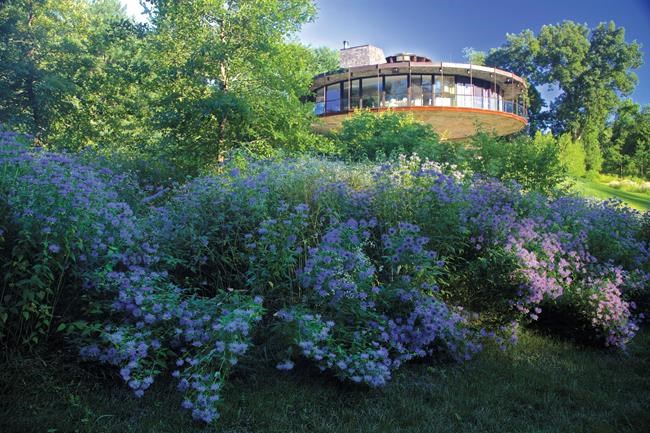
This photo provided by Rizzoli Press shows Round House by Richard Foster and a wild flower garden in Wilton, Conn. The photograph is featured in the book
This photo provided by Rizzoli Press shows Round House by Richard Foster and a wild flower garden in Wilton, Conn. The photograph is featured in the book "Garden Wild: Wildflower Meadows, Prairie-Style Plantings, Rockeries, Ferneries, and Other Sustainable Designs Inspired by Nature" by Andre Baranowski. (Andre Baranowski/Rizzoli Press via AP)

“With every garden, you have the chance to do more than provide a practical solution — for example, something pretty to look at, or screening from a neighbour,” she says. “The best landscape design does that and more: it should be environmentally responsive and also artistic to fully engage both the people lucky enough to enjoy the garden and the breadth of other living things that depend on it.”

Most of the gardens featured are in New York or New Jersey, with the addition of one in Ashley Falls, Massachusetts, and one in Wilton, Connecticut.

The most public of the gardens featured is the High Line in New York City, inspired by the self-seeded landscape that grew up between the rail tracks after trains stopped running there in the 1980s.

Baranowski notes that despite the trend toward more natural-looking gardens, many of America’s suburban spaces continue to run to manicured lawns and hedges.

“If that could change, just a little bit, it could be so much more beautiful and wild,” he says wistfully.


Report Error Submit a Tip

More Stories

Gordon Bell rings in a century

Maggie Macintosh 13 minute read Preview

Gordon Bell rings in a century

Maggie Macintosh 13 minute read Updated: Yesterday at 8:06 PM CDT

Mischka Valencia had gotten used to the hum of heavy machinery at Gordon Bell High School.

“Ever since I’ve been here, it’s all been under construction,” the Grade 12 student said, standing on the sidelines of the brightly painted revamped outdoor basketball court. “I had no idea this was a court.”

The Filipina teenager landed in Winnipeg several months after the inner-city campus had transformed into a construction site.

It was the fall of 2023 and Mischka’s priorities were fitting in, befriending classmates and learning a third language via first-period French.

Read
Updated: Yesterday at 8:06 PM CDT

Nearly four in 10 Manitobans hope Canada restarts trade talks after U.S. midterm elections, poll reveals

Gabrielle Piché 4 minute read Preview

Nearly four in 10 Manitobans hope Canada restarts trade talks after U.S. midterm elections, poll reveals

Gabrielle Piché 4 minute read Yesterday at 7:00 AM CDT

Disorganized — that’s what Marcus Langlois calls recent United States tariffs.

He expects suppliers’ prices to increase — on mugs, pens, hoodies — for his employer, Dreamcatcher Promotions, if the United States–Canada trade war persists.

Still, he’s not pining for a quick trade deal.

“I think it should wait,” said Langlois, Dreamcatcher Promotions’ vice-president. “Let’s hope that it’s later on with proper negotiations happening.”

Read
Yesterday at 7:00 AM CDT

International flavour: Canadian investors may want to make like Ottawa, diversify beyond U.S.

Joel Schlesinger 6 minute read Preview

International flavour: Canadian investors may want to make like Ottawa, diversify beyond U.S.

Joel Schlesinger 6 minute read 2:01 AM CDT

Canada is learning the hard way about the dangers of putting too many eggs in its U.S. economic basket.

Much has been made about the need to diversify our economy away from the United States.

Diversification is understandably beneficial. The more varied streams of revenue a nation has, the less affected the economy will be when one of those sources is interrupted.

The same can be said about investment portfolios.

Read
2:01 AM CDT

Mayoral candidate Vogiatzakis criticized for living outside Winnipeg

Malak Abas 4 minute read Preview

Mayoral candidate Vogiatzakis criticized for living outside Winnipeg

Malak Abas 4 minute read Updated: Yesterday at 6:03 PM CDT

A mayoral hopeful took heat from other candidates Friday for living outside Winnipeg while running in the civic election.

Mike Vogiatzakis’s primary residence is in the Rural Municipality of St. Andrews, about 25 kilometres north of Winnipeg — a community with its own mayor and councillors.

But the funeral director said he owns a home in Winnipeg where he divides his time, and he would move to the city full-time if elected mayor.

“It doesn’t matter where a person lives. Why are we dividing St. Andrews and Manitoba and Winnipeg? I’ve met the criteria to run for mayor,” Vogiatzakis said Friday morning.

Read
Updated: Yesterday at 6:03 PM CDT

What’s luck got to do with it?

Tim Kist 5 minute read 2:01 AM CDT

We all seek certainty in our daily lives. We expect if we make a decision, the outcome will be just as we planned: a direct correlation between the decision and result.

You, as a business leader, seek the same certainty from the decisions you make. And sometimes, the result is what was expected. Sometimes, it isn’t.

The big question is: why is it so difficult to achieve the business results you expect when you carefully craft your plans and seemingly make good decisions?

The truth is we cannot predict the future. This means we almost never know precisely how customers will respond to a sales quote, what competitors are planning, and a myriad of other external variables at play.

Letters, Oct. 3

7 minute read 2:01 AM CDT

A morning in the life …

My very first lesson does not start when I walk into that lecture hall, oh no — it starts long before. It begins when I walk to my car, check the estimated arrival time to the University of Manitoba and hope that Winnipeg traffic agrees with it.

A drive that appears completely manageable changes almost immediately when I’m greeted by a tsunami of orange pylons and a line of cars that appears to go on forever. Traffic moves by the inch, lanes magically disappear and the detour I took yesterday now has a detour of its own. These factors make me do a calculation that I have become all too familiar with. How late can I arrive and still find parking, run to my class across campus and get to class with enough time left to make it worth it?

I have grown used to people saying, “Why not just leave earlier?” I do. But when I’m already leaving for my 8:30 a.m. class at 7 a.m., there’s only so much I can do. This drive that some would think is relaxing is one that feels like an assignment that I didn’t know I had to complete and is due at 8:30 a.m.