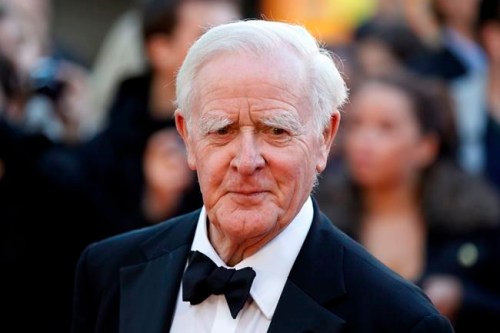
John le Carre, who probed murky world of spies, dies at 89
Advertisement
Read this article for free:
or
Already have an account? Log in here »
To continue reading, please subscribe:

Digital Subscription
One year of digital access for only $205*
- Enjoy unlimited reading on winnipegfreepress.com
- Read the E-Edition, our digital replica newspaper
- Access News Break, our award-winning app
- Play interactive puzzles
*First annual payment billed as $205.00 + GST for one year. This annual subscription will automatically renew at $233.00 + GST every 52 weeks (10% off the regular annual price of $259.35). Offer available to new and qualified returning subscribers only. Cancel any time.
To continue reading, please subscribe:
Add Free Press access to your Brandon Sun subscription for only an additional
$1 for the first 4 weeks*
- Enjoy unlimited reading on winnipegfreepress.com
- Read the E-Edition, our digital replica newspaper
- Access News Break, our award-winning app
- Play interactive puzzles
*Your next Brandon Sun subscription payment will increase by $1.00 and you will be charged $17.95 plus GST for four weeks. After four weeks, your payment will increase to $24.95 plus GST every four weeks.
Read unlimited articles for free today:
or
Already have an account? Log in here »
Hey there, time traveller!
This article was published 13/12/2020 (2099 days ago), so information in it may no longer be current.
LONDON – John le Carre, the spy-turned-novelist whose elegant and intricate narratives defined the Cold War espionage thriller and brought acclaim to a genre critics had once ignored, has died. He was 89.
Le Carre’s literary agency, Curtis Brown, said Sunday he died in Cornwall, southwest England on Saturday after a short illness. The agency said his death was not related to COVID-19. His family said he died of pneumonia
In classics such as “The Spy Who Came in from the Cold,” “Tinker Tailor Soldier Spy” and “The Honourable Schoolboy,” Le Carre combined terse but lyrical prose with the kind of complexity expected in literary fiction. His books grappled with betrayal, moral compromise and the psychological toll of a secret life. In the quiet, watchful spymaster George Smiley, he created one of 20th-century fiction’s iconic characters — a decent man at the heart of a web of deceit.
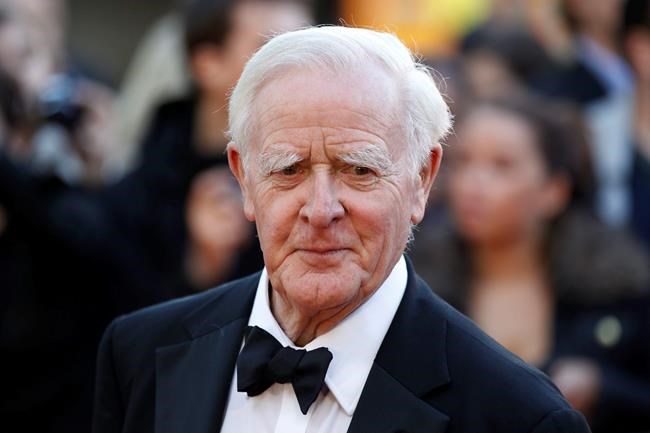
“John le Carre has passed at the age of 89. This terrible year has claimed a literary giant and a humanitarian spirit,” tweeted novelist Stephen King. Margaret Atwood said: “Very sorry to hear this. His Smiley novels are key to understanding the mid-20th century.”
For le Carre, the world of espionage was a “metaphor for the human condition.”
“I’m not part of the literary bureaucracy if you like that categorizes everybody: Romantic, Thriller, Serious,” le Carre told The Associated Press in 2008. “I just go with what I want to write about and the characters. I don’t announce this to myself as a thriller or an entertainment.
“I think all that is pretty silly stuff. It’s easier for booksellers and critics, but I don’t buy that categorization. I mean, what’s ‘A Tale of Two Cities?’ — a thriller?”
His other works included “Smiley’s People,” “The Russia House,” and, in 2017, the Smiley farewell, “A Legacy of Spies.” Many novels were adapted for film and television, notably the 1965 productions of “Smiley’s People’ and “Tinker Tailor” featuring Alec Guinness as Smiley.
Le Carre was drawn to espionage by an upbringing that was superficially conventional but secretly tumultuous.
Born David John Moore Cornwell in Poole, southwest England on Oct. 19, 1931, he appeared to have a standard upper-middle-class education: the private Sherborne School, a year studying German literature at the University of Bern, compulsory military service in Austria — where he interrogated Eastern Bloc defectors — and a degree in modern languages at Oxford University. But his ostensibly ordinary upbringing was an illusion. His father, Ronnie Cornwell, was a con man who was an associate of gangsters and spent time in jail for insurance fraud. His mother left the family when David was 5; he didn’t meet her again until he was 21.
It was a childhood of uncertainty and extremes: one minute limousines and champagne, the next eviction from the family’s latest accommodation. It bred insecurity, an acute awareness of the gap between surface and reality — and a familiarity with secrecy that would serve him well in his future profession.
“These were very early experiences, actually, of clandestine survival,” le Carre said in 1996. “The whole world was enemy territory.”
After university, which was interrupted by his father’s bankruptcy, he taught at the prestigious boarding school Eton before joining the foreign service.
Officially a diplomat, he was in fact a “lowly” operative with the domestic intelligence service MI5 —he’d started as a student at Oxford — and then its overseas counterpart MI6, serving in Germany, on the Cold War front line, under the cover of second secretary at the British Embassy.
His first three novels were written while he was a spy, and his employers required him to publish under a pseudonym. He remained “le Carre” for his entire career. He said he chose the name — square in French — simply because he liked the vaguely mysterious, European sound of it.
“Call For the Dead” appeared in 1961 and “A Murder of Quality” in 1962. Then in 1963 came “The Spy Who Came in From the Cold,” a tale of an agent forced to carry out one last, risky operation in divided Berlin. It raised one of the author’s recurring themes: the blurring of moral lines that is part and parcel of espionage, and the difficulty of distinguishing good guys from bad. Le Carre said it was written at one of the darkest points of the Cold War, just after the building of the Berlin Wall, at a time when he and his colleagues feared nuclear war might be imminent.
“So I wrote a book in great heat which said ‘a plague on both your houses,’” le Carre told the BBC in 2000.
It was immediately hailed as a classic and allowed him to quit the intelligence service to become a full-time writer.
His depictions of life in the clubby, grubby, ethically tarnished world of “The Circus” — the books’ code-name for MI6 — were the antithesis of Ian Fleming’s suave action-hero James Bond, and won le Carre a critical respect that eluded Fleming.
Smiley appeared in le Carre’s first two novels and in the trilogy of “Tinker, Tailor, Soldier, Spy,” “The Honorable Schoolboy,” and “Smiley’s People.”
Le Carre said the character was based on John Bingham — an MI5 agent who wrote spy thrillers and encouraged le Carre’s literary career — and the ecclesiastical historian Vivian Green, the chaplain of his school and later his Oxford college, “who became effectively my confessor and godfather.” The more than 20 novels touched on the sordid realities of spycraft but le Carre always maintained there was a kind of nobility in the profession. He said in his day spies had seen themselves “almost as people with a priestly calling to tell the truth.”
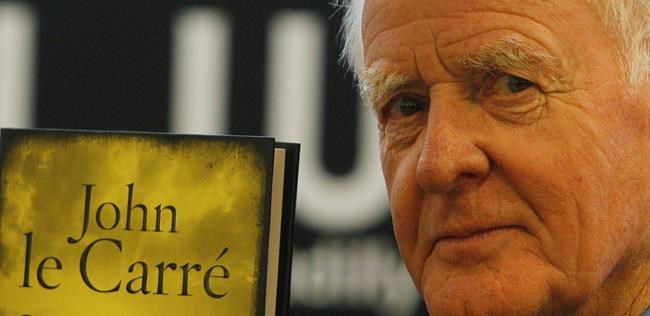
“We didn’t shape it or mould it. We were there, we thought, to speak truth to power.”
“A Perfect Spy,” his most autobiographical novel, looks at the formation of a spy in the character of Magnus Pym, a boy whose criminal father and unsettled upbringing bear a strong resemblance to le Carre’s own.
His writing continued unabated after the Cold War ended and the front lines of the espionage wars shifted. Le Carre said in 1990 that the fall of the Berlin Wall had come as a relief. “For me, it was absolutely wonderful. I was sick of writing about the Cold War. The cheap joke was to say, ‘Poor old le Carre, he’s run out of material; they’ve taken his wall away.’ “The spy story has only to pack up its bags and go where the action is.”
That turned out to be everywhere. “The Tailor of Panama” was set in Central America. “The Constant Gardener,” which was turned into a film starring Ralph Fiennes and Rachel Weisz, was about the pharmaceutical industry’s machinations in Africa.
“A Most Wanted Man,” published in 2008, looked at extraordinary rendition and the war on terror. “Our Kind of Traitor,” released in 2010, took in Russian crime syndicates and the murky machinations of the financial sector.
There was more to come, including a memoir, “The Pigeon Tunnel,” and novels “A Delicate Truth” and “Agent Running in the Field.” The last, published in 2019, brought his stories of duplicity and deceit into the era of Brexit and Donald Trump.
There were many film and television adaptations of his work over the decades, in recent years of high quality. Recent examples included a big screen version of “Tinker Tailor Soldier Spy” starring Gary Oldman as Smiley, and television miniseries of “The Night Manager” and “The Little Drummer Girl.”
Le Carre reportedly turned down an honour from Queen Elizabeth II — though he accepted Germany’s Goethe Medal in 2011 — and said he did not want his books considered for literary prizes.
In later years he was a vocal critic of the government of Tony Blair and its decision, based partly on hyped-up intelligence, to go to war in Iraq. He criticized what he saw as the betrayals of the post-World War II generation by successive British governments.
“The changes that I was promised since I was about 14 — I remember being told when Clement Atlee became prime minister and (Winston) Churchill was slung out after the war that that would be the end of the (private) school system and the monarchy,” he said in 2008.
“How can we have achieved the poverty gap that we have in this country? It’s simply unbelievable.”
In 1954, le Carre married Alison Sharp, with whom he had three sons before they divorced in 1971. In 1972 he married Jane Eustace, with whom he had a son, the novelist Nick Harkaway.
Although he had a home in London, le Carre spent much of his time near Land’s End, England’s southwesternmost tip, in a clifftop house overlooking the sea. He was, he said, a humanist but not an optimist.
“Humanity — that’s what we rely on. If only we could see it expressed in our institutional forms, we would have hope then,” he told the AP. “I think the humanity will always be there. I think it will always be defeated.”
Le Carre is survived by his wife and sons Nicholas, Timothy, Stephen and Simon.