Queen Elizabeth’s coronation lifted Britain’s post-war gloom
Advertisement
Read this article for free:
or
Already have an account? Log in here »
To continue reading, please subscribe:
Digital Subscription
One year of digital access for only $1.44 a week*
- Enjoy unlimited reading on winnipegfreepress.com
- Read the E-Edition, our digital replica newspaper
- Access News Break, our award-winning app
- Play interactive puzzles
*Billed as $5.77 plus GST every four weeks. After 52 weeks, price increases to the regular rate of $19.95 plus GST every four weeks. Offer available to new and qualified returning subscribers only. Cancel any time.
To continue reading, please subscribe:
Add Free Press access to your Brandon Sun subscription for only an additional
$1 for the first 4 weeks*
- Enjoy unlimited reading on winnipegfreepress.com
- Read the E-Edition, our digital replica newspaper
- Access News Break, our award-winning app
- Play interactive puzzles
*Your next Brandon Sun subscription payment will increase by $1.00 and you will be charged $17.95 plus GST for four weeks. After four weeks, your payment will increase to $24.95 plus GST every four weeks.
Read unlimited articles for free today:
or
Already have an account? Log in here »
Hey there, time traveller!
This article was published 28/04/2023 (1270 days ago), so information in it may no longer be current.
LONDON (AP) — In 1953, London was still recovering from World War II. The city was pockmarked with bomb damage, food supplies were tight and life was dull for children who had never eaten anything so exotic as a banana.
But the coronation of Queen Elizabeth II helped lift the gloom.
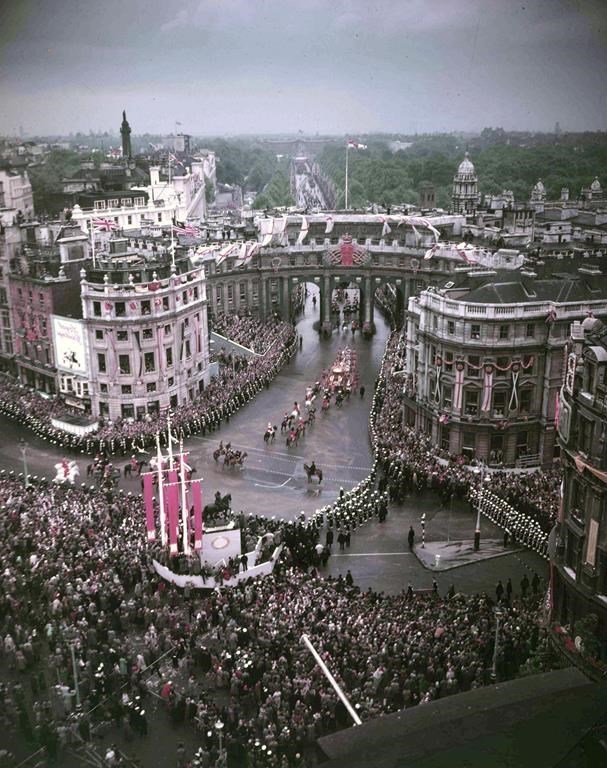
Central London buzzed with activity as workers built temporary stands along the 5-mile route of the queen’s procession. Giant crowns were suspended from arches that soared over The Mall approaching Buckingham Palace, and shopkeepers filled their windows with colorful banners and coronation-themed products.
With Elizabeth’s son, King Charles III, set to be crowned on May 6, people are recalling his mother’s coronation 70 years ago, which was the last time the British public witnessed the ritual.
“The whole of London was sort of a cauldron of people rushing to the area to look at what was happening,” said James Wilkinson, then an 11-year-old member of the Westminster Abbey choir, which sang during the ceremony.
A FRONT-ROW SEAT
Wilkinson’s memories of those events begin more than a year before the coronation.
The choristers, all of whom attended a special boarding school for choir members, were in a Latin lesson when the abbey’s great tenor bell began to toll every minute, and the Union flag was lowered to half staff.
“The headmaster came in and told us that the king had died,’’ Wilkinson said. “And, of course, what excited us then was the fact that there would be new coins and stamps with the queen’s head on them, because we all collected stamps.”
The initial buzz was followed by the realization that there would be a coronation.
The choristers spent months preparing for the service, learning the music and lyrics to the hymns they would sing during the three-hour long ceremony. The abbey was closed to get ready.
Tiers of temporary seating were installed to quadruple the abbey’s capacity to accommodate 8,251 guests, a temporary annex was built outside to provide space for the participants to don their robes and get ready for the procession, and preparations were made to broadcast the event on the still emerging medium of television.
Wilkinson, now 81, remembers being stunned when the choristers entered the church for their first on-site rehearsal a few weeks before the coronation.
“We hadn’t been into the abbey for a long time, and I was absolutely astonished by the sight of it because it was … transformed inside with wonderful new carpets and balconies,” he said. “There (were) the television lights for the filming, which made the whole thing sparkle.”
A MOMENT OF EMPIRE
More than 4,000 miles away on the Caribbean island of Dominica, in what was still a corner of the British Empire, children were also preparing for the crowning of the glamorous young woman who was their queen, too.
Sylius Toussaint, now 83, still remembers the coronation song he learned seven decades ago, chuckling as he softly croons out the blessing for “our queen who is crowned today,” only occasionally stumbling over a phrase lost to the passage of time.
“When in the dust of the abbey brown, and bells ring out in London town, the queen who is crowned with a golden crown, may be crowned, may be crowned, be crowned with thy children’s love,” he concludes. “Heheheh. Yes, I remember that!”
There were no TVs in the village of St. Joseph, about 10 miles from the capital, Roseau, so the adults huddled around two radios to follow events in London.
For Toussaint and his friends, it was a day of food, games and patriotic songs, just like on Empire Day, the annual holiday created at the turn of the last century to remind children in the United Kingdom’s far-flung outposts that they were British.
They played cricket and rounders, drank ginger beer and ate cake sweet with margarine and coconut, Toussaint said. The Boy Scouts marched, and there were three-legged races.
“This is what it was for the queen’s coronation,” he said. “People were talking about her and so on, and we always wished to see her … We were brought up as British; we were proud to be British.”
It was only later, when he moved to Preston in northern England to work in the city’s textile mills, that Toussaint learned about racism. Then several years ago the U.K. government forced Toussaint and his wife to apply for British citizenship, dashing the illusions of the child who once sang about “our queen.”
Thousands of people from the Caribbean were caught up in a government crackdown on immigration, with many losing jobs, housing and benefits if they were unable to produce documents proving their right to be in the country. The government was forced to apologize and pay compensation for what became known as the Windrush Scandal, named after the ship that brought the first Caribbean migrants to Britain in 1948.
But Toussaint blames Britain’s elected government for the scandal, not the monarchy. And despite the country’s problems, he plans to watch the coronation of King Charles III on May 6.
“All told, I am pleased to be able to say, ‘Charles, you are king. God bless you and do a good job.’ Because that’s the system we have until we can come up with something better, that’s where we are. And I’m willing to celebrate it with my neighbors and friends.”
AN AIRMAN’S APPRECIATION
Max Hancock, a 19-year-old from Sparks, Georgia, was a U.S. airman stationed at RAF Brize Norton near Oxford at the time of the coronation.
As Americans, Hancock and his buddies had no allegiance to the British monarch, but they knew the coronation would be a historic event so they made the 70-mile trip to London by bus and train, then joined the crowds hoping to see the queen pass by. On a misty, rainy day, an estimated 3 million people packed the sidewalks along the parade route lined with soldiers, sailors and airmen.
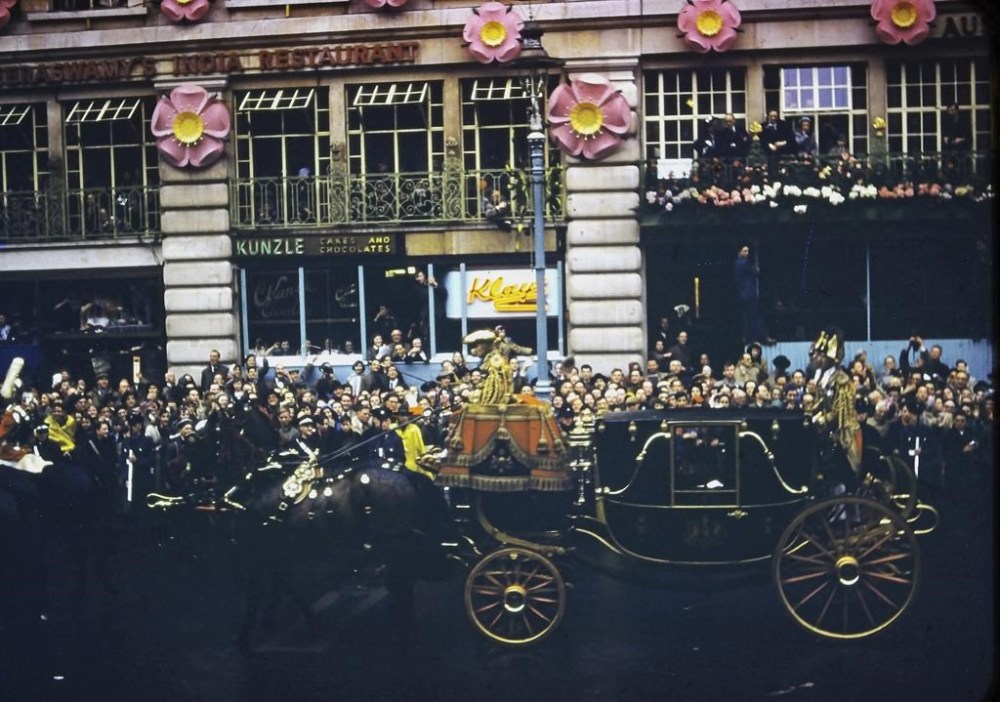
Staking out a position on Regent Street, even then a high-end shopping district, Hancock climbed up a barricade with his camera to get a better view as 46 marching bands, troops of cavalry, and carriages carrying Commonwealth dignitaries and members of the royal family passed by on their circuitous route from the Abbey to Buckingham Palace.
But he only had one roll of film — 25 frames — to capture the cavalcade in the era before smart phones and digital cameras, and he wanted to make sure he got one image of the queen.
Then, up ahead, he saw a carriage that was “the most beautiful thing I thought I’d ever seen,” so he snapped off three or four quick shots thinking it must be Elizabeth. But it turned out to be her sister, Princess Margaret, and the queen mother.
He only had two frames left.
When the golden state coach, pulled by eight white horses and surrounded by liveried footmen, came into view, he knew it was time to use them.
“Though I thought that the queen mother’s was great, it didn’t compare with the queen’s — it was all gold,” Hancock remembered.
“And as I’ve said many times, as I think back on it, I’ve never thought of her being a very great beauty queen, but she was the most beautiful woman I’ve ever seen in the world when she rode by there in that chariot.”
With understandable pride, Hancock showed the slides an elementary school in southern Georgia so he could give the kids a closeup view of history. And when the queen died in September, his local newspaper, the Moultrie Observer, told the story of the day a local boy went to the coronation.
“Seeing that parade, seeing the enthusiasm, seeing the people that were there … it was overwhelming for me,” he said. “I knew I was seeing something special. I knew it would be, for the rest of my life, I’d remember it.”
A MOMENT NEVER TO FORGET

James Wilkinson knew he, too, was part of something extraordinary, so the future BBC journalist recorded everything he saw, in a looping script on the now-yellowed pages of his diary.
There was the ham sandwich, apple and hard candy each boy was given to keep his stomach from growling after the choir filed into the Abbey early in the morning, then waited for the ceremony to begin at 11:15 a.m. The lords and ladies in fur-trimmed state robes, some of whom stashed miniature bottles of whisky and brandy under their caps to fortify them as they waited. And the excitement that went through the crowd when a bustle of activity suggested the queen was on her way, only to be deflated when it turned out to be a troop of attendants with carpet sweepers tidying the way for her majesty.
But the climax for Wilkinson was when the Archbishop of Canterbury raised St. Edward’s Crown — with its purple velvet cap and solid gold frame topped with a bejeweled cross — high in the air, then lowered it slowly onto the queen’s head.
Sitting with the rest of the choir somewhere behind the queen’s right shoulder, he didn’t actually see the moment Elizabeth was crowned because her head was hidden behind the high, peaked back of the Coronation Chair. But he saw its journey to her head.
“I knew this was going to be a thing I should never forget, and I watched it very closely knowing that it was, you know, the highlight of the service and that’s how I remember it today,” he said. “It was a marvelous event.”