‘Oppenheimer’ stirs up conflicted history for Los Alamos and New Mexico downwinders

Advertisement

Advertise with us

LOS ALAMOS, N.M. (AP) — The movie about a man who changed the course of the world’s history by shepherding the development of the first atomic bomb is expected to be a blockbuster, dramatic and full of suspense.

Read this article for free:


or

Already have an account? Log in here »

To continue reading, please subscribe:

Subscribe and receive a limited-edition Free Press branded hat or tote.

Digital Subscription

One year of digital access for only $205*

  • Enjoy unlimited reading on winnipegfreepress.com
  • Read the E-Edition, our digital replica newspaper
  • Access News Break, our award-winning app
  • Play interactive puzzles

*First annual payment billed as $205.00 + GST for one year. This annual subscription will automatically renew at $233.00 + GST every 52 weeks (10% off the regular annual price of $259.35). Offer available to new and qualified returning subscribers only. Cancel any time.

To continue reading, please subscribe:

Add Free Press access to your Brandon Sun subscription for only an additional

$1 for the first 4 weeks*

  • Enjoy unlimited reading on winnipegfreepress.com
  • Read the E-Edition, our digital replica newspaper
  • Access News Break, our award-winning app
  • Play interactive puzzles
Start now

*Your next Brandon Sun subscription payment will increase by $1.00 and you will be charged $17.95 plus GST for four weeks. After four weeks, your payment will increase to $24.95 plus GST every four weeks.

Hey there, time traveller!
This article was published 19/07/2023 (1175 days ago), so information in it may no longer be current.

LOS ALAMOS, N.M. (AP) — The movie about a man who changed the course of the world’s history by shepherding the development of the first atomic bomb is expected to be a blockbuster, dramatic and full of suspense.

On the sidelines will be a community downwind from the testing site in the southern New Mexico desert, the impacts of which the U.S. government never has fully acknowledged. The movie on the life of scientist J. Robert Oppenheimer and the top-secret work of the Manhattan Project sheds no light on those residents’ pain.

“They’ll never reflect on the fact that New Mexicans gave their lives. They did the dirtiest of jobs. They invaded our lives and our lands and then they left,” Tina Cordova, a cancer survivor and founder of a group of New Mexico downwinders, said of the scientists and military officials who established a secret city in Los Alamos during the 1940s and tested their work at the Trinity Site some 200 miles (322 kilometers) away.
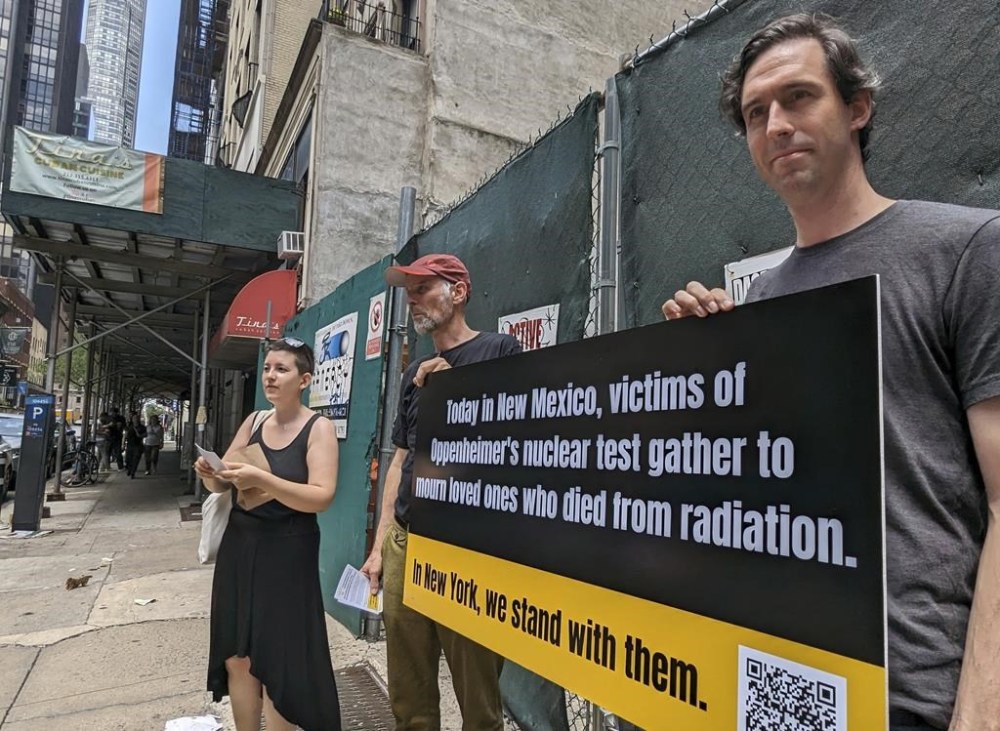
Matthew Bolton, right, and Jan-Christoph Zoels, center, hold a sign while rallying in New York City on July 15, 2023. Activists gathered to bring attention to residents in New Mexico who were exposed to radiation during the Trinity atomic test done in 1945 as part of the Manhattan Project. The rally proceeded a screening and panel discussion on the new film
Matthew Bolton, right, and Jan-Christoph Zoels, center, hold a sign while rallying in New York City on July 15, 2023. Activists gathered to bring attention to residents in New Mexico who were exposed to radiation during the Trinity atomic test done in 1945 as part of the Manhattan Project. The rally proceeded a screening and panel discussion on the new film "Oppenheimer." (Andrew Facini via AP)

Cordova’s group, the Tularosa Basin Downwinders Consortium, has been working with the Union of Concerned Scientists and others for years to bring attention to what the Manhattan Project did to people in New Mexico.

While film critics celebrate “Oppenheimer” and officials in Los Alamos prepare for the spotlight to be on their town, downwinders remain frustrated with the U.S. government — and now movie producers — for not recognizing their plight.

Advocates held vigils Saturday on the 78th anniversary of the Trinity Test in New Mexico and in New York City, where director Christopher Nolan and others participated in a panel discussion following a special screening of the film.

Nolan has called the Trinity Test an extraordinary moment in human history.

“I wanted to take the audience into that room and be there for when that button is pushed and really fully bring the audience to this moment in time,” he said in a clip being used by Universal Studios to promote the film.

The movie is based on Kai Bird and Martin J. Sherwin’s Pulitzer Prize-winning “American Prometheus: The Triumph and Tragedy of J. Robert Oppenheimer.” Nolan has said Oppenheimer’s story is both a dream and a nightmare.

Lilly Adams, a senior outreach coordinator with the Union of Concerned Scientists, participated in the New York City vigil and said it was meant to show support for New Mexicans who have been affected.

“The human cost of Oppenheimer’s Trinity Test, and all nuclear weapons activities, is a crucial part of the conversation around U.S. nuclear legacy,” she told The Associated Press in an email. “We have to reckon with this human cost to fully understand Oppenheimer’s legacy and the harm caused by nuclear weapons.”

In developing and testing nuclear weapons, Adams said the U.S. government effectively “poisoned its own people, many of whom are still waiting for recognition and justice.”

Adams and others have said they hope that those involved in making “Oppenheimer” help raise awareness about the downwinders, who have not been added to the list of those covered by the federal government’s compensation program for people exposed to radiation.

Government officials chose the Trinity Test Site because it was remote, flat and had predictable winds. Due to the secret nature of the project, residents in surrounding areas were not warned.

The Tularosa Basin was home to a rural population that lived off the land by raising livestock and tending to gardens and farms. They drew water from cisterns and holding ponds. They had no idea that the fine ash that settled on everything in the days following the explosion was from the world’s first atomic blast.

The government initially tried to hide it, saying that an explosion at a munitions dump caused the rumble and bright light, which could be seen more than 160 miles (257 kilometers) away.

It wasn’t until the U.S. dropped bombs on Japan weeks later that New Mexico residents realized what they had witnessed.

According to the Manhattan Project National Historical Park, large amounts of radiation shot up into the atmosphere and fallout descended over an area about 250 miles (402 kilometers) long and 200 miles (322 kilometers) wide. Scientists tracked part of the fallout pattern as far as the Atlantic Ocean, but the greatest concentration settled about 30 miles (48 kilometers) from the test site.

For Cordova and younger generations who are dealing with cancer, the lack of acknowledgement by the government and those involved with the film is inexcusable.

“We were left here to live with the consequences,” Cordova said. “And they’ll over-glorify the science and the scientists and make no mention of us. And you know what? Shame on them.”

In Los Alamos, more than 200 miles (321 kilometers) north of the Tularosa Basin, reaction to the film has been much different. The legacy of Oppenheimer and the Manhattan Project means Los Alamos is home to one of the nation’s premier national laboratories and has the highest percentage of people with doctorate degrees in the U.S.

Oppenheimer Drive cuts through the heart of Los Alamos, Hoppenheimer IPA is on tap at a local brewery and the physicist is the focus of an exhibit at the science museum, where some of his handwritten notes and ID card are displayed.

The city is hosting an Oppenheimer Festival that starts Thursday and runs through the end of July.

About 200 extras used in the film were locals, many of them Los Alamos National Laboratory employees.

During breaks, conversations among the extras centered on science and world problems, said Kelly Stewart, who works with Los Alamos County’s economic development division and was the film liaison when Nolan and his crew were on location at historic sites around town.

There’s a pride that’s woven into the town’s DNA, Stewart said, and it revolves around the lab’s work to address national security and global concerns.

The goal is to position Los Alamos as a place where people can begin to learn “the true stories” behind the events depicted in the film, Stewart said.

The county’s “Project Oppenheimer” effort began in early 2023 and has included forums, documentaries, art installations and exhibits to educate visitors about the science happening at the lab as well as the social implications of the Manhattan Project.

A special area will be set up during the festival where people can discuss the movie after seeing it.

She believes efforts to help people understand the community’s history will continue.

“There’s a huge interest here in our own community to keep revisiting that and discussing it,” she said.


Report Error Submit a Tip

More Stories

Two hospitalized in Osborne Village assault

1 minute read Updated: Yesterday at 10:12 AM CDT

Two people are in hospital and another two are in police custody after a serious assault in Osborne Village early Monday morning.

Winnipeg Police Service spokesman Const. Pat Saydak said officers were called to the assault scene on Osborne Street near River Avenue just after midnight.

Two people were rushed to hospital, one in critical condition and the other in stable condition.

Two individuals, both adults, were arrested by police. There's no word yet on charges.

A Selkirk woman was sentenced to two-and-a-half years in prison last week for nearly $500,000 in tax fraud, the Canada Revenue Agency says

Michele Gabrielle pleaded guilty to one count of fraud over $5,000 in provincial court in Selkirk on Friday, the CRA says.

The tax agency had uncovered a scheme in which Gabrielle fraudulently claimed Manitoba tax credits from 2016 and 2019. She also filed and amended returns for two family members and a romantic partner, using their names to commit further fraud.

She made false claims in 22 of her own returns and 33 returns file or amended on behalf of others, the CRA says.

Real journalists matter in an AI world

Paul Deegan 4 minute read Preview

Real journalists matter in an AI world

Paul Deegan 4 minute read 2:00 AM CDT

An algorithm can decide what you see, but it doesn’t report the news. Nunatsiaq News, an award-winning newspaper in Nunavut, recently reported that a so-called “news” website was posting AI-generated articles about the north by stealing real news stories produced by real journalists.

The articles were supposedly written by Nunavut correspondent Leah Qammaniq — a fake journalist, with a fake photo and a fake bio.

Governor General Louise Arbour warned us of fake news in her installation speech in June. She said, “We must continue to protect the public space in which our national debates take place: from schools and universities to the media, political parties, unions and civil society organizations …With instant access to vast amounts of information, it is very tempting to pay little attention to the reliability of sources. The lines between knowledge and belief, between truth and falsehood, between facts and assumptions, are increasingly blurred. AI could be threatening not only the way we live and work, but also the control we exercise over our own destiny.”

The Government of Canada has recognized the problem as well. Its recent discussion paper, Enhancing trust in artificial intelligence through increased transparency, stated, “Canadians encounter news reporting, product reviews, and audio-visual content across the internet, often without any indication of whether it was written by a person, generated by an AI system, or produced through some combination of both … A particular concern within this broader landscape is that generative AI greatly enables the creation and dissemination of deceptive or misleading content.”

Read
2:00 AM CDT

MPI lowers speed limit on tech upgrade with ‘IT roadmap’ following Project Nova debacle

Carol Sanders 5 minute read Preview

MPI lowers speed limit on tech upgrade with ‘IT roadmap’ following Project Nova debacle

Carol Sanders 5 minute read Updated: Yesterday at 9:44 PM CDT

Manitoba Public Insurance is now using an “IT road map” and phasing in new technology and systems after pulling the plug last year on its failed $164-million overhaul known as Project Nova, its annual report says.

Read
Updated: Yesterday at 9:44 PM CDT

Clocks stay in daylight saving, but analysis backs permanent standard time

Ashley Joannou, The Canadian Press 5 minute read Preview

Clocks stay in daylight saving, but analysis backs permanent standard time

Ashley Joannou, The Canadian Press 5 minute read Updated: Yesterday at 6:15 AM CDT

VANCOUVER - Ralph Mistlberger's light is adjustable, allowing him to have the full spectrum of options depending on what his internal clock needs.

"You want cool in the morning. You want warm in the evening or warm in the afternoon," he said.

"And so, it goes from being more bluish in the morning to more reddish in the evenings. Both of those are important because artificial light affects your clock."

Mistlberger knows real sunlight is better than a lamp, but after more than 40 years as a neuroscientist studying sleep and the body's circadian rhythms, he's preparing for what's to come Nov. 1.

Read
Updated: Yesterday at 6:15 AM CDT

Telekinetic teen hits small screen

Denise Duguay 4 minute read Preview

Telekinetic teen hits small screen

Denise Duguay 4 minute read 2:00 AM CDT

At desperate times like these, it’s good to be reminded that one person can make a difference. A telekinetic high schooler, grieving lover, ambitious law firm, frantic father and spiritual climber offer a variety of inspiring lessons in this new offering of TV recommendations.

Carrie (series premières Wednesday, Oct. 7 on Prime Video)Famously over-the-top filmmaker Brian De Palma (Phantom of the Paradise, Dressed to Kill, Scarface) directed the 1976 Carrie into its status as one of the scariest films of the time and beyond. It became better known than the debut horror novel by Stephen King from which it was adapted. It even trumped the three adaptations that followed. This new TV series looks ready to challenge that supremacy. Taking the title role made famous by Sissy Spacek, Manitoba actress Summer H. Howell (see Randall King’s interview at wfp.to/carrie) plays a homeschooler thrilled to finally be allowed to attend public high school. But when the mean girls begin circling and blood manifests in scary new ways, the new girl’s telekinetic potential blossoms in spectacular fashion. Also of horrific note as Halloween approaches: Below (Netflix miniseries premièring Thursday) stars Josh Hartnett as a fisherman trying to protect his family and town from a mysterious sea creature; Eternally Yours (sitcom premièring Thursday, Oct. 8, on CBS/Global) is a new vampire comedy; and Crystal Lake (thriller series premières Oct. 15 on Crave) stars Linda Cardellini (DTF St. Louis) as Pam Voorhees, single mom of a tormented kid named Jason, in this Friday the 13th origin story. Boo!


Small Prophets (series Canadian première Wednesday, Oct. 7, on Apple TV)Canadian fans of British TV have been champing at the bit for this quirky series since its acclaimed U.K. première in February. It’s a shaggy, quietly hilarious character study in the vein of Detectorists (2014-22, AcornTV), both of which were created by Mackenzie Crook (Pirates of the Caribbean), who also starred in Detectorists and plays a supporting role in Small Prophets. When the new story opens, Michael Sleep (Detectorists’ Pearce Quigley) is living a life of quiet desperation, visiting his father (Sir Michael Palin) and pining for the return of his disappeared beloved, Clea. Until, that is, Dad shares a loony alchemical recipe that sparks hope in Michael that he might be able to summon spirits to then summon Clea to … the garden shed? Not as creepy as it sounds? A tale of hope, frustratingly indirect action, meddlesome and ineffectual neighbours and, of course, true, true love.

Read
2:00 AM CDT