Keith Spicer, Canada’s first official languages commissioner, dead at 89
Advertisement
Read this article for free:
or
Already have an account? Log in here »
To continue reading, please subscribe:

Digital Subscription
One year of digital access for only $205*
- Enjoy unlimited reading on winnipegfreepress.com
- Read the E-Edition, our digital replica newspaper
- Access News Break, our award-winning app
- Play interactive puzzles
*First annual payment billed as $205.00 + GST for one year. This annual subscription will automatically renew at $233.00 + GST every 52 weeks (10% off the regular annual price of $259.35). Offer available to new and qualified returning subscribers only. Cancel any time.
To continue reading, please subscribe:
Add Free Press access to your Brandon Sun subscription for only an additional
$1 for the first 4 weeks*
- Enjoy unlimited reading on winnipegfreepress.com
- Read the E-Edition, our digital replica newspaper
- Access News Break, our award-winning app
- Play interactive puzzles
*Your next Brandon Sun subscription payment will increase by $1.00 and you will be charged $17.95 plus GST for four weeks. After four weeks, your payment will increase to $24.95 plus GST every four weeks.
Read unlimited articles for free today:
or
Already have an account? Log in here »
Hey there, time traveller!
This article was published 24/08/2023 (1119 days ago), so information in it may no longer be current.
OTTAWA – Keith Spicer, Canada’s first commissioner of official languages, died Thursday in Ottawa at 89.
Canadians who closely followed the constitutional debates of the early 1990s might remember him as the man who starkly described the “fury in the land” against the prime minister who had named him to lead a commission on national unity.
Those nearest to Spicer remember him as a hard-working family man who brought a sense of humour to his often high-ranking roles — and someone who preferred to drink his beer from a wine glass.
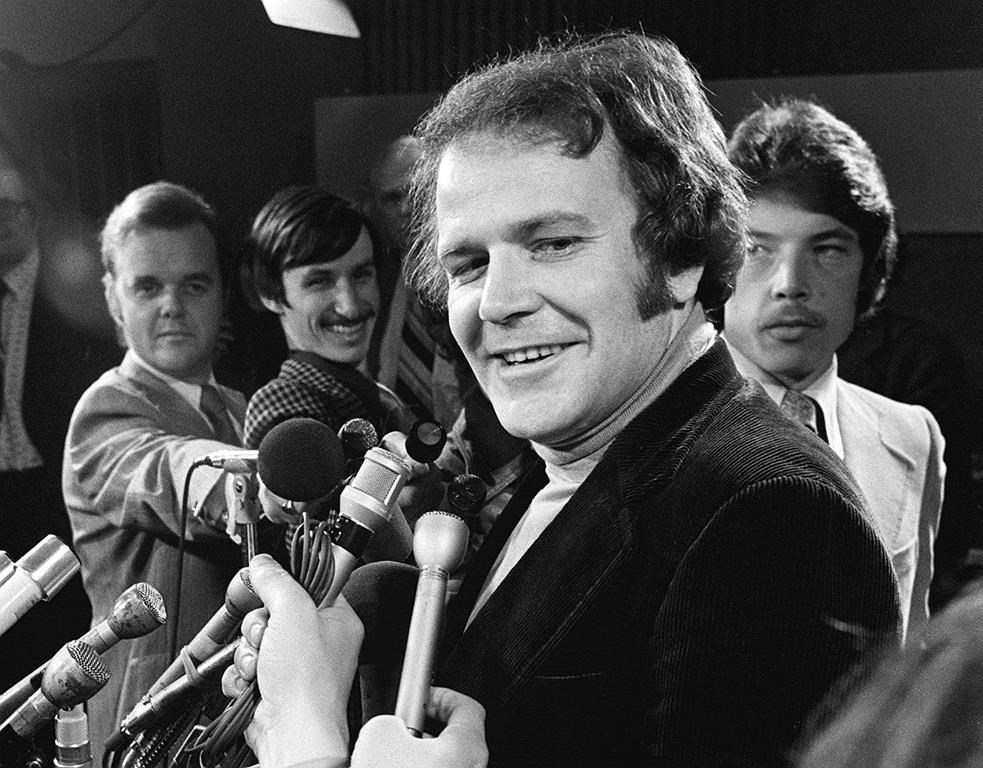
“Because that’s how they drink it in Paris,” his son, Nick Spicer, said in an interview Monday after arriving in Ottawa to be with his father in hospital.
“He had his way of having fun.”
The son told The Canadian Press that his father died Thursday morning.
“His tireless work over decades helped shape Canada’s linguistic landscape as we know it — a torch we continue to hold high as we work to achieve substantive equality of English and French in Canada,” Prime Minister Justin Trudeau said in a statement on Thursday.
Spicer was appointed to the role of official languages commissioner in 1970 under then-prime minister Pierre Trudeau, with the mandate to uphold French and English language rights in federal institutions.
He had earlier served as a researcher for the Royal Commission on Bilingualism and Biculturalism in 1964. He also worked as a special assistant to the minister of justice and president of the Privy Council from 1964 to 1965.
During his time as official languages commissioner, which lasted from 1970 to 1977, Nick said his father often referred to himself as the “commissioner of Cornflakes.” It was a nod to the debate that raged around him over adding both French and English to cereal boxes and other food packaging.
Despite the self-effacing joke about the debates and the grievances from English-speaking Canadians at the time, Nick said his father took his role seriously.
But his foray into learning more about French language and culture was nothing new to Spicer, who had learned the language earlier on and, as a teenager, corresponded with a girl his age in France.
“From the start, he actually cared about French and learning about another culture, which was revolutionary at the time,” Nick said of his father, who was born in Toronto to parents who grew up in a working-class family on a farm.
His job as commissioner was to promote equality between French- and English-speaking Canadians, and to make communications more bilingual.
In 1976, that issue would become potentially dire for the Montreal Olympics. Canadian pilots and air traffic controllers were walking off the job over a decision by the federal government to allow French to be used in air-traffic communications.
Nick said his father threatened to hold a news conference in the Montreal airport control tower and speak his mind about the issue.
“And that problem disappeared overnight. He was a man of action, and not afraid,” said Nick.
He did not pull his punches in his 1976 annual report as official languages commissioner when it came to how Air Canada, then a Crown corporation, was doing on bilingualism. He called the airline’s approach to language “fearful, defensive and negative.”
In 1978, Spicer was invested into the Order of Canada, with a citation that lauded the “courage and imagination” he brought to implementing the Official Languages Act.
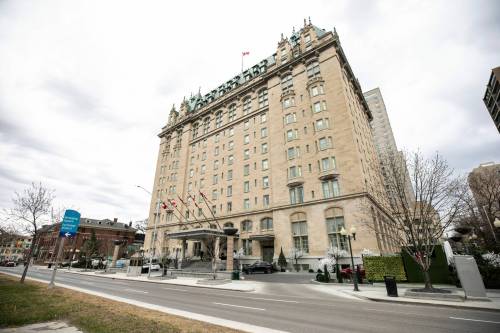
He also co-founded CUSO, a Canadian charity that works toward ending global poverty and inequality, and was the editor-in-chief of the Ottawa Citizen from 1985 to 1989.
In his 2004 book, “Life Sentences: Memoirs of an Incorrigible Canadian,” Spicer recounted his time at the newspaper, including how his newsroom covered the 1985 terrorist attack on Ottawa’s Turkish Embassy, the explosion of the U.S. Challenger space shuttle and the Chornobyl nuclear-station meltdown.
Jane Taber, who worked as an editorial writer and parliamentary reporter during Spicer’s tenure at the paper, remembers how he arrived to his new job “as such a celebrity” who admired elegant writing. She described him as a “dashing fixture” who left his mark in the newsroom and at the newspaper, including by launching a Sunday edition.
Nick said his father spoke fondly of his time at the paper, including his two-week rotations between departments where he wrote about food, fashion, sports and everything in between.
Nicole Feriancek, who is the current editor-in-chief of the Ottawa Citizen, said the fact that Spicer didn’t grow up working in newspapers made him an editor with a fresh perspective.
“His legacy is one that rings true today: lead with kindness and be bold in reshaping what a newspaper can be.”
Russell Mills, the publisher of the paper when Spicer was there, called him an “inspiring leader” and “extremely creative person” who brought new ideas to the paper. “The Citizen evolved significantly and improved under his leadership,” he said.
After leaving the Ottawa Citizen, he was chair of the Canadian Radio-television and Telecommunications Commission from 1989 to 1996, where he worked to promote Canadian television programming and support artists.
From 1990 to 1991, he chaired the Citizens’ Forum on Canada’s Future, dubbed the “Spicer Commission,” which examined national unity after the failure of the Meech Lake accord.
Progressive Conservative prime minister Brian Mulroney had negotiated a series of constitutional amendments that would have given the provinces stronger powers and declared Quebec a “distinct society.”
Political support for the effort fell apart in 1990, which fuelled the Quebec sovereignty movement. The Spicer Commission was set up as a way to explore the issues affecting national unity. It preceded the next, ultimately unsuccessful attempt at constitutional reform: the Charlottetown accord in 1992.
Spicer’s 1991 report called for an independent review of the official languages policy, Senate reform, recognition of the unique nature of Quebec culture and recognition of the rights of Indigenous Peoples.
The commission, which involved extensive engagement with hundreds of thousands of Canadians, also found strong dissatisfaction with the policies of multiculturalism and bilingualism. And, famously, with Mulroney himself: “There is a fury in the land against the prime minister,” Spicer wrote in his report.
Nick said his father loved his time at the Ottawa Citizen most of all. He continued to reminisce about those days when he moved to Paris, where he spent most of his later years.
“His heart will always be in Paris,” Nick said. “Because of the beauty, because he was young there.”
But he came back to Canada, a country “he loved so much.”
He then began joining his former Citizen colleagues for chats over coffee on Friday mornings, said Jay Stone, who was a longtime film critic for the newspaper. He said he could tell how much Spicer missed France. “He didn’t like looking out the window of his home and seeing trees,” he said. “He wanted to see Champs-Élysées.”
But his son made sure to remind his father of his legacy regarding the use of French at home in Canada, noting his care chart at the hospital in Ottawa was written in both official languages.
“That all changed because of you,” Nick said he told his father.
This report by The Canadian Press was first published Aug. 24, 2023.
Note to readers: This is a corrected story. A previous version erroneously reported that Keith Spicer had held a press conference in an air-traffic control tower in Montreal in 1976. It also reported that Spicer had grown up on a farm.