Turning offices into homes could help address the housing crisis, but can it be done?
Advertisement
Read this article for free:
or
Already have an account? Log in here »
To continue reading, please subscribe:
Digital Subscription
One year of digital access for only $1.44 a week*
- Enjoy unlimited reading on winnipegfreepress.com
- Read the E-Edition, our digital replica newspaper
- Access News Break, our award-winning app
- Play interactive puzzles
*Billed as $5.77 plus GST every four weeks. After 52 weeks, price increases to the regular rate of $19.95 plus GST every four weeks. Offer available to new and qualified returning subscribers only. Cancel any time.
To continue reading, please subscribe:
Add Free Press access to your Brandon Sun subscription for only an additional
$1 for the first 4 weeks*
- Enjoy unlimited reading on winnipegfreepress.com
- Read the E-Edition, our digital replica newspaper
- Access News Break, our award-winning app
- Play interactive puzzles
*Your next Brandon Sun subscription payment will increase by $1.00 and you will be charged $17.95 plus GST for four weeks. After four weeks, your payment will increase to $24.95 plus GST every four weeks.
Read unlimited articles for free today:
or
Already have an account? Log in here »
Hey there, time traveller!
This article was published 27/09/2023 (1119 days ago), so information in it may no longer be current.
OTTAWA – The building used to feature endless cubicles, long hallways and fluorescent lighting.
Now, the same spaces house modern apartments featuring granite countertop islands, fully furnished bedrooms and living rooms with views looking out to the Gatineau Hills.
The Slayte, in the heart of Ottawa’s downtown, has transformed from a vacant government office built in the 1970s to a residential space with amenities such as a gym and rooftop terrace with shared barbecues, a hot tub and lounge.
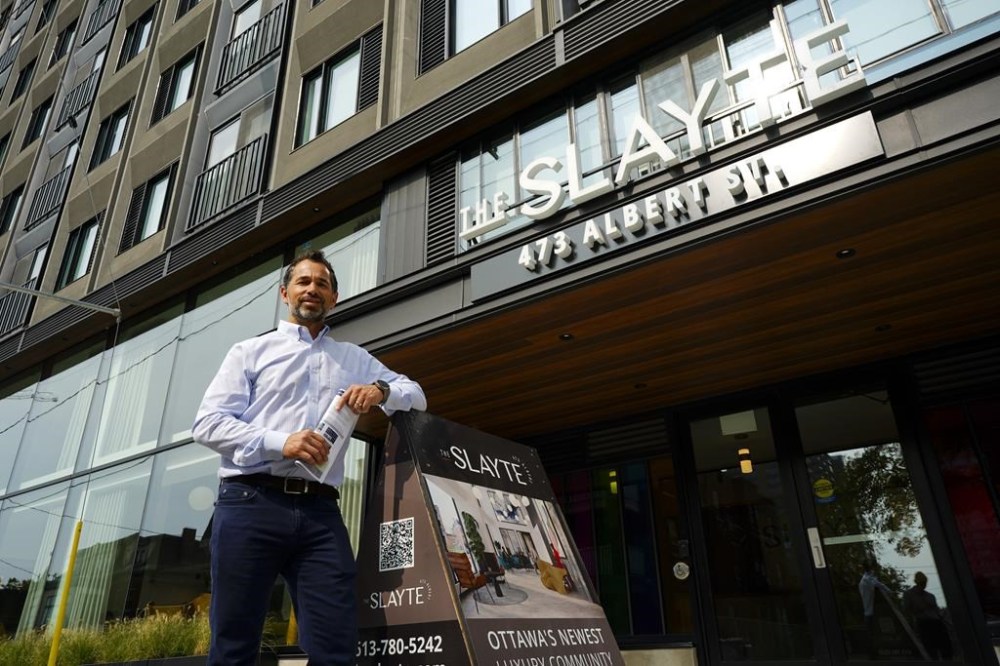
The 158-unit apartment building — which took about two years to transform, plus a yearlong permitting process — is one of the first office-to-residential conversions in the city. Construction on the building, owned by real estate investment trust company InterRent, finished last year.
As Canadian politicians and policy thinkers try to come up with ways to solve a growing housing crisis, the project is one example of a novel solution for some urban centres.
The conversion of office buildings into housing is a trending topic. And vacancy rates in many downtowns are growing. But experts say the same kinds of barriers that have contributed to the housing shortage writ large are also at play for companies seeking to retrofit existing buildings.
CLV Group president Oz Drewniak said in an interview that office conversions have a heap of benefits, including adding vibrancy to neighbourhoods, reducing crime, expanding customer bases for local businesses and increasing public transit ridership in downtown cores.
Drewniak said it has an upside for sustainability, too, because keeping structures in place contains the millions of kilograms in carbon dioxide emissions that are embedded in the concrete of old commercial buildings.
He estimated for The Slayte, renovating the unused office building, rather than completely tearing it down and building anew, would save the need for 770 trucks worth of concrete.
Drewniak said though there’s no “silver bullet” to the housing crisis, office conversion is one of the many pieces to the puzzle.
“Every option has to be looked at,” he said.
“We need municipalities to do whatever they can to speed up development, to provide incentives to get moving.”
Steven Paynter, a director and architect in Toronto with the Gensler architecture and planning firm, has created an algorithm along with his colleagues that calculates the viability of converting offices into homes.
He said of the nearly 1,000 buildings in Canada and the United States that Gensler has assessed for residential retrofitting, about 25 to 30 per cent fit the criteria for conversion.
Paynter said the feasibility of an office metamorphosis is dependent on the existing conditions of an office building, such as the floorplate and window layouts.
In the transformation of The Slayte, everything but the concrete foundation and some elevators in the building was stripped or demolished. Even its core was modified so as to create bigger rooms.
Though a faster construction processes lead to savings on interest, overall costs are the same as developing a new apartment building, Drewniak said, because of costly demolition and structural reinforcing.
“The cost of the windows, the cost of the flooring and the cost of electrical, all that kind of stuff — there’s no difference in cost between brand new and conversion,” he said while giving The Canadian Press a tour of the Slayte on Monday.
A recent study by commercial real estate firm CBRE shows Canada’s national office vacancy rate is just over 18 per cent and continues to rise, though it varies from city to city.
Paynter estimated that around seven per cent of vacant offices in major city centres will actually be turned into housing, based on other factors such as commercial real estate loans.
“It might not sound like much, but it’s huge,” said Paynter.
In Ottawa, the number could be much higher. About 40 per cent of the buildings Paynter ran through his algorithm were viable for conversion.
The federal government is disposing of 10 office buildings in the National Capital Region, as more public servants work from home. And the city’s downtown vacancy rate is above 15 per cent and rapidly increasing, according to CBRE.
“Wherever we can do conversions and build more housing, and have more people living downtown … we’re open to that, but obviously it’s got to be in the right circumstances,” Ottawa Mayor Mark Sutcliffe said during a news conference earlier this month.
A report this year by the Canadian Urban Institute that looked at conditions that enable office conversions — such as municipal policy, market viability and building types — said Ottawa could convert 11 to 17 buildings and create 1,500 to 4,200 new housing units.
“Based on the modelling, Ottawa has the most potential for conversions,” the institute’s report says.
“This is largely due to the size of the city as one of Canada’s largest (and a larger building inventory overall), but it is notable that there are a significant number of high and low-rise, mid-century buildings considered feasible for conversion.”
Both Paynter and Drewniak said Calgary offers an example of how municipalities can promote downtown office conversions.
That city’s program, which has funded more than 700 homes, provides a $75 incentive per square foot of converted space. A special team is dedicated to expediting the permit and approval process.
If Ottawa had a similar policy, the savings it created could result in renters spending more than $300 less a month for units built under the program, Drewniak said.
It would speed things up, too. Paynter said while it takes up to two years to get a project approved in other major Canadian cities, it takes only four to six weeks in Calgary.
Lacklustre municipal policies are a chief barrier preventing more office conversions from happening, he said.
Another is the high cost of construction, which Paynter said combined with high borrowing costs make development projects harder to budget.
“The federal government’s scrapping of GST on rental buildings will be a big help, once they clarify that it applies to conversion,” he said, referring to an announcement the Liberals made last week as part of efforts to boost the housing supply in Canada.
The Liberals’ 2021 election platform promised that $600 million would be spent on converting office spaces into market-based housing.
Neither the Canada Mortgage and Housing Corp. nor Housing Minister Sean Fraser’s office responded to a question about whether the pledge was honoured.
“To date there has been no word on how this will be spent, but recently CMHC has had a renewed focus on conversions, so it may come through that,” said Paynter about the pledge.
He said he hopes some of that committed funding will be spent on converting office assets the government has decided to dispose of.

Conservative Leader Pierre Poilievre has promised to sell 15 per cent of federal buildings and land to support housing in a recently tabled bill.
Paynter said the idea has really picked up steam in the last six months, first accelerated by the pandemic and virtual work.
“I think that’s because we’re starting to see the return to work stabilize,” said Paynter.
“And we’re all also starting to see that people very clearly want to be in more desirable buildings with really close proximity to transit.”
This report by The Canadian Press was first published Sept. 27, 2023.