‘Please regulate AI:’ Artists push for U.S. copyright reforms but tech industry says not so fast
Advertisement
Read this article for free:
or
Already have an account? Log in here »
To continue reading, please subscribe:

Digital Subscription
One year of digital access for only $205*
- Enjoy unlimited reading on winnipegfreepress.com
- Read the E-Edition, our digital replica newspaper
- Access News Break, our award-winning app
- Play interactive puzzles
*First annual payment billed as $205.00 + GST for one year. This annual subscription will automatically renew at $233.00 + GST every 52 weeks (10% off the regular annual price of $259.35). Offer available to new and qualified returning subscribers only. Cancel any time.
To continue reading, please subscribe:
Add Free Press access to your Brandon Sun subscription for only an additional
$1 for the first 4 weeks*
- Enjoy unlimited reading on winnipegfreepress.com
- Read the E-Edition, our digital replica newspaper
- Access News Break, our award-winning app
- Play interactive puzzles
*Your next Brandon Sun subscription payment will increase by $1.00 and you will be charged $17.95 plus GST for four weeks. After four weeks, your payment will increase to $24.95 plus GST every four weeks.
Read unlimited articles for free today:
or
Already have an account? Log in here »
Hey there, time traveller!
This article was published 18/11/2023 (1033 days ago), so information in it may no longer be current.
Country singers, romance novelists, video game artists and voice actors are appealing to the U.S. government for relief — as soon as possible — from the threat that artificial intelligence poses to their livelihoods.
“Please regulate AI. I’m scared,” wrote a podcaster concerned about his voice being replicated by AI in one of thousands of letters recently submitted to the U.S. Copyright Office.
Technology companies, by contrast, are largely happy with the status quo that has enabled them to gobble up published works to make their AI systems better at mimicking what humans do.
The nation’s top copyright official hasn’t yet taken sides. She told The Associated Press she’s listening to everyone as her office weighs whether copyright reforms are needed for a new era of generative AI tools that can spit out compelling imagery, music, video and passages of text.
“We’ve received close to 10,000 comments,” said Shira Perlmutter, the U.S. register of copyrights, in an interview. “Every one of them is being read by a human being, not a computer. And I myself am reading a large part of them.”
WHAT’S AT STAKE?
Perlmutter directs the U.S. Copyright Office, which registered more than 480,000 copyrights last year covering millions of individual works but is increasingly being asked to register works that are AI-generated. So far, copyright claims for fully machine-generated content have been soundly rejected because copyright laws are designed to protect works of human authorship.
But, Perlmutter asks, as humans feed content into AI systems and give instructions to influence what comes out, “is there a point at which there’s enough human involvement in controlling the expressive elements of the output that the human can be considered to have contributed authorship?”
That’s one question the Copyright Office has put to the public. A bigger one — the question that’s fielded thousands of comments from creative professions — is what to do about copyrighted human works that are being pulled from the internet and other sources and ingested to train AI systems, often without permission or compensation.
More than 9,700 comments were sent to the Copyright Office, part of the Library of Congress, before an initial comment period closed in late October. Another round of comments is due by Dec. 6. After that, Perlmutter’s office will work to advise Congress and others on whether reforms are needed.
WHAT ARE ARTISTS SAYING?
Addressing the “Ladies and Gentlemen of the US Copyright Office,” the “Family Ties” actor and filmmaker Justine Bateman said she was disturbed that AI models were “ingesting 100 years of film” and TV in a way that could destroy the structure of the film business and replace large portions of its labor pipeline.
It “appears to many of us to be the largest copyright violation in the history of the United States,” Bateman wrote. “I sincerely hope you can stop this practice of thievery.”
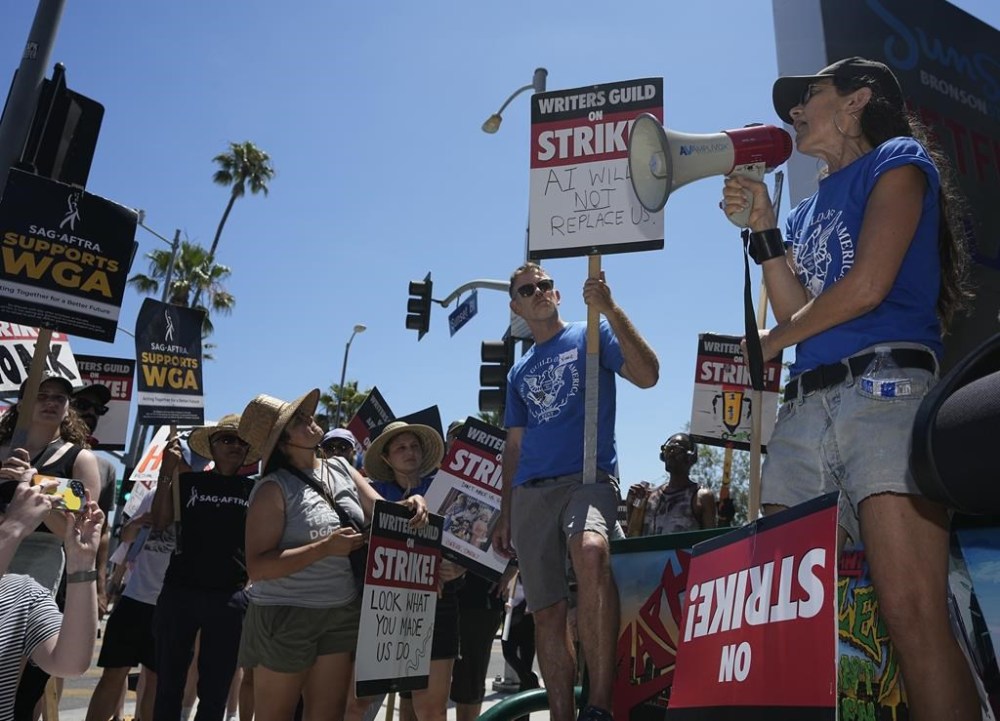
Airing some of the same AI concerns that fueled this year’s Hollywood strikes, television showrunner Lilla Zuckerman (“Poker Face”) said her industry should declare war on what is “nothing more than a plagiarism machine” before Hollywood is “coopted by greedy and craven companies who want to take human talent out of entertainment.”
The music industry is also threatened, said Nashville-based country songwriter Marc Beeson, who’s penned tunes for Carrie Underwood and Garth Brooks. Beeson said AI has potential to do good but “in some ways, it’s like a gun — in the wrong hands, with no parameters in place for its use, it could do irreparable damage to one of the last true American art forms.”
While most commenters were individuals, their concerns were echoed by big music publishers (Universal Music Group called the way AI is trained “ravenous and poorly controlled”) as well as author groups and news organizations including the New York Times and The Associated Press.
IS IT FAIR USE?
What leading tech companies like Google, Microsoft and ChatGPT-maker OpenAI are telling the Copyright Office is that their training of AI models fits into the “fair use” doctrine that allows for limited uses of copyrighted materials such as for teaching, research or transforming the copyrighted work into something different.
“The American AI industry is built in part on the understanding that the Copyright Act does not proscribe the use of copyrighted material to train Generative AI models,” says a letter from Meta Platforms, the parent company of Facebook, Instagram and WhatsApp. The purpose of AI training is to identify patterns “across a broad body of content,” not to “extract or reproduce” individual works, it added.
So far, courts have largely sided with tech companies in interpreting how copyright laws should treat AI systems. In a defeat for visual artists, a federal judge in San Francisco last month dismissed much of the first big lawsuit against AI image-generators, though allowed some of the case to proceed.
Most tech companies cite as precedent Google’s success in beating back legal challenges to its online book library. The U.S. Supreme Court in 2016 let stand lower court rulings that rejected authors’ claim that Google’s digitizing of millions of books and showing snippets of them to the public amounted to copyright infringement.
But that’s a flawed comparison, argued former law professor and bestselling romance author Heidi Bond, who writes under the pen name Courtney Milan. Bond said she agrees that “fair use encompasses the right to learn from books,” but Google Books obtained legitimate copies held by libraries and institutions, whereas many AI developers are scraping works of writing through “outright piracy.”
Perlmutter said this is what the Copyright Office is trying to help sort out.
“Certainly this differs in some respects from the Google situation,” Perlmutter said. “Whether it differs enough to rule out the fair use defense is the question in hand.”