Review: Bradley Cooper’s ‘Maestro’ leaves many notes of Bernstein unplayed
Advertisement
Read this article for free:
or
Already have an account? Log in here »
To continue reading, please subscribe:

Digital Subscription
One year of digital access for only $205*
- Enjoy unlimited reading on winnipegfreepress.com
- Read the E-Edition, our digital replica newspaper
- Access News Break, our award-winning app
- Play interactive puzzles
*First annual payment billed as $205.00 + GST for one year. This annual subscription will automatically renew at $233.00 + GST every 52 weeks (10% off the regular annual price of $259.35). Offer available to new and qualified returning subscribers only. Cancel any time.
To continue reading, please subscribe:
Add Free Press access to your Brandon Sun subscription for only an additional
$1 for the first 4 weeks*
- Enjoy unlimited reading on winnipegfreepress.com
- Read the E-Edition, our digital replica newspaper
- Access News Break, our award-winning app
- Play interactive puzzles
*Your next Brandon Sun subscription payment will increase by $1.00 and you will be charged $17.95 plus GST for four weeks. After four weeks, your payment will increase to $24.95 plus GST every four weeks.
Read unlimited articles for free today:
or
Already have an account? Log in here »
Hey there, time traveller!
This article was published 21/11/2023 (1048 days ago), so information in it may no longer be current.
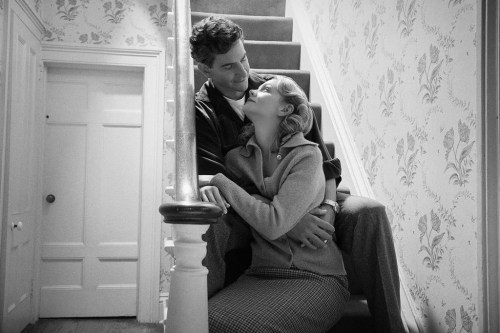
Bradley Cooper’s “Maestro,” a high-wire act of a biopic, leaps constantly between on stage and off, flying through Leonard Bernstein’s very public life as a conductor while diving into his more private marriage to Felicia Montealegre. How each side of Bernstein’s existence interacts with the other is the tension and harmony of “Maestro.” Which is authentic? Which a performance?
Resolving those dichotomies is, thankfully, not the aim of Cooper’s admirably ambitious if performative drama about the musical conscience of 20th century America. Bernstein’s polymorphous life was spread between his family life and a string of male lovers, just as it was between conducting and the solitary toil of composing. “Maestro” resists neat conclusions about any facet of an expansively contradictory life.
“If you carry around both personalities, I suppose that means you become a schizophrenic and that’s the end of it,” Bernstein (Cooper) says with a laugh in a TV interview alongside Montealegre (Carey Mulligan).
“Maestro,” which debuts Wednesday in theaters before streaming next month on Netflix, isn’t a cradle-to-the-grave biopic, though it doesn’t avoid some of the genre’s standard pitfalls, either. It’s largely set around the beginning and end of his relationship with Montealegre, an actor he first meets at a party. ““Hello, I’m Lenny,” he says, grinning from the piano bench.
It’s a framework with some benefits — no matter what the title says, this is Mulligan’s movie – that also omits much of Bernstein’s most lasting accomplishments. There is little here of music making, generally, and virtually none of “West Side Story,” “Candide,” “On the Waterfront” or all those influential TV broadcasts. Fans such as Lydia Tár may not approve.
But “Maestro” begins, thrillingly, in a black-and-white blur. Characters exit scenes like they’re falling through trap doors, a surreal swirl propelled by the verve of Bernstein’s music. In the first scene, a 25-year-old Bernstein is woken with a call notifying him to substitute for Bruno Walter in conducting the New York Philharmonic that night. Enthralled, he pulls open the blinds, slaps, in rhythm, the bare bottom of the man sharing his bed and runs down stairs that magically lead right into Carnegie Hall.
It won’t be the last time that “Maestro” draws a straight line between lovemaking and music. “If nothing sings in you, then you can’t make music,” Montealegre will later tell him. Music, no doubt, swells most in the Bernstein of “Maestro” when he’s liberated to be himself.
On the night of their first date, Bernstein and Montealegre end up, fittingly, on a stage running lines, with one floor lamp casting them in shadow. “Even though you’re the king, you’re quite taken with me,” she says, explaining his characterization.
The fiction is quickly borne out, albeit with a foreboding sense of marital trouble. Another headlong sprint between scenes ends with the two rushing onto the stage of “Fancy Free,” the Jerome Robbins ballet that will lead to “On the Town.” Bernstein, himself, joins the hip-swinging sailors.
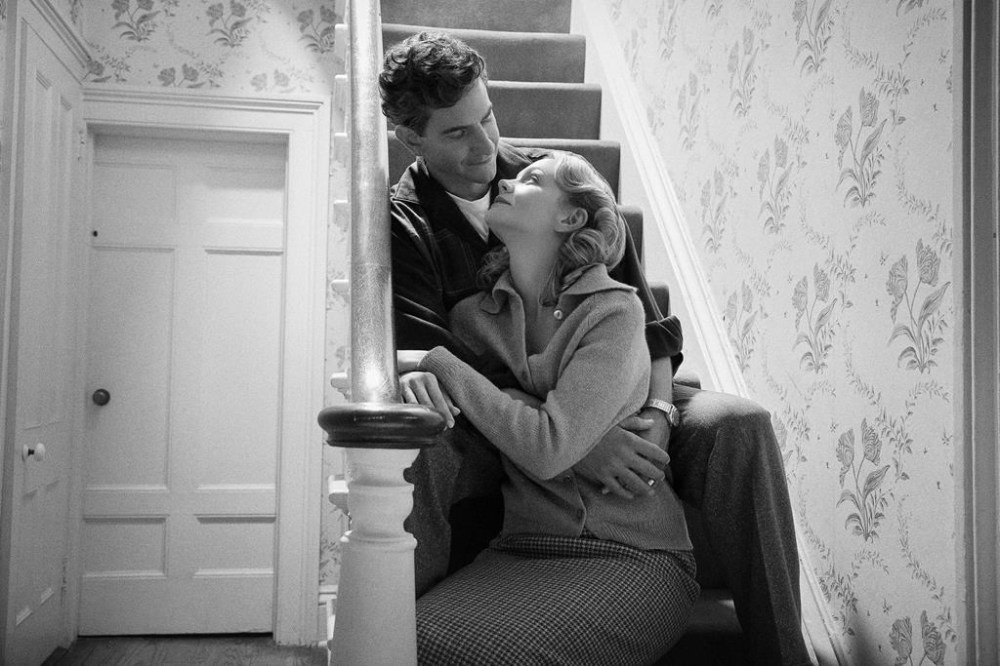
“Maestro” is, for this roughly first black-and-white hour, wonderfully brisk and free of normal biopic constraints. It’s like a dream of 1950s New York modernism. Dialogue moves at an urbane clip. The photography, by Matthew Libatique, dips confidently between intimate exchanges and wide-shot vistas of the Berkshires of Tanglewood or of Central Park. (This is, most definitely, a great Central Park movie, full of romance and encounters along its pathways.)
When “Maestro” shifts forward and into color, it loses its brio. The film, which Cooper wrote with Josh Singer, skips over the central decades of Bernstein’s accomplishments, taking up residence instead in the early 1970s.
By then, Bernstein and Montealegre are married with three children (the oldest, Jamie, is played by Maya Hawke) and a house in Connecticut. But even though Montealegre entered into the marriage without wool over her eyes (“I know exactly who you are,” she tells him, early on), all is now discord. Bernstein’s dalliances, she tells him, have gotten sloppy. In a Thanksgiving Day argument in their Manhattan apartment overlooking the park, she seethes: “If you’re not careful, you’re going to die a lonely queen.” Right about then, an inflated Snoopy floats past the window, like an eclipse.
In scene after scene like this, “Maestro” is staged exquisitely. But even as the film moves from its nervy first hour to its melodramatic set pieces, artifice steadily grips “Maestro.” Cooper’s Bernstein has come under criticism for the prosthetic nose, but it’s other affectations in his performance that smother. It’s a sincere performance, thoughtful and dedicated, but it’s also mannered and showy, drowning in turtlenecks, cigarettes and accents.
But Cooper, a sensitive director, was also wise enough to follow Mulligan’s increasingly moving performance. (She gets top billing, too.) The film’s slide into family dynamics comes at the expense of Bernstein’s larger story, but it yields a beautiful platform for Mulligan to capture a woman too infatuated by her husband to abandon him, but too clear-eyed not to be devasted.
“It’s my own arrogance to think I could survive on what he could give,” she says.

It’s a powerfully piercing moment, followed by an extended, passionate recreation of Bernstein in 1976 conducting Mahler’s Second Symphony. There, gyrating at the podium before an orchestra, the film tells us, may be where Bernstein truly gives all of himself.
Some of America’s top filmmakers have long been tempted to tackle a film on Bernstein, among them Martin Scorsese and Steven Spielberg (both credited producers here). But Cooper’s film never finds its balance. If Bernstein’s sexuality must be the prism through which we view him, why do his male lovers (Matt Bomer makes a brief impression) pass by so fleetingly? “Maestro” is a fine portrait of a complicated marriage. But for a man who contained symphonies, that leaves a lot of notes unplayed.
“Maestro,” a Netflix release is rated R by the Motion Picture Association for some language and drug use. Running time: 129 minutes. Two and a half stars out of four.
___
Follow AP Film Writer Jake Coyle at: http://twitter.com/jakecoyleAP