Montreal music venues call for rule changes as noise complaints choke industry

Advertisement

Advertise with us

Montreal bar and live music venue Turbo Haüs is doing everything it can to mitigate noise and be a good neighbour, says co-owner Sergio Da Silva.

Read this article for free:


or

Already have an account? Log in here »

To continue reading, please subscribe:

Subscribe and receive a limited-edition Free Press branded hat or tote.

Digital Subscription

One year of digital access for only $205*

  • Enjoy unlimited reading on winnipegfreepress.com
  • Read the E-Edition, our digital replica newspaper
  • Access News Break, our award-winning app
  • Play interactive puzzles

*First annual payment billed as $205.00 + GST for one year. This annual subscription will automatically renew at $233.00 + GST every 52 weeks (10% off the regular annual price of $259.35). Offer available to new and qualified returning subscribers only. Cancel any time.

To continue reading, please subscribe:

Add Free Press access to your Brandon Sun subscription for only an additional

$1 for the first 4 weeks*

  • Enjoy unlimited reading on winnipegfreepress.com
  • Read the E-Edition, our digital replica newspaper
  • Access News Break, our award-winning app
  • Play interactive puzzles
Start now

*Your next Brandon Sun subscription payment will increase by $1.00 and you will be charged $17.95 plus GST for four weeks. After four weeks, your payment will increase to $24.95 plus GST every four weeks.

Hey there, time traveller!
This article was published 26/11/2023 (1042 days ago), so information in it may no longer be current.

Montreal bar and live music venue Turbo Haüs is doing everything it can to mitigate noise and be a good neighbour, says co-owner Sergio Da Silva.

The punk rock institution moved in 2018 from a mostly residential neighbourhood to the lively downtown theatre district known as the Quartier des Spectacles. It spent thousands of dollars soundproofing the new space and pays an extra $3,200 in rent each month to keep the two apartments above it empty.

So a warning from the city last week to reduce noise came as a shock.
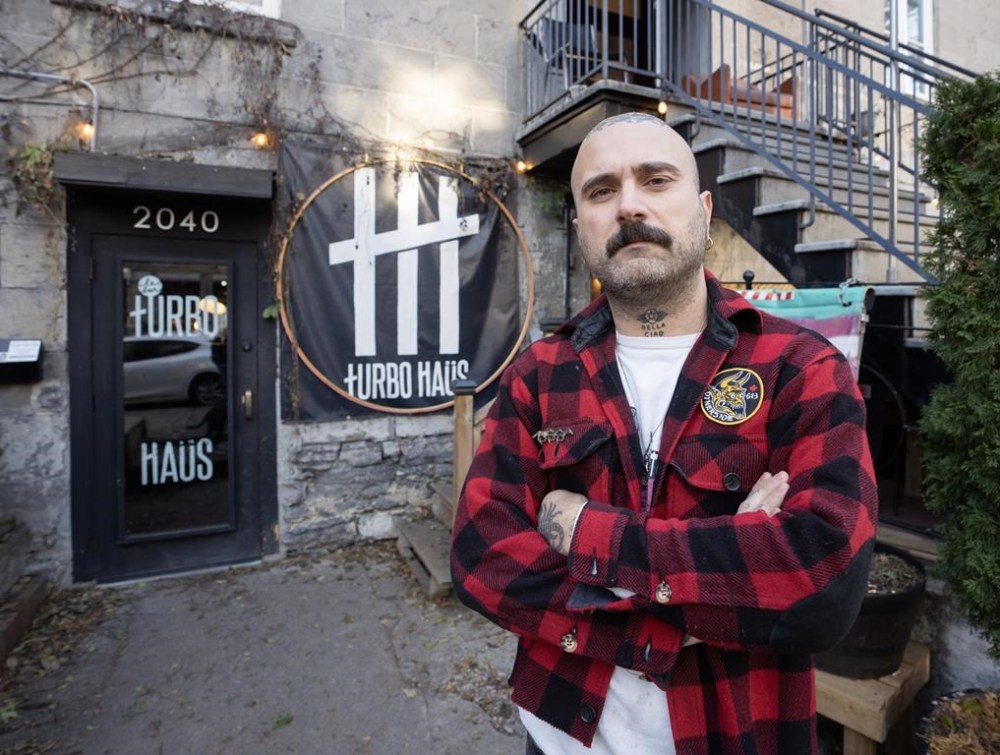
Sergio Da Silva, co-owner of the Turbo Haüs nightclub, poses for photos in front of the club Friday, Nov. 24, 2023, in Montreal. The club has received warnings related to noise complaints from the city, a problem affecting many small music venues in Montreal. THE CANADIAN PRESS/Ryan Remiorz

“Nice to know it’s illegal to have des spectacles in the … Quartier des Spectacles,” Turbo Haüs lamented in a widely circulated social media post alongside a screenshot of the city notice, which threatens fines of up to $12,000.

“It’s a bit surprising and pretty frustrating to be honest,” Da Silva said in a recent interview.

He’s one of several club owners calling on Montreal to update noise bylaws and development rules to better protect its small venues — revered nightlife destinations that have in recent years found themselves increasingly surrounded by new residential construction.

The venues serve as a key avenue to success for emerging artists, says Dan Seligman, creative director of music festival POP Montreal. Band Arcade Fire and DJ Kaytranada are among the countless acts that bounced between Montreal clubs and stages on their way to greater fame, he said.

“On a cultural level, I think we’d all be much, much worse off without these places.”

Da Silva is confident a complaint from a resident in the new building behind Turbo Haüs spurred the warning from the city.

“The issue here is there aren’t rules in place to enforce (for) new people coming into currently existing ecosystems,” he said.

Montreal noise rules vary by borough but are generally subjective and give too much credence to complaints, says Jon Weisz, director of Scènes de Musique Alternatives du Québec, an association of about 50 independent music venues.

“They’re incredibly one-sided and they leave open the possibility for venues to essentially get closed down by one unhappy neighbour,” Weisz said. Montreal police, meanwhile, “just kind of wing it” when responding to noise complaints, he added. “They just kind of walk into the space and decide on site whether it’s too loud or not.”

Bylaws in the central Ville-Marie borough, where Turbo Haüs is located, empower police officers to determine — without the use of sound equipment — whether noise is disturbing to nearby residents.

Both Weisz and Da Silva want Montreal to apply what’s called the “agent of change” principle to development around music venues, which would put the onus on developers to adapt their projects to existing noise conditions.

Toronto has such a rule, requiring new development in mixed-use neighbourhoods to incorporate design or construction elements that dampen sound from music venues. The regulation applies the other way, too, mandating sound mitigation design in new live music spaces. As well, the city has a regulation that requires residential developments near music venues to notify new residents of potential noise.

Montreal has offered soundproofing subsidies to small venues since 2022, but sound insulation alone doesn’t eliminate the risk of noise complaints, Da Silva and Weisz say.

“I like being in a mixed-use neighbourhood. I think that’s a good idea and it’s good use of space,” Da Silva said. “There needs to be regulation added so that people can live harmoniously.”

He, Weisz and others say persistent noise complaints and fines are exacerbating what is already a difficult financial environment for small music venues, which have been battered by the pandemic and high inflation. They warn that Montreal risks losing a cherished element of its culture unless the city’s administration takes action.

“Montreal’s noise bylaws absolutely threaten independent venues in the city,” Weisz said. “I think it’s probably one of the biggest threats I would say to the existence of certain venues … because they’re working on razor-thin margins.”

This report by The Canadian Press was first published Nov. 26, 2023.

Report Error Submit a Tip

More Stories

U of W Collegiate students thank residential school survivors with the lessons they’ve learned

Maggie Macintosh 6 minute read Preview

U of W Collegiate students thank residential school survivors with the lessons they’ve learned

Maggie Macintosh 6 minute read Yesterday at 6:49 PM CDT

It’s become a back-to-school tradition for teachers to invite Indigenous elders to their classrooms to share first-hand accounts about the ongoing impacts of Canada’s residential school system.

This fall, the University of Winnipeg Collegiate was among the schools that sent an invitation — but its purpose wasn’t to educate students about the system’s horrors.

“Truth and Reconciliation week is so emotional and draining for residential school survivors,” said Christine M’Lot, a longtime instructor of the school’s Grade 9 truth and reconciliation course.

“I wanted to do something a little bit different and offer a thank you.”

Read
Yesterday at 6:49 PM CDT

You’re a solid, loyal sister, so worry not

Maureen Scurfield 5 minute read Yesterday at 2:00 AM CDT

DEAR MISS LONELYHEARTS: I ran into my sister’s husband at the bar recently. He was drinking with a bunch of people from his work. I noticed he was sitting close to a young woman, with his arm around her.

I just nodded without a smile as I slowly passed them. I kept on going, but he knew I saw them together. A few minutes later he came over — obviously drunk — and said, “You’re a good girl! You won’t say anything to your sister, will you?” Ha! I looked at him and said, “Of course I’m going to say something!”

My loyalty will always be to my sister. I phoned my sis in my car and blabbed. She tried to laugh it off, but she’s gone silent since — not answering my calls or messages. So apparently now I’m the troublemaker? That’d be just her style! What should I do?

— Worried About Us, North Kildonan

Mayoral candidate Vogiatzakis criticized for living outside Winnipeg

Malak Abas 4 minute read Preview

Mayoral candidate Vogiatzakis criticized for living outside Winnipeg

Malak Abas 4 minute read Updated: Yesterday at 6:03 PM CDT

A mayoral hopeful took heat from other candidates Friday for living outside Winnipeg while running in the civic election.

Mike Vogiatzakis’s primary residence is in the Rural Municipality of St. Andrews, about 25 kilometres north of Winnipeg — a community with its own mayor and councillors.

But the funeral director said he owns a home in Winnipeg where he divides his time, and he would move to the city full-time if elected mayor.

“It doesn’t matter where a person lives. Why are we dividing St. Andrews and Manitoba and Winnipeg? I’ve met the criteria to run for mayor,” Vogiatzakis said Friday morning.

Read
Updated: Yesterday at 6:03 PM CDT

J’accuse!: Kinew uses French to fry interim Tory leader over alleged caucus subterfuge

Chris Kitching and Maggie Macintosh 4 minute read Preview

J’accuse!: Kinew uses French to fry interim Tory leader over alleged caucus subterfuge

Chris Kitching and Maggie Macintosh 4 minute read Thursday, Oct. 1, 2026

NDP Premier Wab Kinew took a dig at the Progressive Conservatives’ leadership change while facing off with Obby Khan’s short-term replacement for the first time in question period Thursday.

Read
Thursday, Oct. 1, 2026

Clock ticks down on destruction of records documenting residential school abuses

Marsha McLeod 13 minute read Preview

Clock ticks down on destruction of records documenting residential school abuses

Marsha McLeod 13 minute read Yesterday at 12:49 PM CDT

In less than a year, a private company is set to destroy the largest cache of records detailing the widespread abuse of Indigenous children at residential schools in Canada.

The destruction, which was ordered by an Ontario court in 2014 and later upheld by the Supreme Court, is set to take place on Sept. 19, 2027.

This countdown is igniting emotional conversations that seek to balance the immense historical value of the records alongside the confidentiality survivors were promised as part of the process of providing detailed testimony about abuses they’d suffered.

The records were created as part of the Indian Residential Schools Settlement Agreement, a class-action settlement stemming from survivors who began suing the federal government in the late 1990s over the harm they’d been subjected to at residential schools.

Read
Yesterday at 12:49 PM CDT

Gordon Bell rings in a century

Maggie Macintosh 13 minute read Preview

Gordon Bell rings in a century

Maggie Macintosh 13 minute read Updated: Yesterday at 8:06 PM CDT

Mischka Valencia had gotten used to the hum of heavy machinery at Gordon Bell High School.

“Ever since I’ve been here, it’s all been under construction,” the Grade 12 student said, standing on the sidelines of the brightly painted revamped outdoor basketball court. “I had no idea this was a court.”

The Filipina teenager landed in Winnipeg several months after the inner-city campus had transformed into a construction site.

It was the fall of 2023 and Mischka’s priorities were fitting in, befriending classmates and learning a third language via first-period French.

Read
Updated: Yesterday at 8:06 PM CDT