

U of W Collegiate students thank residential school survivors with the lessons they’ve learned

Advertisement
Read this article for free:
or
Already have an account? Log in here »
To continue reading, please subscribe:

Digital Subscription
One year of digital access for only $205*
- Enjoy unlimited reading on winnipegfreepress.com
- Read the E-Edition, our digital replica newspaper
- Access News Break, our award-winning app
- Play interactive puzzles
*First annual payment billed as $205.00 + GST for one year. This annual subscription will automatically renew at $233.00 + GST every 52 weeks (10% off the regular annual price of $259.35). Offer available to new and qualified returning subscribers only. Cancel any time.
To continue reading, please subscribe:
Add Free Press access to your Brandon Sun subscription for only an additional
$1 for the first 4 weeks*
- Enjoy unlimited reading on winnipegfreepress.com
- Read the E-Edition, our digital replica newspaper
- Access News Break, our award-winning app
- Play interactive puzzles
*Your next Brandon Sun subscription payment will increase by $1.00 and you will be charged $17.95 plus GST for four weeks. After four weeks, your payment will increase to $24.95 plus GST every four weeks.
Read unlimited articles for free today:
or
Already have an account? Log in here »
It’s become a back-to-school tradition for teachers to invite Indigenous elders to their classrooms to share first-hand accounts about the ongoing impacts of Canada’s residential school system.
This fall, the University of Winnipeg Collegiate was among the schools that sent an invitation — but its purpose wasn’t to educate students about the system’s horrors.
“Truth and Reconciliation week is so emotional and draining for residential school survivors,” said Christine M’Lot, a longtime instructor of the school’s Grade 9 truth and reconciliation course.
MIKE DEAL / FREE PRESS
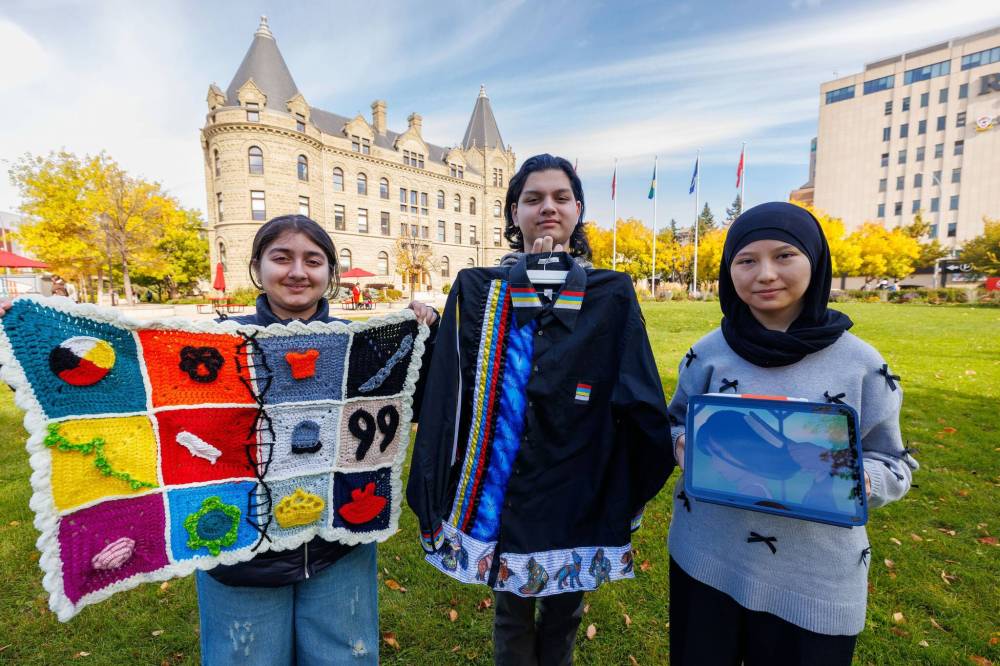
From left: Students Swasti Kumar, 14, with her crochet project about trauma and abnormal DNA musculation in residential school survivors, Nazareth Mallett with his ribbon shirt, and animator/filmmaker Setayesh Khasheei.
“I wanted to do something a little bit different and offer a thank you.”
The Anishinaabe instructor mobilized students who’d taken her course in recent years to showcase what they learned for an audience of survivors and their relatives on Monday.
The university prep school was the first in Manitoba to require incoming students to learn about the fallout of colonization in Canada, intergenerational trauma and the reconciliation movement.
Since May 2017, Grade 9 students at the independent school have been mandated to take a two-month course in the spring designed by teachers.
The U of W introduced its Indigenous course requirement for undergraduate students in September 2016.
Instead of a final exam, the high school course ends with an inquiry project. Teenagers are asked to explore an issue that stuck out to them.
For Swasti Kumar, 14, it was research revealing abnormal DNA methylation in descendants of residential school survivors.
Students who were sent to government- and church-run institutions that sought to assimilate them into European settler culture were often “looking over their shoulder,” the Grade 10 student said.
“That trauma can lead to your body staying in permanent fight or flight mode and you can pass it down,” she said.
Through her research into how chronic stress can affect epigenetics, Swasti learned about the healing benefits of participating in medicine picking, ceremonies and other cultural activities.
Given Swasti’s grandmother taught her how to crochet, the teen said she thought it’d be meaningful to craft a quilt of her takeaways about intergenerational trauma. She hangs the artwork in her room.
The quilt, made up of 12 granny squares in total, is split in half with a stitch mimicking two strands of DNA.
One side is filled with muted colours that depict colonization, residential schools and the MMIWG2S+ crisis. The other has colourful patches with a medicine wheel, white feather and other symbols representing cultural revitalization on them.
Swasti said her quilt is a reminder of how lucky she is to have a loving home and be able to regularly spend time with her family. “Feeling safe where you are — that’s something we take for granted a lot,” she said.
Geraldine Shingoose, better known as “Gramma Shingoose,” has visited the downtown campus annually to share stories with students about how unsafe she felt at Muscowequan Indian Residential School in Saskatchewan between 1962 and 1971.
“I was so touched by all (the projects). I was just really, really touched by their gratitude,” Shingoose said after visiting Monday’s U of W event.
The high school community wanted to express its appreciation for the Saulteaux and Anishinaabe elder’s visits and vulnerability in a new way, said M’Lot, whose late grandmother attended Portage la Prairie Indian Residential School.
M’Lot said she’s extremely grateful to all survivors who are willing to share difficult stories. Her grandmother didn’t want to speak about her experience because she didn’t want to pass on her pain, she noted.
MIKE DEAL / FREE PRESS
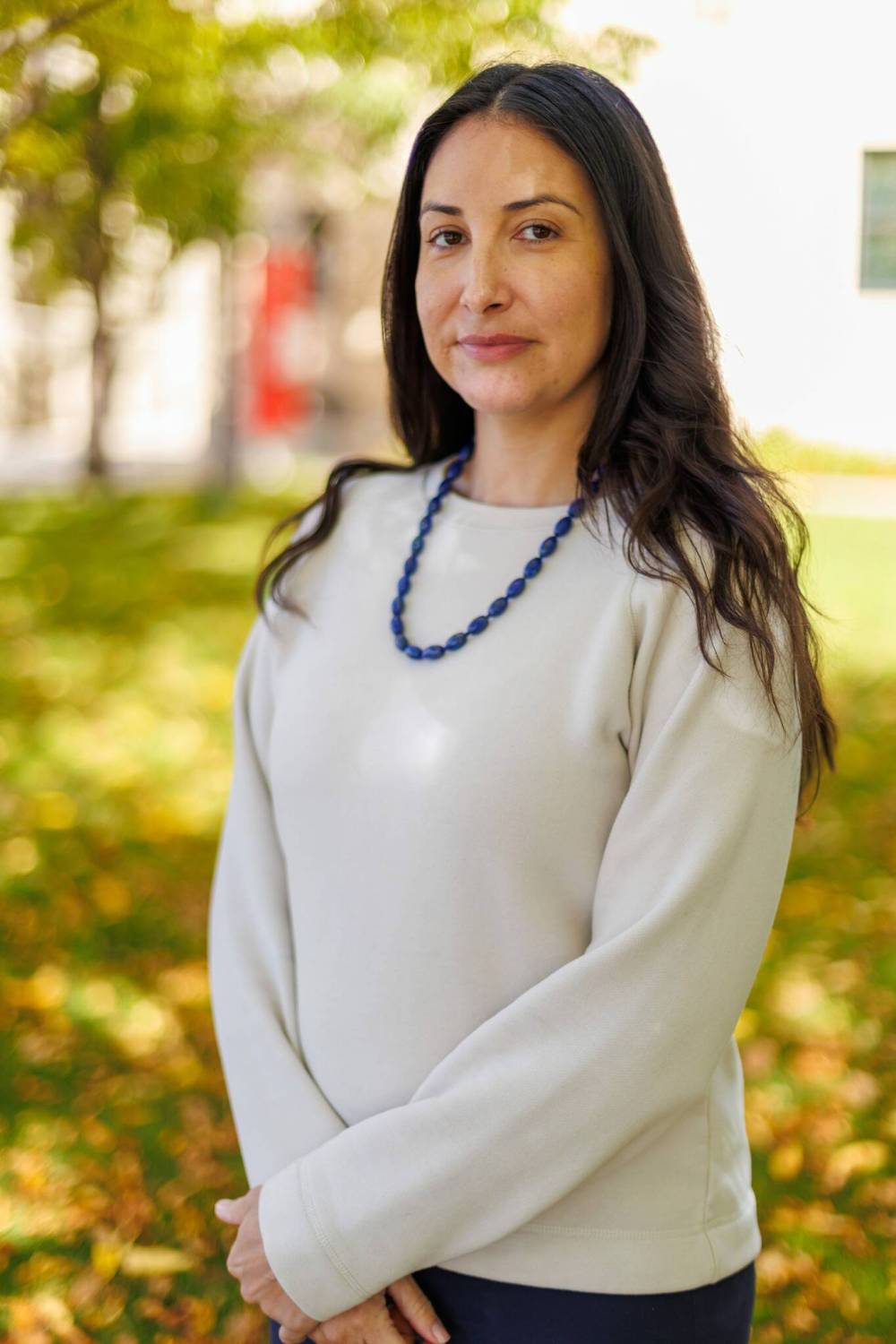
U of W Collegiate instructor Christine M’Lot
The Truth and Reconciliation Commission documented widespread abuse, including malnutrition and sexual assault, at the institutions that operated between 1831 and 1996.
The commission documented 3,200 deaths, although the true figure is believed to be far greater due to poor record-keeping.
“Gramma Shingoose has been dealing with a lot lately in terms of residential school denialists and she’s been dealing with a lot of hate online,” M’Lot said.
“I wanted to create a space where she could see that, (in reality), the vast majority of people and students believe you and empathize with you and honour you.”
A prominent figure in the residential school denialism movement has visited U of W for two consecutive years in the leadup to the National Day for Truth and Reconciliation, also known as Orange Shirt Day on Sept. 30.
“That makes me so mad,” said Setayesh Khasheei, 15, about all the misconceptions, negative stereotypes and false information that continues to circulate about First Nations, Métis and Inuit people.
The Grade 10 student produced an animated short fim of a girl attending residential school for her spring TRC course.
“(Imagine) someone coming into your house, taking your things and then telling you that you don’t belong here,” Setayesh said.
Senior administration on the campus encompassing the high school, in collaboration with faculty and student leaders, issued a public statement on Sept. 17 to condemn Frances Widdowson for harassing Indigenous students, employees and community members.
“We unequivocally denounce any attempts to deny or downplay the harms that residential schools, day schools, and other acts of genocide against Indigenous peoples have caused,” it said.

High school students at U of W expressed concerns their counterparts elsewhere in the province don’t have to take a TRC course to graduate.
“They really should,” said Nazareth Mallett, a Grade 10 student who sewed a ribbon shirt to honour his late uncle for his final assignment.
The teenage boy had help from his grandmother, Sharon Mallett, the Red River Métis founder of the Black Ribbon Shirt Project.
Nazareth said he wanted to promote the project to raise awareness about Indigenous men and boys’ mental health, addiction and disappearances.
maggie.macintosh@freepress.mb.ca
Maggie Macintosh
Education reporter
Maggie Macintosh reports on education for the Free Press. Originally from Hamilton, Ont., she first reported for the Free Press in 2017. Read more about Maggie.
Funding for the Free Press education reporter comes from the Government of Canada through the Local Journalism Initiative.
Every piece of reporting Maggie produces is reviewed by an editing team before it is posted online or published in print — part of the Free Press‘s tradition, since 1872, of producing reliable independent journalism. Read more about Free Press’s history and mandate, and learn how our newsroom operates.
Our newsroom depends on a growing audience of readers to power our journalism. If you are not a paid reader, please consider becoming a subscriber.
Our newsroom depends on its audience of readers to power our journalism. Thank you for your support.
Maggie Macintosh
Education reporter
Maggie Macintosh reports on education for the Free Press. Originally from Hamilton, Ont., she first reported for the Free Press in 2017. Read more about Maggie.
Funding for the Free Press education reporter comes from the Government of Canada through the Local Journalism Initiative.
Every piece of reporting Maggie produces is reviewed by an editing team before it is posted online or published in print — part of the Free Press‘s tradition, since 1872, of producing reliable independent journalism. Read more about Free Press’s history and mandate, and learn how our newsroom operates.
Our newsroom depends on a growing audience of readers to power our journalism. If you are not a paid reader, please consider becoming a subscriber.
Our newsroom depends on its audience of readers to power our journalism. Thank you for your support.
Advertisement Advertise With Us
Advertisement Advertise With Us