Amazon rift: Five things to know about the dispute between an Indigenous chief and Belgian filmmaker
Advertisement
Read this article for free:
or
Already have an account? Log in here »
To continue reading, please subscribe:

Digital Subscription
One year of digital access for only $205*
- Enjoy unlimited reading on winnipegfreepress.com
- Read the E-Edition, our digital replica newspaper
- Access News Break, our award-winning app
- Play interactive puzzles
*First annual payment billed as $205.00 + GST for one year. This annual subscription will automatically renew at $233.00 + GST every 52 weeks (10% off the regular annual price of $259.35). Offer available to new and qualified returning subscribers only. Cancel any time.
To continue reading, please subscribe:
Add Free Press access to your Brandon Sun subscription for only an additional
$1 for the first 4 weeks*
- Enjoy unlimited reading on winnipegfreepress.com
- Read the E-Edition, our digital replica newspaper
- Access News Break, our award-winning app
- Play interactive puzzles
*Your next Brandon Sun subscription payment will increase by $1.00 and you will be charged $17.95 plus GST for four weeks. After four weeks, your payment will increase to $24.95 plus GST every four weeks.
Read unlimited articles for free today:
or
Already have an account? Log in here »
Hey there, time traveller!
This article was published 13/12/2023 (1024 days ago), so information in it may no longer be current.
RIO DE JANEIRO (AP) — The renowned chief from the Amazon rainforest and the Belgian filmmaker appeared to be close friends at this year’s Cannes Film Festival. Far from the flashing cameras, however, their decades-long partnership was nearing its end.
With his feathered crown and wooden lip plate, Chief Raoni of the Kayapo tribe is instantly recognizable the world over. He has met with presidents, royals and celebrities to raise funds for Brazil’s Indigenous peoples and to protect their lands. Almost always in the background was a less familiar face, that of Jean-Pierre Dutilleux, whose documentary about Raoni was a 1979 Oscar nominee. In the years since, he has acted as Raoni’s gatekeeper abroad and brokered meetings with leaders and luminaries. But many Kayapo and others who crossed Dutilleux’s path harbored growing suspicions about him.
The Associated Press interviewed dozens of people over nearly a year — including both Raoni and Dutilleux — to provide an inside look at the falling out and what it signals about efforts to preserve the Amazon.
HOW DID THEY RAISE MONEY?
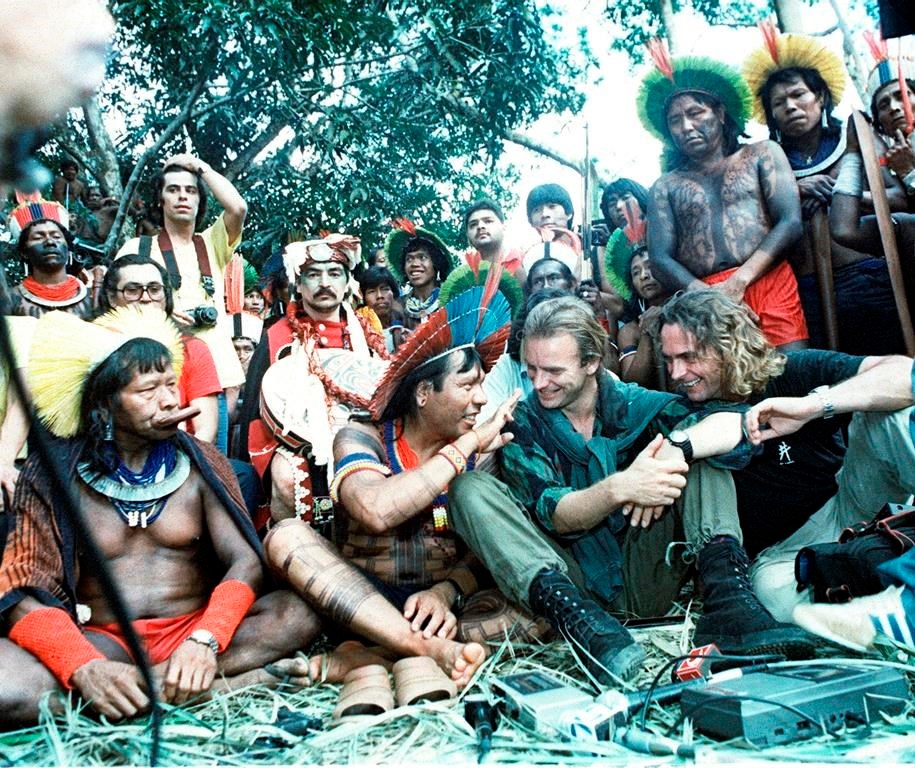
The two repeatedly traveled to Europe, meeting with leaders including French Presidents Jacques Chirac and Emmanuel Macron, Leonardo DiCaprio, Monaco’s Prince Albert II, the Grand Duke Henri of Luxembourg and even Pope Francis. At each of those encounters, they sought contributions to help Raoni’s people and other Indigenous groups in the Amazon — and secured pledges for hundreds of thousands of dollars over the years. They also hosted galas, charity dinners and auctions for private donors.
Dutilleux launched the Rainforest Foundation with music legend Sting, who put down his guitar to travel the world with Raoni and Dutilleux to spotlight the plight of Indigenous people. Their efforts largely contributed to the Brazilian government’s recognition -– and, theoretically, protection -– of the Menkragnoti Indigenous Territory, an area of 5 million hectares (19,000 square miles). Several films and books about the Indigenous chief, including one about their tour with Sting, yielded royalties. Dutilleux also raised money in Raoni’s name through Association Forêt Vierge, one of the several non-profit groups created to receive donations during his tour with Sting.
WHAT ARE THE ACCUSATIONS?
The tribal leader, two other members of his non-profit group, the Raoni Institute, and Raoni’s future successor as leader of the tribe all said Dutilleux over the last two decades repeatedly promised them large sums of money to fund social projects but only delivered a fraction of it. They said he also refused to be transparent about money raised in Raoni’s name on their tours of Europe, or from his books and films about the Kayapo.
“My name is used to raise money,” Raoni told The Associated Press in an interview in Brasilia. “But Jean-Pierre doesn’t give me much.”
Others who have come to work with Dutilleux in the Amazon over the years have also expressed concerns about the filmmaker’s relationship with Raoni. In interviews with the AP, many have complained about his lack of transparency when it came to raising funds for Indigenous peoples.
Some directly suffered from it, including Spanish photographer Alexis de Vilar, whose non-profit group was in charge of organizing a charity gala for the U.S. premiere of Dutilleux’s “Raoni” documentary in 1979. The funds were supposed to go to Indigenous peoples in Brazil and the U.S. Dutilleux had been in charge of collecting money from ticket sales for the event, but never turned over any amount, de Vilar said. “There was no money, not even to build a school,” de Vilar said.
Sting accused Dutilleux in 1990 of keeping all royalties from the book about their tour, rather than giving them to the Rainforest Foundation as was promised on the book’s cover. As a result, the Rainforest Foundation removed him as a trustee.
HOW MUCH OF THE TOTAL RAISED WAS PROVIDED TO INDIGENOUS PEOPLE?
AP was not able to determine the amount of money raised over the last five decades.
Association Forêt Vierge president Robert Dardanne told the AP that the group gave the Raoni Institute all the money that it was owed. The organization provided records indicating it sent 14,200 euros ($15,300) after a 2011 fund-raising trip and a little over 80,000 euros ($86,000) after a 2019 campaign. But it did not supply records for at least four previous campaigns, saying that under French law it was only required to retain such records for a decade.
Raoni and others close to him say these amounts pale in comparison with the millions of dollars that Dutilleux has repeatedly promised them.
Dardanne said he believed a lack of communication between the chief and the Raoni Institute was at the root of the chief’s discontent. “There is sometimes a gap between the expectations of Indigenous communities and reality,” he said.
WHAT DOES DUTILLEUX SAY?
Dutilleux told the AP that he never had access to the money raised and denied Raoni’s claims that he had failed to deliver.
“He can sometimes say things like that, it has to do with age. Maybe it’ll happen to me too, to say stupid things,” Dutilleux, now 74, said in an interview in Paris. “I want nothing to do with money. It doesn’t interest me. I’m a filmmaker, I’m an artist. I’m not an accountant.”

He maintains that the gala in Mann’s Chinese Theatre did not generate any profit and said his relationship with Sting had broken down due to their “different visions,” without elaborating.
Dutilleux said criticism of his legacy in the Amazon involved “three or four people” who were trying to take him down. The AP spoke to more than two dozen people for this story.
WHY DID RAONI KEEP FUNDRAISING WITH DUTILLEUX FOR SO LONG?
Despite the Kayapo’s suspicions that stretch back nearly 20 years, Raoni’s inner circle believed he could not abandon Dutilleux. It was a decision, they said, rooted in the centuries-old power imbalance that exists when an Indigenous tribe partners with an influential white man. In short, Raoni needed help from someone — anyone — for preservation of the Amazon, and Dutilleux was willing and able to open doors to international donors.
“He sees far beyond petty quarrels between egos and clans,” said French environmentalist Philippe Barre, who has worked with Raoni in the past. “What matters to him is that the important subjects emerge … even if some feather their own nests in the process.”