King Charles III’s cancer diagnosis lays bare pressures at Buckingham Palace

Advertisement

Advertise with us

LONDON (AP) — King Charles III’s cancer diagnosis heaps more pressure on the British monarchy, which is still evolving after the 70-year reign of the late Queen Elizabeth II.

Read this article for free:


or

Already have an account? Log in here »

To continue reading, please subscribe:

Subscribe and receive a limited-edition Free Press branded hat or tote.

Digital Subscription

One year of digital access for only $205*

  • Enjoy unlimited reading on winnipegfreepress.com
  • Read the E-Edition, our digital replica newspaper
  • Access News Break, our award-winning app
  • Play interactive puzzles

*First annual payment billed as $205.00 + GST for one year. This annual subscription will automatically renew at $233.00 + GST every 52 weeks (10% off the regular annual price of $259.35). Offer available to new and qualified returning subscribers only. Cancel any time.

To continue reading, please subscribe:

Add Free Press access to your Brandon Sun subscription for only an additional

$1 for the first 4 weeks*

  • Enjoy unlimited reading on winnipegfreepress.com
  • Read the E-Edition, our digital replica newspaper
  • Access News Break, our award-winning app
  • Play interactive puzzles
Start now

*Your next Brandon Sun subscription payment will increase by $1.00 and you will be charged $17.95 plus GST for four weeks. After four weeks, your payment will increase to $24.95 plus GST every four weeks.

Hey there, time traveller!
This article was published 06/02/2024 (966 days ago), so information in it may no longer be current.

LONDON (AP) — King Charles III’s cancer diagnosis heaps more pressure on the British monarchy, which is still evolving after the 70-year reign of the late Queen Elizabeth II.

When he succeeded his mother 17 months ago, Charles’ task was to demonstrate that the 1,000-year-old institution remains relevant in a modern nation whose citizens come from all corners of the globe. Now the king, who turned 75 in November, will have to lead that effort while undergoing cancer treatment.

Buckingham Palace announced Monday that Charles had been diagnosed with an undisclosed form of cancer. The king plans to continue fulfilling his state duties, such as reviewing government papers and meeting with the prime minister, but he will step back from public appearances.

FILE - Britain's Prince Harry, left, and Meghan, Duchess of Sussex, arrive for a visit at the town hall in Duesseldorf, Germany on Sept. 6, 2022. King Charles III's cancer diagnosis heaps more pressure on the British monarchy, which is still evolving after the 70-year reign of the late Queen Elizabeth II. Charles' relationship with his younger son has been strained even before Harry and the Duchess of Sussex moved closer to the former Meghan Markle's California home and left royal duty in 2020. Charles told Harry the news about his cancer, and his son traveled to the U.K. soon after it was announced. (AP Photo/Martin Meissner, File)

While royal experts say the diagnosis is unlikely to destabilize the House of Windsor, significant pressures remain.

Here is a look at the major challenges facing the royal family.

AGING MONARCH

Charles waited almost 74 years — longer than any previous heir — to become king. Now, at an age when most of his contemporaries are well into retirement, Charles has had less than two years to put his stamp on the monarchy.

Although the duties of a constitutional monarch are largely ceremonial, the royal whirl can be exhausting. Besides the occasional procession in full royal regalia, there are meetings with political leaders, dedication ceremonies and events honoring the accomplishments of British citizens. That added up to 161 days of royal engagements during Charles’s first year on the throne.

The pressures on an aging monarch aren’t unique to Charles. Denmark’s Queen Margrethe became the first Danish monarch to abdicate in nearly 900 years last month when she handed over the throne to her son, Frederik. Margrethe, 83, had always maintained she wouldn’t quit.

But Britain isn’t Denmark. Queen Elizabeth II stuck by a commitment to devote her life to service before she died on the throne at the age of 96. Charles made a similar commitment during his coronation.

“I don’t think he will go anywhere anytime soon,” said Joe Little, managing editor of Majesty Magazine. “I still think that abdication is not a word that is bandied about at Buckingham Palace. I mean, who knows what the coming years will bring, but with the best will in the world, Charles III will reign as his mother did, and until the moment of his death.”

A SHRINKING WORKFORCE

Charles’ illness comes at an awkward time as he cuts costs, in part by reducing the number of “working royals.”

Not only is Charles stepping away from public duties, his daughter-in-law, Kate, the Princess of Wales, isn’t expected to resume her royal tasks until April after recent abdominal surgery.

With two of the most visible family members out sick, it will be more challenging for the family to keep up. Hundreds of charities look to their connections to the royals to keep interest in their work at a high level.

Who will cut the ribbons, open the swimming pools, shake the hands of civic leaders at institutions across the land if not the Windsors?

“They are resilient. Lord knows the royal family’s been through a lot of things over the years … and they’ve bounced back. But the underlying fact is …. he is 75. The queen is 76,” said Sally Bedell Smith, author of “Prince Charles: The Passions and Paradoxes of an Improbable Life.″

“It’s a reminder that they are vulnerable in ways that people haven’t particularly liked to think.”

HARRY & MEGHAN

Charles’ relationship with his younger son was strained even before Harry and the Duchess of Sussex moved closer to the former Meghan Markle’s home in California and left royal duties in 2020.

Charles told Harry the news about his cancer, and his son traveled to the U.K. soon after it was announced.

But with his book “Spare” and his Netflix series, Harry has been a shadow over the early years of the monarch’s reign. Can illness offer an opportunity for reconciliation?

“That can only be a good sign,” Little said of Harry’s visit. “What will come of that remains to be seen. It’s unlikely that we will be told anything officially by the palace. So, again, a lot of conjecture will come into play. But we think the king and his younger son haven’t seen each other since the coronation back in May.”
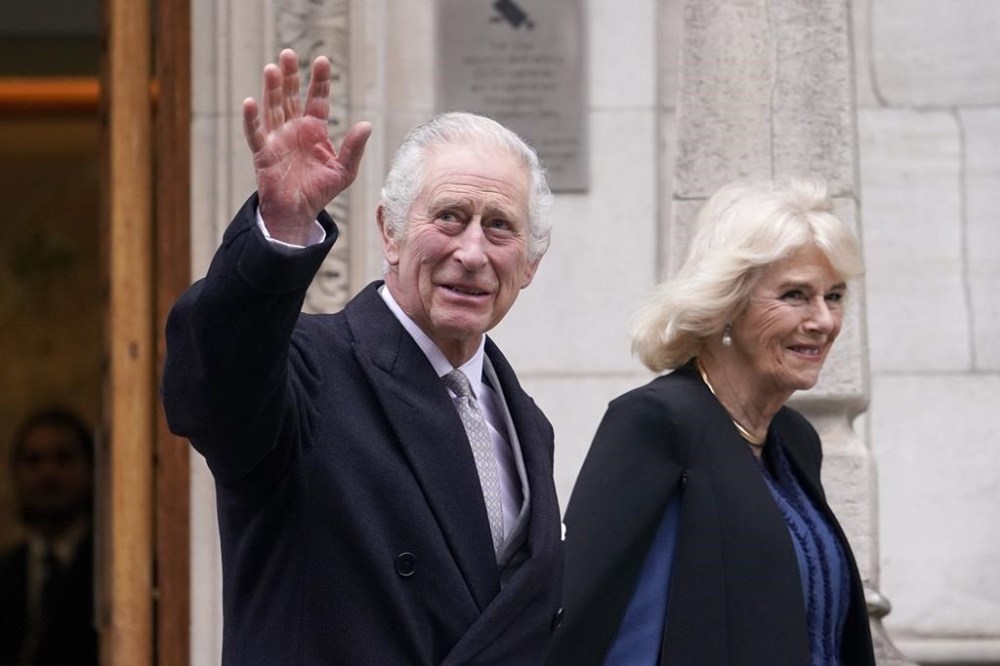
FLE - Britain's King Charles III and Queen Camilla leave The London Clinic in central London on Jan. 29, 2024. King Charles III was in hospital to receive treatment for an enlarged prostate. The king's cancer diagnosis heaps more pressure on the British monarchy, which is still evolving after the 70-year reign of the late Queen Elizabeth II. When he succeeded his mother 18 months ago, Charles' task was to demonstrate that the 1,000-year-old institution remains relevant in a modern nation whose citizens come from all corners of the globe. Now the king, who turned 75 in November, will have to lead that effort while undergoing treatment for cancer. (AP Photo/Alberto Pezzali, File)

“So, it’ll be a welcome meeting from both sides.”

THE MONARCHY’S RELEVANCE

Charles reigns over a country that looks much different from the one his mother inherited in 1952.

Over the past seven decades, the U.K. has become a multi-cultural nation where school children speak more than 300 languages and less than half the population identifies as Christian.

Against this backdrop, Charles has tried to demonstrate the continuing relevance of the monarchy by reaching out to faith leaders, ethnic minorities and each of the four nations that make up the United Kingdom.

Supporters argue this is what makes the monarchy so important. The crown is a unifying force, a symbol of stability in a rapidly changing world and a reminder of the common history and traditions that unite a nation of 67 million people.

But others see a hereditary monarch as anachronistic, a vestige of Britain’s feudal past that can’t possibly represent the people of today. During Charles’ coronation, republican campaigners staged protests calling for the monarchy to be replaced by an elected head of state.

“The monarchy serves at the pleasure of the people. And the people need to believe that the monarchy is in tune with what’s going on in the world,” Smith said. “And, and I think that’s a kind of constant challenge.”

LEGACY OF EMPIRE

While the monarchy is a symbol of Britain’s history, that can be a two-edged sword.

The crown is also a reminder of the British Empire’s dominance of Indigenous people around the world and its role in the trans-Atlantic slave trade.

Charles faces pressure to address these issues, including from Prince Harry, who has called on the royal family to confront its unconscious racism, and Caribbean nations seeking reparations for slavery.

The king responded to these calls by opening the royal archives to scholars researching the monarchy’s links to the slave trade.

He also addressed the misdeeds of Britain’s colonial history during a state visit to Kenya in October.

“The wrongdoings of the past are a cause of the greatest sorrow and the deepest regret,” Charles said during that visit. “There were abhorrent and unjustifiable acts of violence committed against Kenyans as they waged … a painful struggle for independence and sovereignty — and for that, there can be no excuse.”

“In coming back to Kenya, it matters greatly to me that I should deepen my own understanding of these wrongs, and that I meet some of those whose lives and communities were so grievously affected.”

Report Error Submit a Tip

More Stories

Is another goalie on Jets’ wish list?

Ken Wiebe 7 minute read Preview

Is another goalie on Jets’ wish list?

Ken Wiebe 7 minute read Sunday, Sep. 27, 2026

Kevin Cheveldayoff and company are down to the short strokes.

With the opening-day roster due on Monday afternoon, the Winnipeg Jets took steps on the weekend to get down to the final number.

As it stood on Sunday, the Jets were down to 24 healthy players in training camp after centre Danny Zhilkin and defenceman Henry Thrun were placed on waivers.

With a maximum of 23 spots available, the only things left to determine are whether the Jets are interested in claiming a more experienced goalie to serve as the backup to Stuart Skinner and if centre Brayden Yager will break camp with the big club.

Read
Sunday, Sep. 27, 2026

Khan cites infighting, quits as Tory leader

Carol Sanders 5 minute read Preview

Khan cites infighting, quits as Tory leader

Carol Sanders 5 minute read Updated: 9:56 AM CDT

Manitoba’s Leader of the Opposition is stepping down.

Progressive Conservative Leader Obby Khan announced late Monday afternoon he is quitting caucus and will sit in the legislature as an independent MLA, effective today.

He cited internal party fighting for his decision.

The former Winnipeg Blue Bombers offensive lineman survived a caucus confidence vote Friday. He said there were 13 votes for him to remain and six against, with one person absent.

Read
Updated: 9:56 AM CDT

Wab Kinew as ‘communicator in chief’

Paul G. Thomas 6 minute read Preview

Wab Kinew as ‘communicator in chief’

Paul G. Thomas 6 minute read Yesterday at 2:00 AM CDT

Premier Wab Kinew and his party have been riding high in the polls longer than normal for a government one year or less away from its first re-election contest. One reason is his ubiquitous, dominating communications presence as NDP leader and premier.

The argument here is that Kinew has supplemented his prerogatives as premier and party leader (such as appointing cabinet ministers and approving party nominations) with the skilful use of communications to advance his policy agenda, boost his personal popularity and maintain the competitive advantage of his party over the opposition Progressive Conservatives.

Communications has always been a significant part of politics and policy making. However, in the contemporary political and media environments, communications considerations have moved from the background to the foreground of decision-making by political parties, including when they are performing in the role of government. Campaigning and governing now overlap in what has been described as a permanent election campaign.

Political parties use communications strategies for several purposes: to establish an image of the leader which makes a positive emotional connection with voters; to promote a coherent message and to keep party members on message; and to gain favourable media coverage for its policies and other actions on almost a daily basis.

Read
Yesterday at 2:00 AM CDT

Perfumer battling city hall to keep his shop open

Gabrielle Piché 5 minute read Preview

Perfumer battling city hall to keep his shop open

Gabrielle Piché 5 minute read Yesterday at 5:45 PM CDT

Michael O’Malley has been here before — fighting the City of Winnipeg to keep his business open.

He usually spends his days concocting scents. He’s owned La Parfumerie, a Wolseley shop, since 1993.

Twenty-seven natural perfumes line shelves on 145 Evanson St.’s bottom floor. O’Malley lives above the space.

Now, he’s required to change the home’s zoning or shut out walk-in customers. Either would kill the company, O’Malley said.

Read
Yesterday at 5:45 PM CDT

Canada resorting to its tried and true playbook

Niigaan Sinclair 5 minute read Preview

Canada resorting to its tried and true playbook

Niigaan Sinclair 5 minute read Yesterday at 6:00 AM CDT

In 1846, Britain faced an emergency influenced by the Irish famine, so leaders repealed the country’s “Corn Laws” and restrictions on imported food and grain, transitioning to a system of free trade.

This created a crisis in the then Province of Canada, which had relied on British “preferential” status to prop up its agricultural and resource industries.

As a result, Canada looked south for new markets and eventually negotiated a free trade agreement with the United States.

This required land to be acquired and converted for industrial use quickly, so Canada quickly dispatched Commissioner William Robinson to negotiate with Indigenous communities along Lake Huron and Lake Superior for land.

Read
Yesterday at 6:00 AM CDT

Dealing now with increasing judicial dangers

Ben Wickstrom 5 minute read 2:00 AM CDT

For years, the Manitoba Association of Crown Attorneys (“MACA”) has been engaged in a dispute with the Manitoba government over the workload of its lawyers. That dispute is expected to come to a head at the end of November, when two weeks of grievance hearings are scheduled.

We remain hopeful that we can reach an agreement with our employer. But if we cannot, our union’s lawyers are prepared to make our case. As those hearings approach, we want to explain how we got here, what is at stake, and why this dispute matters beyond the working conditions of our members.

These problems are longstanding and predate the election of Manitoba’s current government. Our concern with the current government is not that it created these problems, but that it is now responsible for addressing them.

Despite the evidence before it, the government has not meaningfully addressed the workload concerns we have raised throughout its time in office.