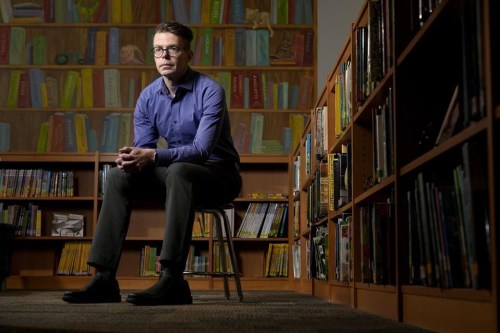
Librarians fear new penalties, even prison, as activists challenge books
Advertisement
Read this article for free:
or
Already have an account? Log in here »
To continue reading, please subscribe:

Digital Subscription
One year of digital access for only $205*
- Enjoy unlimited reading on winnipegfreepress.com
- Read the E-Edition, our digital replica newspaper
- Access News Break, our award-winning app
- Play interactive puzzles
*First annual payment billed as $205.00 + GST for one year. This annual subscription will automatically renew at $233.00 + GST every 52 weeks (10% off the regular annual price of $259.35). Offer available to new and qualified returning subscribers only. Cancel any time.
To continue reading, please subscribe:
Add Free Press access to your Brandon Sun subscription for only an additional
$1 for the first 4 weeks*
- Enjoy unlimited reading on winnipegfreepress.com
- Read the E-Edition, our digital replica newspaper
- Access News Break, our award-winning app
- Play interactive puzzles
*Your next Brandon Sun subscription payment will increase by $1.00 and you will be charged $17.95 plus GST for four weeks. After four weeks, your payment will increase to $24.95 plus GST every four weeks.
Read unlimited articles for free today:
or
Already have an account? Log in here »
Hey there, time traveller!
This article was published 09/04/2024 (919 days ago), so information in it may no longer be current.
When an illustrated edition of Margaret Atwood’s “The Handmaid’s Tale” was released in 2019, educators in Clayton, Missouri needed little debate before deciding to keep copies in high school libraries. The book is widely regarded as a classic work of dystopian literature about the oppression of women, and a graphic novel would help it reach teens who struggle with words alone.
But after Missouri legislators passed a law in 2022 subjecting librarians to fines and possible imprisonment for allowing sexually explicit materials on bookshelves, the suburban St. Louis district reconsidered the new Atwood edition, and withdrew it.
“There’s a depiction of a rape scene, a handmaid being forced into a sexual act,” says Tom Bober, Clayton district’s library coordinator and president of the Missouri Association of School Librarians. “It’s literally one panel of the graphic novel, but we felt it was in violation of the law in Missouri.”

Across the country, book challenges and bans have soared to the highest levels in decades. Public and school-based libraries have been inundated with complaints from community members and conservative organizations such as as Moms for Liberty. Increasingly, lawmakers are considering new punishments — crippling lawsuits, hefty fines, and even imprisonment — for distributing books some regard as inappropriate.
The trend comes as officials seek to define terms such as “obscene” and “harmful.” Many of the conflicts involve materials featuring racial and/or LGBTQ+ themes, such as Toni Morrison’s novel, “The Bluest Eye,” and Maia Kobabe’s memoir, “Gender Queer.” And while no librarian or educator has been jailed, the threat alone has led to more self-censorship.
Already this year, lawmakers in more than 15 states have introduced bills to impose harsh penalties on libraries or librarians.
Utah enacted legislation in March that empowers the state’s Attorney General to enforce a new system of challenging and removing “sensitive” books from school settings. The law also creates a panel to monitor compliance and violations.
Awaiting Idaho Gov. Brad Little’s signature is a bill that empowers local prosecutors to bring charges against public and school libraries if they don’t move “harmful” materials away from children.
“The laws are designed to limit or remove legal protections that libraries have had for decades,” says Deborah Caldwell-Stone, director of the American Library Association’s Office for Intellectual Freedom.
Since the early 1960s, institutions including schools, libraries and museums — as well as educators, librarians and other staffers who distribute materials to children — have largely been exempt from expensive lawsuits or potential criminal charges.
These protections began showing up in states as America grappled with standards surrounding obscenity, which was defined by the Supreme Court in 1973.
Ruling 5-4 in Miller v. California, the justices said obscene materials are not automatically protected by the First Amendment, and offered three criteria that must be met for being labeled obscene: whether the work, taken as a whole, appeals to “prurient interest,” whether “the work depicts or describes, in a patently offensive way, sexual conduct specifically defined by the applicable state law,” and whether the work lacks “serious literary, artistic, political, or scientific value.”
Eventually, almost every state adopted protections for educators, librarians and museum officials, among others who provide information to minors.
“Until recently, police and prosecutors were unable to pursue charges against public libraries over materials that make certain individuals uncomfortable. These exemptions have prevented spurious prosecutions of teachers over health and sexuality curriculum, art, theater, and difficult subjects in English classes,” stated a 2023 report from EveryLibrary, a national political action committee that opposes censorship.
Arkansas and Indiana targeted educators and librarians with criminalization laws last year. Tennessee criminalized publishers that provide “obscene” materials to public schools.
Some Republicans are seeking penalties and restrictions that would apply nationwide. Referring to “pornography” in the foreword to Project 2025, the Heritage Foundation’s blueprint for a possible second Donald Trump administration, the right-wing group’s president, Kevin Roberts, wrote that the “people who produce and distribute it should be imprisoned. Educators and public librarians who purvey it should be classed as registered sex offenders.”
Arkansas’ version was temporarily blocked by a federal judge after a coalition of librarians and publishers challenged the legality of subjecting librarians and booksellers to criminal charges if they provide “harmful” materials to minors.
Indiana lawmakers stripped away “educational purposes” as a defense for school librarians and educators charged with giving minors “obscene” or “harmful” material — felonies punishable by up to 2 1/2 years in jail and $10,000 in fines. The law also requires public catalogs of what’s in each school library and systems for responding to complaints.
Indiana’s law took effect January 1. It’s likely a matter of when — not if — a lawsuit is filed, and the anxiety has created a chilling effect.

“It’s putting fear into some people. It’s very scary,” said Diane Rogers, a school librarian who serves as president of the Indiana Library Federation. “If you’re a licensed teacher just being charged with a felony potentially gets rid of your license even if you’re found innocent. That’s a very serious thing.”
Rogers said she’s confident Indiana’s school libraries don’t offer obscene materials, but she’s seen reports that some districts have moved certain titles to higher age groups or required parental approval to check them out.
A PEN America list shows 300 titles were removed from school libraries across 11 Missouri districts after lawmakers in 2022 banned “sexually explicit” material, punishable by up to a year in jail or a $2,000 fine. The American Civil Liberties Union of Missouri and library groups challenged the law last year, but it remains in effect pending a motion for the state to intervene.
“Gender Queer” is another title no longer available to high schoolers in Clayton, where district officials recently turned their attention to Mike Curato’s graphic novel, “Flamer,” about a teenager who struggles with his sexual identity and how to fit in at Boy Scout camp. The American Library Association included “Flamer” on its list of 2023’s most challenged and/or banned books.
“We had a lot of conversations about how to interpret the law and not be in violation,” Bober said. “But we also didn’t want to overreach and overcensor our collections. With ‘Flamer,’ we did not feel we were in violation of the law.”