‘Language is identity’: Indigenous Ontario legislator to make history at Queen’s Park
Advertisement
Read this article for free:
or
Already have an account? Log in here »
To continue reading, please subscribe:

Digital Subscription
One year of digital access for only $205*
- Enjoy unlimited reading on winnipegfreepress.com
- Read the E-Edition, our digital replica newspaper
- Access News Break, our award-winning app
- Play interactive puzzles
*First annual payment billed as $205.00 + GST for one year. This annual subscription will automatically renew at $233.00 + GST every 52 weeks (10% off the regular annual price of $259.35). Offer available to new and qualified returning subscribers only. Cancel any time.
To continue reading, please subscribe:
Add Free Press access to your Brandon Sun subscription for only an additional
$1 for the first 4 weeks*
- Enjoy unlimited reading on winnipegfreepress.com
- Read the E-Edition, our digital replica newspaper
- Access News Break, our award-winning app
- Play interactive puzzles
*Your next Brandon Sun subscription payment will increase by $1.00 and you will be charged $17.95 plus GST for four weeks. After four weeks, your payment will increase to $24.95 plus GST every four weeks.
Read unlimited articles for free today:
or
Already have an account? Log in here »
Hey there, time traveller!
This article was published 26/05/2024 (866 days ago), so information in it may no longer be current.
TORONTO – Decades after being punished in a residential school for speaking his own language, Sol Mamakwa will hold the powerful to account at Ontario’s legislature in the very same language past governments tried to bury.
On Tuesday, Mamakwa, the only First Nation legislator at Queen’s Park, will rise in the legislative chamber – with his mother, sister, brothers, friends and elders watching from the gallery – and ask a question in Anishininiimowin, known in English as Oji-Cree.
For the first time in its history, the Ontario legislature will allow, interpret and transcribe a language other than English and French.
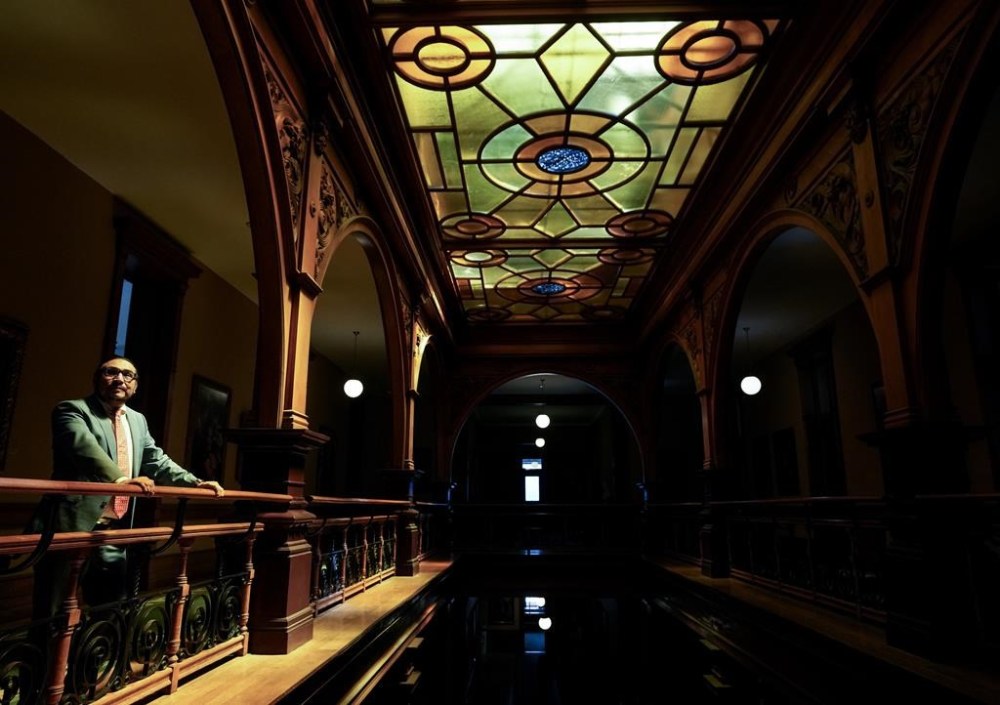
It will also be a birthday gift to his mom, Kezia Mamakwa, who turns 79 that day, and a nod to his late father, Jerry Mamakwa.
“Language is nationhood, language is identity, language is where history comes from and language is me and my people,” Sol Mamakwa, a 53-year-old NDP legislator, said in an interview.
“It’s important because there’s so many of us who are losing our languages. I think it’s a step toward reconciliation and a step toward reviving our languages.”
The federal government in decades past, with help from the Catholic and Protestant churches, tried to kill Indigenous languages through various means, including residential schools that ripped children away from their families and forced them to speak English. Indigenous languages have been slowly dying over the past century.
About 25 people from Mamakwa’s Kingfisher Lake First Nation in northwestern Ontario will travel to Toronto to watch him make history along with 75 other guests, including Indigenous leaders.
“I think about the people who have lost their language, I think about the people who were not allowed to speak their language in residential schools and I think about my mom,” Mamakwa said as he choked up. She lives with dementia and has good days and bad, he said.
His family’s pride resonates through several phone conversations.
“She’s so proud, ” Mamakwa’s sister Esther Sakakeep, said of her mother. “As I am, for my little brother. I just wish our dad would be there, but I know he will be looking down on us.”
His older brother struggled to find words to describe his feelings.
“I went to residential school, and I remember, even though I didn’t think of it much at the time as a teenager, they had told us we couldn’t speak our language, you just couldn’t and if you did, you’d be punished badly,” Jonathon Mamakwa said.
“To see this, it’s awesome.”
___
SPARKING CHANGE
A chance encounter in March between Sol Mamakwa and Government House Leader Paul Calandra triggered the change.
One evening Mamakwa found himself at a reception at Queen’s Park where he gave a speech partly in his own language and partly in English.
He told the crowd his parents taught him to speak Anishininiimowin first, and English second. He lamented the fact he could not speak his own language in the legislative assembly, then went on with his speech.
Mamakwa said his comments were deliberate, trying to plant an idea for change inside the mind of Calandra, who also spoke at the event.
It worked. Calandra was irritated, believing Mamakwa was peddling untruths.
The next morning, Mamakwa sipped coffee at the cafeteria in the basement of Queen’s Park with his northern New Democrat friends, Guy Bourgoin, a Métis man representing Mushkegowuk-James Bay, and John Vanthof, a farmer representing Timiskaming-Cochrane.
Calandra, a staunch Progressive Conservative who runs multiple ministries, strolled by with his staffers and, as he is wont to do, chirped at the Official Opposition members.
“I asked Sol if I should cross the floor to help them ask better questions,” Calandra said with a laugh.
He also chided Mamakwa for his belief he could not speak his language in the legislative chamber. Mamakwa, getting irritated himself, said he had tried to speak several times before, but was cut off by the Speaker every time.
Owen Macri, Calandra’s chief of staff and a walking encyclopedia of legislative procedures, then told his boss Mamakwa was right.
The only official languages at Queen’s Park are English and French, he told Calandra. It had been that way since Confederation in 1867, with the rules laid out in a standing order.
“For the first time in six years, I walked out of the room and said, ‘I’m wrong, you’re right,'” Calandra recalled telling Mamakwa.
Over breakfast, the pair decided to fix it.
“It was just wrong,” Calandra said. “It just seemed like this is common sense and I can’t believe that we don’t actually allow it to happen.”
Mamakwa is widely respected among the different parties. Both the governing PCs and the Ontario Liberals tried to persuade him to join their sides at some point since he was elected for the riding of Kiiwetinoong, including a personal invitation from Premier Doug Ford to cross the floor.
Within days of that encounter, Calandra’s chief of staff had two standing orders ready to go, one specifically for Mamakwa and a second allowing all future Indigenous members of the provincial parliament to speak their language.
The new rules are now enshrined: “Every Member desiring to speak must rise in his or her place and address the Speaker, in either English, French or an Indigenous language spoken in Canada. If a Member wishes to address the House in an Indigenous language, they shall, prior to taking their seat for the first time, notify the Clerk of the House of the language in which they intend to speak so the Speaker may arrange appropriate interpretation and translation capabilities.”
The change means the world to Mamakwa.
“I guess I’m friends with Paul Calandra now,” he said with a big laugh.
___
BEHIND THE SCENES
The change set in motion a flurry of activity to prepare for Tuesday.
The legislature’s broadcast and recording service department currently provides a live simultaneous interpretation of English to French or vice versa in the chamber, in committee hearings and on television and online.
Adding a third language has presented some technical challenges, said Jeff Goodman, operations manager of the broadcast service, but there are plans to address them.
On Tuesday, one Indigenous interpreter will be in a broadcast booth inside the chamber usually occupied by the French interpreter, Goodman explained. The French interpreter will shift upstairs to an empty committee interpretation booth as part of a makeshift relay that’s been set up.
When Mamakwa speaks, his words will be translatedto English and sent to the earbuds inside the house, out for broadcast and up to the French interpreter on the fifth floor for further translation – all in real-time.
The legislature may eventually need to add a third interpretationbooth to accommodate anyone speaking an Indigenous language, but they will also need to figure out how to perform the same act remotely if interpreters are not physically in Toronto.
Indigenous interpreters have been difficult to find, Goodman said, but the legislature has two Oji-Cree interpreters ready for Tuesday.
Mamakwa will speak for about 10 minutes in his language before the question period.
In addition to live translation, one interpreter will help transcribe Mamakwa’s speech and questions so they can be represented in syllabics, an Indigenous writing system, in Hansard, the official record of proceedings at Queen’s Park.
“It’s a big challenge, but, it’s amazing to see all of these different groups work together, and we’re excited to be a part of something really important,” Goodman said.
Indigenous leaders are expected to take in the historic moment, including Grand Chief Alvin Fiddler of Nishnawbe Aski Nation, which represents 49 First Nations in northwestern Ontario.
“I continue to be amazed by Sol’s leadership,” Fiddler said. “This is just an example of how effective he can be as a provincial parliamentarian to advancing our language initiatives, to restore our language and our culture and for him to do this at that level is pretty incredible.”
For Mamakwa, the change is part of his goal to better the lives of First Nations people and keep his roots strong.
“This is change for the good at Queen’s Park because there will be others behind me,” he said. “It will be a good day.”
This report by The Canadian Press was first published May 26, 2024.