Banned Books Week starts with mixed messages as reports show challenges both up and down

Advertisement

Advertise with us

NEW YORK (AP) — Two reports released Monday provide a mixed but compelling outlook on the wave of book removals and challenges as the annual Banned Books Week begins for schools, stores and libraries nationwide.

Read this article for free:


or

Already have an account? Log in here »

To continue reading, please subscribe:

Subscribe and receive a limited-edition Free Press branded hat or tote.

Digital Subscription

One year of digital access for only $205*

  • Enjoy unlimited reading on winnipegfreepress.com
  • Read the E-Edition, our digital replica newspaper
  • Access News Break, our award-winning app
  • Play interactive puzzles

*First annual payment billed as $205.00 + GST for one year. This annual subscription will automatically renew at $233.00 + GST every 52 weeks (10% off the regular annual price of $259.35). Offer available to new and qualified returning subscribers only. Cancel any time.

To continue reading, please subscribe:

Add Free Press access to your Brandon Sun subscription for only an additional

$1 for the first 4 weeks*

  • Enjoy unlimited reading on winnipegfreepress.com
  • Read the E-Edition, our digital replica newspaper
  • Access News Break, our award-winning app
  • Play interactive puzzles
Start now

*Your next Brandon Sun subscription payment will increase by $1.00 and you will be charged $17.95 plus GST for four weeks. After four weeks, your payment will increase to $24.95 plus GST every four weeks.

Hey there, time traveller!
This article was published 23/09/2024 (713 days ago), so information in it may no longer be current.

NEW YORK (AP) — Two reports released Monday provide a mixed but compelling outlook on the wave of book removals and challenges as the annual Banned Books Week begins for schools, stores and libraries nationwide.

The American Library Association found a substantial drop in 2024 so far in complaints about books stocked in public, school and academic libraries, and in the number of books receiving objections. Meanwhile, PEN America is documenting an explosion in books being removed from school shelves in 2023-24, tripling to more than 10,000 over the previous year. More than 8,000 were pulled just in Florida and Iowa, where laws restricting the content of books have been passed.

The two surveys don’t necessarily contradict each other.
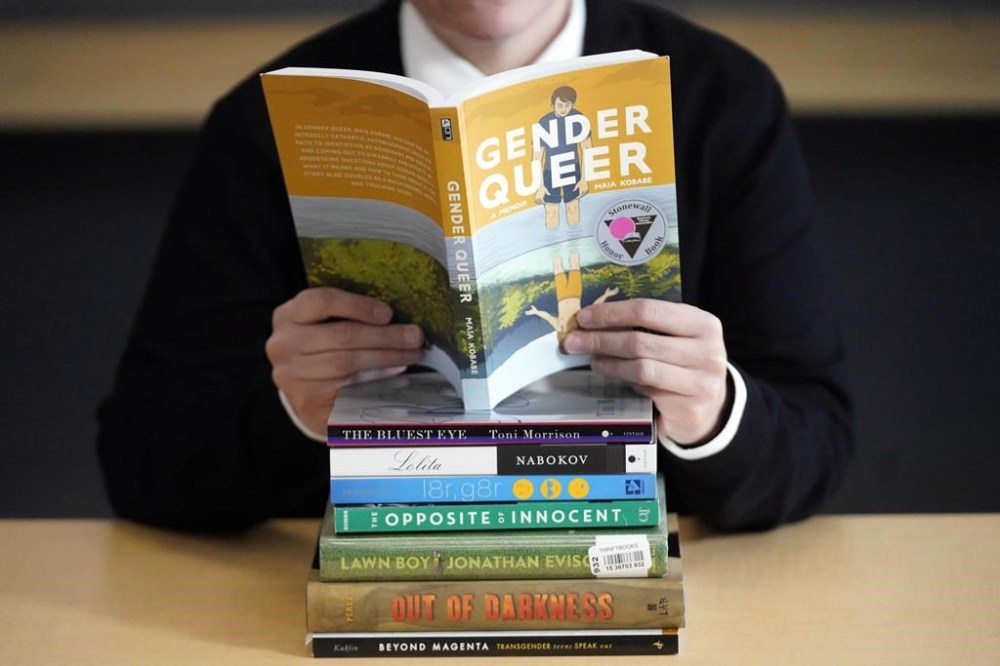
FILE - Amanda Darrow, director of youth, family and education programs at the Utah Pride Center, poses with books that have been the subject of complaints from parents, including
FILE - Amanda Darrow, director of youth, family and education programs at the Utah Pride Center, poses with books that have been the subject of complaints from parents, including "Gender Queer" by Meir Kobabe, on Dec. 16, 2021, in Salt Lake City. (AP Photo/Rick Bowmer, File)

The library association’s Office for Intellectual Freedom has recorded 414 challenges over the first eight months of 2024, with 1,128 different titles criticized. Over the same time period last year, the office tallied 695 cases, involving 1,915 books. The ALA relies on media accounts and reports from librarians and has long acknowledged that many challenges may not be included, whether because librarians preemptively withhold a book that may be controversial or decline to even acquire it.

Challenges have surged to record highs over the past few years, and the 2024 totals so far still exceed the ALA’s numbers before 2020. Deborah Caldwell-Stone, who directs the association’s Office for Intellectual Freedom, also cautioned that the numbers predate the start of the fall school year, when laws that had been on hold in Iowa will again be in effect.

“Reports from Iowa are still coming in,” she said. “And we expect that to continue through the end of the year.”

The library association defines a “challenge” as a “formal, written complaint filed with a library or school requesting that materials be removed because of content or appropriateness.” The ALA doesn’t keep a precise figure of how many books have actually been withdrawn.

According to PEN, bans are tallied through local media reports, “school district websites, and school board minutes, as well as organizational partners” such as the Florida Freedom to Read Project and Let Utah Read. The library association relies primarily on local media and accounts from public librarians. And the two organizations have differing definitions of “ban,” a key reason their numbers vary so greatly. For the ALA, a ban is the permanent removal of a book from a library’s collection. Should hundreds of books be pulled from a library for review, then returned, they are not counted as banned, but listed as a single “challenge.”

For PEN, withdrawals of any length qualify as bans.

“If access to a book is restricted, even for a short period of time, that is a restriction of free speech and free expression,” says Kasey Meehan, who directs PEN’s Freedom to Read program.

The ALA and PEN both say that most of the books targeted have racial or LGBTQIA+ themes, whether it’s Maia Kobabe’s “Gender Queen,” Toni Morrison’s “Beloved” and “The Bluest Eye” or Jonathan Evison’s “Lawn Boy.” While some complaints have come from liberals objecting to the racist language of “The Adventures of Huckleberry Finn” and other older works, the vast majority originate with conservatives and such organizations as Moms for Liberty.

The Iowa law, passed last year in the Republican-controlled statehouse, bans school libraries from carrying books that depict sex acts. The law also requires schools to publicize its library collection online and provide instructions for parents on how to request the removal of books or other materials. Many districts already had those systems in place.

After LGBTQIA+ youth, teachers and major publishers filed legal challenges, a federal judge in December put a temporary hold on key parts of the law, but it was lifted by a federal appeals court last month in an order that left room for challengers to seek a block again.

Records requests filed by the Des Moines Register with Iowa’s 325 districts showed nearly 3,400 books had been removed from school libraries to comply with the law before it was paused. In Davenport, which is among Iowa’s 10 largest districts and serves more than 12,000 students, Margaret Atwood’s “The Handmaid’s Tale,” Kabobe’s “Gender Queer” and Morrison’s “Bluest Eye” were among the nine books taken out of circulation.
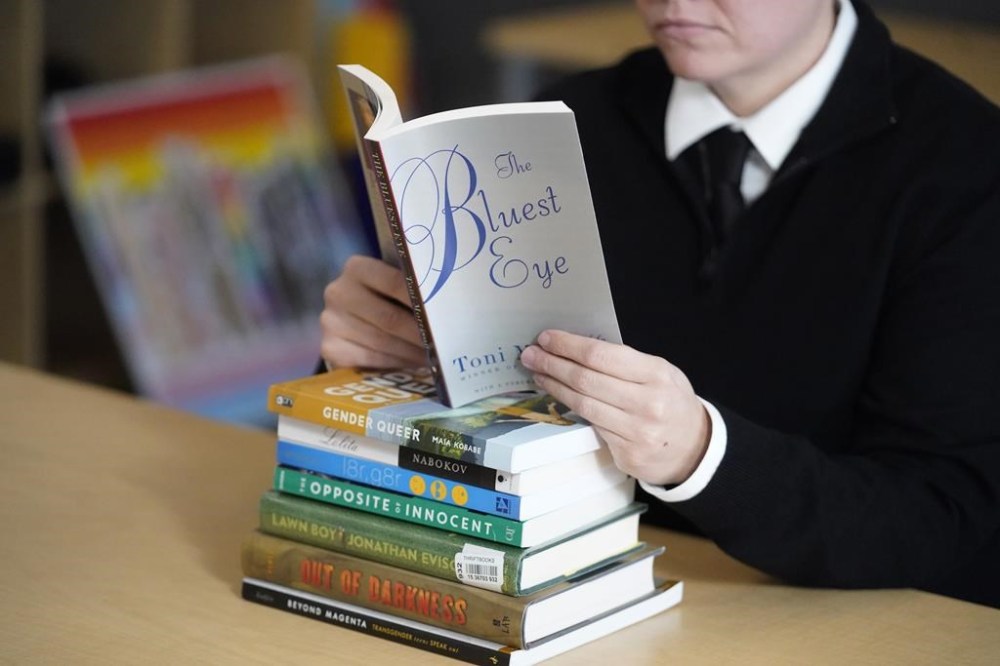
FILE - Amanda Darrow, director of youth, family and education programs at the Utah Pride Center, poses with books, including
FILE - Amanda Darrow, director of youth, family and education programs at the Utah Pride Center, poses with books, including "The Bluest Eye," by Toni Morrison, that have been the subject of complaints from parents in Salt Lake City on Dec. 16, 2021. (AP Photo/Rick Bowmer, File)

After the law passed, staff were instructed to review books in their care available to students, district communications director Sarah Ott wrote in an email.

“If any books were preliminarily identified as potentially violating the new law, building staff referred the books to district administration for official review,” according to Ott. The district administration uses a process that was already in place to review materials and ensure compliance with the law, she said.

Banned Books Week, which runs through Sunday, was established in 1982 and features readings and displays of banned works. It is supported by the ALA, PEN, the Authors Guild, the National Book Foundation and more than a dozen other organizations. Filmmaker Ava Duvernay has been named honorary chair, and student activist Julia Garnett, who has opposed bans in her native Tennessee, is the youth honorary chair. Garnett was among 15 “Girls Leading Change” praised last fall by first lady Jill Biden during a White House ceremony.

“We observe Banned Books Week, but we don’t celebrate,” Caldwell-Stone said. “Banned books are the opposite of the freedoms promised by the First Amendment.”

___

Associated Press writer Hannah Fingerhut in Des Moines, Iowa, contributed to this report.

___

This story corrects the name of author Maia Kobabe.
Report Error Submit a Tip

More Stories

Politicians who harp on Klein’s history with Nygard do so at their own peril

Tom Brodbeck 5 minute read Preview

Politicians who harp on Klein’s history with Nygard do so at their own peril

Tom Brodbeck 5 minute read Yesterday at 1:13 PM CDT

It was probably the easiest prediction to make in Winnipeg politics this week: the moment Kevin Klein officially entered the mayoral race, someone would bring up Peter Nygard.

Sure enough, they did.

And it was led by Klein’s chief political opponent in this race, Mayor Scott Gillingham, who called Klein a “fixer” for the convicted sex offender.

None of this is particularly surprising.

Read
Yesterday at 1:13 PM CDT

Art piece connects viewers to broader national landscape

Allison Gillmor 4 minute read Preview

Art piece connects viewers to broader national landscape

Allison Gillmor 4 minute read 2:01 AM CDT

WHAT IT IS: Copy Paperis a 2014 textile-based piece by Ontario-born, Winnipeg-based artist Kristin Nelson, currently on view at WAG-Qaumajuq as part of the exhibition Terra Cognita/Incognita.

Of the 125 works in the show — which uses historical and contemporary pieces from WAG-Qaumajuq’s permanent collection to explore how artists have represented the landscape over time and across cultures —probably the most attention-getting are the beautiful paintings of Canada’s lakes, plains, forests and mountains.

So, how does this seemingly modest, somewhat enigmatic work connect to Terra Cognita/Incognita’s larger themes?

WHAT IT’S ABOUT: In the middle of the exhibition, an antique desk holds several objects of beauty and utility, and this is where Copy Paper sneaks in, as something both “cognita and incognita,” known and unknown.

Read
2:01 AM CDT

‘Quite a journey’: dozens move into transitional housing downtown

Carol Sanders 4 minute read Preview

‘Quite a journey’: dozens move into transitional housing downtown

Carol Sanders 4 minute read Yesterday at 5:54 PM CDT

Dozens of residents have moved into transitional housing units in a former university building in downtown Winnipeg.

Housing, Addictions and Homelessness Minister Bernadette Smith said 42 residents have moved into suites on the third and fourth floors of a seven-storey building previously owned by Providence University College and Theological Seminary. There will be space for as many as 118 people who were in encampments or otherwise homeless.

The remaining units under renovation are expected to be ready and occupied in the coming weeks, Smith said.

“This has been two years in the making,” the minister said at a media event with residents, staff, neighbours and supporters. The building cost the province $24.4 million to purchase and renovate.

Read
Yesterday at 5:54 PM CDT

Woman died while getting wisdom teeth out; case raises questions about transparency of dental association

Nicole Buffie 5 minute read Preview

Woman died while getting wisdom teeth out; case raises questions about transparency of dental association

Nicole Buffie 5 minute read Yesterday at 7:19 PM CDT

The parents of a 23-year-old southwestern Manitoba woman who died after receiving a local anesthetic during a wisdom tooth extraction say they are in the dark about the investigation into their daughter’s death.

Dulaney and Victoria Blatz say the Manitoba Dental Association has been unwilling to give them information about the probe into their daughter’s death, saying the self-governing regulatory body must be more transparent with the public.

“We have pushed through various channels trying to get information, but it’s nothing but stalling and sidelining,” Victoria said Friday. “This has crashed our world to pieces and we just want answers.”

Virginia Blatz went to Boundary Trails Dental Centre in Morden on Nov. 27, 2024, to have her wisdom teeth removed, but never returned home.

Read
Yesterday at 7:19 PM CDT

Letters, Sept. 5

7 minute read 2:01 AM CDT

Clearing the airRe: QDoc patients in middle of billing dispute (Sept. 4)

QDoc has been fortunate to have a genuine partner in the Manitoba government over the past several years. Premier Wab Kinew and Health Minister Uzoma Asagwara have been consistently clear that no Manitoban should go without care because of where they live, and that commitment is exactly why virtual care exists as a permanent, publicly available option today. We built MediNav, the province’s online appointment booking system, together with Manitoba Health, and that same collaborative spirit has helped make more than 350,000 patient visits possible through our platform — many of them evenings, overnights and weekends, reaching rural and underserviced communities that need it most.

We want to be direct with the people who rely on us: QDoc is not going anywhere. We continue to see patients today, and we will keep doing so tomorrow. The issue reported this week is a technical billing matter, not a service disruption, and we are actively working with the province to resolve it quickly, so we can keep growing our capacity to serve Manitobans rather than limiting it.

We also want to take responsibility for our part in the recent confusion. Our Aug. 24 message to a small subset of our patients was meant to keep our community informed, but its tone left some people more worried than they needed to be, and for that we apologize. That was never our intention.

QDoc patients in tight spot over billing dispute

Chris Kitching 6 minute read Preview

QDoc patients in tight spot over billing dispute

Chris Kitching 6 minute read Thursday, Sep. 3, 2026

Manitobans have been pulled into a dispute between QDoc — a Winnipeg-based virtual health-care platform — and the NDP government over fees billed to the province for patient care.

An Aug. 24 email from QDoc to its users prompted concern or calls for clarity from Manitobans who use the 24-7 platform to see a physician or nurse practitioner through encrypted video calls.

“When I first read it, like many others, I assumed they were going to be nixing the service altogether because that’s the way it was presented,” Tyndall resident Stephanie Pituley said.

“Upon further research, obviously that’s not the case, but I am still concerned to be honest. How many people did that research, I don’t know.”

Read
Thursday, Sep. 3, 2026