Key takeaways from AP’s interview with Francis Ford Coppola about ‘Megalopolis’
Advertisement
Read this article for free:
or
Already have an account? Log in here »
To continue reading, please subscribe:

Digital Subscription
One year of digital access for only $205*
- Enjoy unlimited reading on winnipegfreepress.com
- Read the E-Edition, our digital replica newspaper
- Access News Break, our award-winning app
- Play interactive puzzles
*First annual payment billed as $205.00 + GST for one year. This annual subscription will automatically renew at $233.00 + GST every 52 weeks (10% off the regular annual price of $259.35). Offer available to new and qualified returning subscribers only. Cancel any time.
To continue reading, please subscribe:
Add Free Press access to your Brandon Sun subscription for only an additional
$1 for the first 4 weeks*
- Enjoy unlimited reading on winnipegfreepress.com
- Read the E-Edition, our digital replica newspaper
- Access News Break, our award-winning app
- Play interactive puzzles
*Your next Brandon Sun subscription payment will increase by $1.00 and you will be charged $17.95 plus GST for four weeks. After four weeks, your payment will increase to $24.95 plus GST every four weeks.
Read unlimited articles for free today:
or
Already have an account? Log in here »
Hey there, time traveller!
This article was published 24/09/2024 (725 days ago), so information in it may no longer be current.
NEW YORK (AP) — Francis Ford Coppola believes he can stop time.
It’s not just a quality of the protagonist of Coppola’s new film “Megalopolis,” a visionary architect named Cesar Catilina ( Adam Driver ) who, by barking “Time, stop!” can temporarily freeze the world for a moment before restoring it with a snap of his fingers. And Coppola isn’t referring to his ability to manipulate time in the editing suite. He means it literally.
“We’ve all had moments in our lives where we approach something you can call bliss,” Coppola says. “There are times when you have to leave, have work, whatever it is. And you just say, ‘Well, I don’t care. I’m going to just stop time.’ I remember once actually thinking I would do that.”
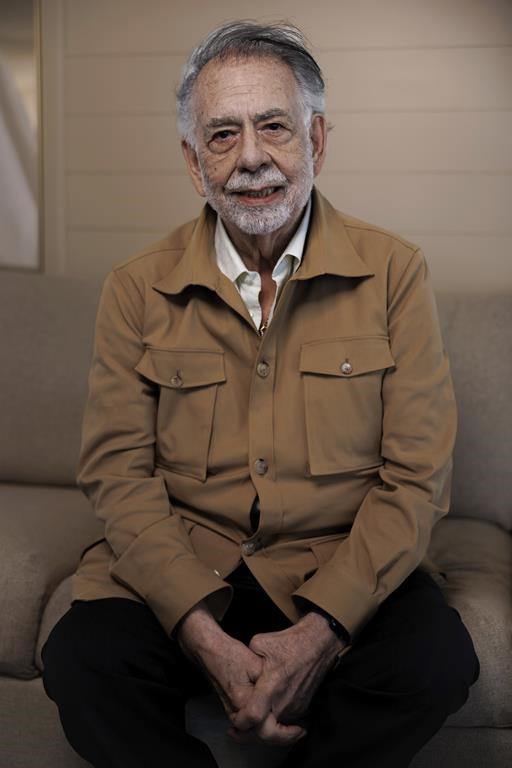
Time is much on Coppola’s mind. He’s 85 now. Eleanor, his wife of 61 years, died in April. “Megalopolis,” which is dedicated to her, is his first movie in 13 years. He’s been pondering it for more than four decades. The film begins, fittingly, with the image of a clock.
You have by now probably heard a few things about “Megalopolis.” Maybe you know that Coppola financed the $120 million budget himself, using his lucrative wine empire to realize a long-held vision of Roman epic set in a modern New York. You might be familiar with the film’s clamorous reception from critics at the Cannes Film Festival in May, some of whom saw a grand folly, others a wild ambition to admire.
“Megalopolis,” a movie Coppola first began mulling in the aftermath of “Apocalypse Now” in the late 1970s, has been a subject of intrigue, anticipation, gossip, a lawsuit and sheer disbelief for years.
Here’s details and excerpts of The Associated Press’ interview with Coppola and the film’s stars.
COPPOLA ON THE FILM’S RISKS
If Coppola has a lot riding on “Megalopolis,” he doesn’t, in any way, appear worried. Recouping his investment in the film will be virtually impossible; he stands to lose many millions. But speaking with Coppola, it’s clear he’s filled with gratitude. “I couldn’t be more blessed,” he says.
“Everyone’s so worried about money. I say: Give me less money and give me more friends,” Coppola says. “Friends are valuable. Money is very fragile. You could have a million marks in Germany at the end of World War II and you wouldn’t be able to buy a loaf of bread.”
WHAT THE ‘MEGALOPOLIS’ CAST SAYS ABOUT THE FILM
“On our first day of shooting, at one point in the day he said to everybody, ’We’re not being brave enough,” Driver recalled in Cannes. “That, for me, was what I hooked on for the rest of the shoot.”
Giancarlo Esposito, who first sat for a reading of the script 37 years ago with Laurence Fishburne and Billy Crudup, calls it “some deep, deep dream of consciousness” from Coppola.
Esposito was surprised to find the script hadn’t changed much over the years.
Every morning, he would receive a text from the director with a different ancient story. On set, Coppola favored theater games, improvisation and going with instinct.
“He takes his time. What we’re used to in this modern age is immediate answers and having to know the answer,” Esposito says. “And I don’t think Francis needs to know the answer. I think the question for him is sometimes more important.”
COPPOLA ON THE STATE OF HOLLYWOOD
“I’m a creation of Hollywood,” says Coppola. “I went there wanting to be part of it, and by hook or crook, they let me be part of it. But that system is dying.”

COPPOLA’S VISION FOR THE FUTURE OF FILM
In recent years, Coppola has experimented with what he calls “live cinema,” trying to imagine a movie form that’s created and seen simultaneously. In festival screenings, “Megalopolis” has included a live moment in which a man walks on stage and addresses a question to a character on the screen.
“The movies your grandchildren will make are not going to be like this formula happening now. We can’t even imagine what it’s going to be, and that’s the wonderful thing about it,” says Coppola. “The notion that there’s a set of rules to make a film — you have to have this, you have to have that — that’s OK if you’re making Coca-Cola because you want to know that you’re going to be able to sell it without risk. But cinema is not Coca-Cola. Cinema is something alive and ever-changing.”
HOW TO SEE ‘MEGALOPOLIS’
“Megalopolis” will be released by Lionsgate in theaters Friday, including many IMAX screens.