Journalists anticipate a renewed hostility toward their work under the incoming Trump administration
Advertisement
Read this article for free:
or
Already have an account? Log in here »
To continue reading, please subscribe:
Digital Subscription
One year of digital access for only $1.44 a week*
- Enjoy unlimited reading on winnipegfreepress.com
- Read the E-Edition, our digital replica newspaper
- Access News Break, our award-winning app
- Play interactive puzzles
*Billed as $5.77 plus GST every four weeks. After 52 weeks, price increases to the regular rate of $19.95 plus GST every four weeks. Offer available to new and qualified returning subscribers only. Cancel any time.
To continue reading, please subscribe:
Add Free Press access to your Brandon Sun subscription for only an additional
$1 for the first 4 weeks*
- Enjoy unlimited reading on winnipegfreepress.com
- Read the E-Edition, our digital replica newspaper
- Access News Break, our award-winning app
- Play interactive puzzles
*Your next Brandon Sun subscription payment will increase by $1.00 and you will be charged $17.95 plus GST for four weeks. After four weeks, your payment will increase to $24.95 plus GST every four weeks.
Read unlimited articles for free today:
or
Already have an account? Log in here »
Hey there, time traveller!
This article was published 16/12/2024 (672 days ago), so information in it may no longer be current.
NEW YORK (AP) — For the press heading into a second Trump administration, there’s a balancing act between being prepared and being fearful.
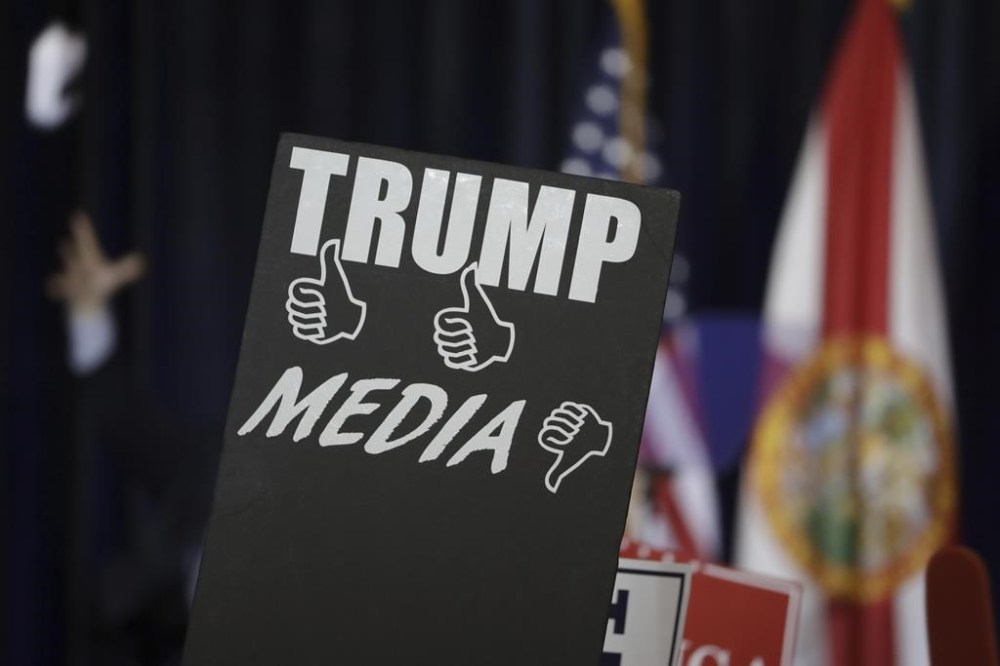
The return to power of Donald Trump, who has called journalists enemies and talked about retribution against those he feels have wronged him, has news executives nervous. Perceived threats are numerous: lawsuits of every sort, efforts to unmask anonymous sources, physical danger and intimidation, attacks on public media and libel protections, day-to-day demonization.
In a closely-watched case settled over the weekend, ABC chose to settle a defamation lawsuit brought by the president-elect over an inaccurate statement made by George Stephanopoulos by agreeing to pay $15 million toward Trump’s presidential library.
“The news media is heading into this next administration with its eyes open,” said Bruce Brown, executive director of the Reporters Committee for the Freedom of the Press.
“Some challenges to the free press may be overt, some may be more subtle,” Brown said. “We’ll need to be prepared for rapid response as well as long campaigns to protect our rights — and to remember that our most important audiences are the courts and the public.”
One prominent editor warned against going on war footing with an administration that hasn’t taken office yet. “There may be a moment to cry wolf here,” said Stephen Engelberg, editor-in-chief of the nonprofit news outlet ProPublica. “But I don’t think we’ve reached it.”
Trump at news conference: ‘We have to straighten out the press.’
At a news conference on Monday, Trump said that “we need a fair media” and discussed some potential and ongoing legal cases he has against news outlets.
“We have to straighten out the press,” Trump said. “Our press is very corrupt, almost as corrupt as our elections.”
News organizations are heading into the second Trump era weak both financially and in public esteem. To a large extent, Trump sidestepped legacy media outlets during his campaign in favor of podcasters, yet still had time for specific beefs against ABC, CBS and NBC.
The Trump team knows that many of its followers despise a probing press, and stoking that fury has political advantages. Two examples in the campaign to install Trump nominee Pete Hegseth as defense secretary shows how routine reporting activities can be characterized as an attack.
When The New York Times was tipped to an email that Hegseth’s mother once sent to him criticizing his treatment of women, it called her for comment. Penelope Hegseth later told Fox News that she perceived that as a threat, even though it enabled the newspaper to report that she had quickly apologized for sending the email and says she doesn’t feel that way about him now.
Pete Hegseth also used social media to say that ProPublica — he called it a “Left Wing hack group” — was about to knowingly publish a false report that he hadn’t been accepted into West Point decades ago. The news site had contacted him after officials at the military academy contradicted Hegseth’s claim of acceptance. Hegseth provided proof that those officials were mistaken, and ProPublica never published a story.
“That’s journalism,” noted ProPublica’s Jesse Eisinger. But a narrative had taken hold: “ProPublica’s botched Pete Hegseth smear,” the New York Post called it in a headline.
Keeping an eye on how journalists’ work is portrayed
During the presidential campaign, Trump sued CBS News for the way it edited an interview with opponent Kamala Harris; suggested ABC News lose its broadcast license for fact-checking him during his lone debate with Harris; and successfully called for equal time on NBC after Harris appeared on “Saturday Night Live.” In the Stephanopoulos lawsuit, the ABC anchor said Trump had been “found liable for rape” in writer E. Jean Carroll’s civil trial, when he had not.
At his news conference, Trump said he was expecting to file a lawsuit against the Des Moines Register in Iowa for publishing results of a poll shortly before the election that suddenly had him behind Harris. He said that amounted to “fraud and election interference.” He eventually won the state handily.
Trump engages with the mainstream media — besides the news conference Monday he gave a newsmaking interview to NBC’s “Meet the Press” this month — but journalists have to be alert to how their work will be portrayed.
Trump’s appointments, and what they’ve said about journalists, have raised alarms.
Kash Patel, Trump’s choice to lead the FBI, said on a podcast last year that “we’re going to come after people in the media who lied about American citizens.” Two appointees who have expressed hostility toward the media will be in a position to impact the work of journalists: Brendan Carr as chairman of the Federal Communications Commission and Kari Lake as director of Voice of America.
News organizations are worried that a Justice Department policy that has generally prohibited prosecutors from seizing the records of journalists in order to investigate leaks will be reversed, and are already urging journalists to protect their work. “If you have something you don’t want to share with a broader audience, don’t put it on the cloud,” ProPublica’s Engelberg said.
During the first Trump administration, some journalists who covered immigration issues were pulled aside for screening and questioning. The Reporter’s Committee wonders if this might happen again — and whether similar practices might extend toward reporting on expected deportations.
The literary and human rights organization PEN America is concerned about journalists facing physical danger and digital hostility. It may have seemed like a flippant remark to some of his supporters when Trump, months after an attempt on his life, said at a rally that he wouldn’t mind if somebody had to “shoot through the fake news” to get to him. But it wasn’t for people standing on media risers.
“It’s important that the president act with responsibility to reduce physical violence against the press rather than encourage it,” said Viktorya Vilk, PEN America’s program director for digital safety and free expression.
Sen. John Kennedy of Louisiana recently introduced a bill that would end taxpayer funding for public radio and television, a longtime goal of many Republicans that may get momentum with the party back in power. Some U.S. Supreme Court justices are eager to revisit a legal precedent that has made it difficult to prove defamation against news organizations.
It’s apparent that the new administration will come after the press in every conceivable way, former Washington Post editor Martin Baron said recently on NPR. “I do think he will use every tool in his toolbox,” Baron said, “and there are a lot of tools.”
Hungary’s experience inspires pessimism — but maybe a glimmer of hope
In their most pessimistic moments, advocates for the press look at what has happened in Hungary under the control of Prime Minister Viktor Orban. Since Orban took control in 2010, he and his supporters have taken control of most media and turned it into a propaganda arm.
Don’t think that can’t happen in the United States, warns Andras Petho, an investigative journalist in Hungary who left a news website when it was pressured to stifle his work, and started the investigative journalism center Direkt36.

Despite repression, there is still a market for independent journalism in Hungary, he said. Earlier this year, two Hungarian officials resigned following an outcry when it was revealed that they had pardoned a man who had forced children to retract sexual abuse claims made against the director of a government-run facility.
Petho said it is important for journalists not to portray themselves as any sort of resistance, because that makes it easier for the government to dismiss them. Instead, they should just do the work.
“To be honest, we all have to accept and admit that our power as media has declined,” said Petho, who participated in the Nieman fellowship for journalists at Harvard University. “Our stories don’t have the same impact that they had a decade ago. But I wouldn’t underestimate the power of the news media, either.”
___
David Bauder writes about media for the AP. Follow him at http://x.com/dbauder and https://bsky.app/profile/dbauder.bsky.social.