Soderbergh’s fear in shooting a ghost’s roaming POV: ‘Don’t fall down the stairs’
Advertisement
Read this article for free:
or
Already have an account? Log in here »
To continue reading, please subscribe:

Digital Subscription
One year of digital access for only $205*
- Enjoy unlimited reading on winnipegfreepress.com
- Read the E-Edition, our digital replica newspaper
- Access News Break, our award-winning app
- Play interactive puzzles
*First annual payment billed as $205.00 + GST for one year. This annual subscription will automatically renew at $233.00 + GST every 52 weeks (10% off the regular annual price of $259.35). Offer available to new and qualified returning subscribers only. Cancel any time.
To continue reading, please subscribe:
Add Free Press access to your Brandon Sun subscription for only an additional
$1 for the first 4 weeks*
- Enjoy unlimited reading on winnipegfreepress.com
- Read the E-Edition, our digital replica newspaper
- Access News Break, our award-winning app
- Play interactive puzzles
*Your next Brandon Sun subscription payment will increase by $1.00 and you will be charged $17.95 plus GST for four weeks. After four weeks, your payment will increase to $24.95 plus GST every four weeks.
Read unlimited articles for free today:
or
Already have an account? Log in here »
Hey there, time traveller!
This article was published 29/01/2025 (570 days ago), so information in it may no longer be current.
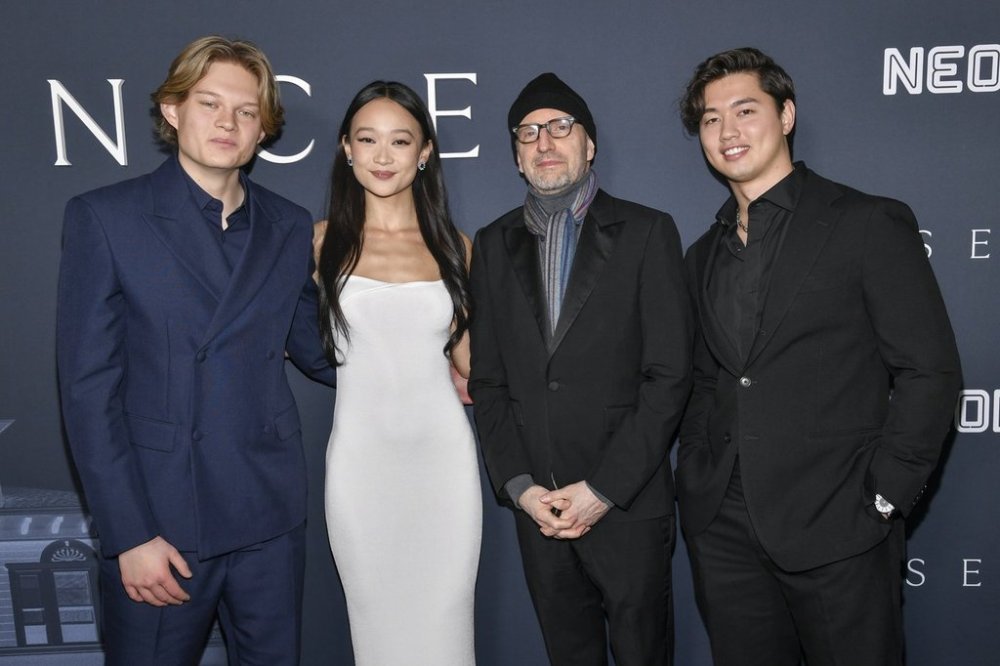
TORONTO – A haunted house story, told from the perspective of the ghost: that’s the elevator pitch for Steven Soderbergh’s new film, “Presence.”
The high-level concept came with some logistical challenges for the prolific Academy Award-winning director, who’s known for being his own camera operator.
The ghost in “Presence” is bound to the house where the story takes place, so the entire film is shot inside its walls.
And the ghost is almost entirely an observer, getting up close and personal with the family that lives in its home. Its gaze lingers on one conversation before it moves to another; no camera cuts to be found.
Now in theatres, “Presence” premiered at the Toronto International Film Festival in September, when Soderbergh talked to The Canadian Press about spectral inspiration, working with screenwriter David Koepp and crafting a definitive end.
CP: Do you believe in ghosts?
Soderbergh: My mother, as I think is mentioned in the press notes, was a parapsychologist. So I grew up around this subject. I know too many people who’ve had experiences to say it’s impossible…. I’m kind of open-minded about it now, I don’t discount it. I’ve never seen anything that would qualify as that, and I’ve never had that sense of a presence in a room with me or that I intruded upon.
CP: Would you be afraid?
Soderbergh: I don’t know. Because so many of the descriptions are, for instance, the one that prompted the idea for this film — somebody who was house-sitting for us in Los Angeles (saw) a woman at the end of the hallway. Most of these sightings, it doesn’t look like a ghost. You know what I mean? It just looks like a person there. That’s what our house-sitter friend saw. She’s like, ‘I saw a woman walk across the hallway, just like somebody was there, and I called out and realized there’s nobody here, that’s why I’m house sitting.’ They seem almost commonplace. It seems almost ordinary.
CP: In the film, the camera embodies the ghost, the viewer embodies the ghost. How did that feel for you behind the camera?
Soderbergh: It was an extreme version of the kind of intimacy that I seek with my cast. Since I am the director of photography and the camera operator already on a normal movie, I’m used to being this far away from them most of the time. This was another level of engagement, because it was so choreographed, and I’m so close to them for so long sometimes that it was really fun and pleasurable, but also really intense.
CP: How long was the longest take?
Soderbergh: I think it’s 10-and-a-half minutes. So it’s long. And there’s a lot happening. Or, a lot of things have to go exactly right. The rig was not that heavy. It was the Sony a7 camera, which is pretty small, the rig’s pretty small. So 10 pounds, 11 pounds. The problem is, that’s not that heavy unless you have to hold it out from your body for like eight minutes, and you start to shake. I mean, on a couple of those takes, by the end I’m like drenched and have to step outside and cool off and then come back in. And then there’s: “Don’t fall down the stairs.”
CP: Were you afraid of falling down the stairs?
Soderbergh: They were wood, so if you fell down those stairs, there’s no, like, runner on them. Like, you’re going to get hurt. At those points, you’ve rehearsed it but if I’m actually on the stairs, I’ve got the camera in front of me but I have to look at my feet. So in those moments where I’m actually on the stairs, my eyes are down to see where my feet are. And I’m judging the composition based on slow-motion rehearsals I’ve done where I don’t look at my feet and I know if I hold the camera in this position, that’s the correct composition.
But when you’re running, in a couple of cases where I’m running up the stairs and I have to look at my feet and hold the camera, there were a couple takes where what I thought the correct default composition was, was wrong.
CP: There are two big examples of first-person films at TIFF – there’s “Presence,” and then there’s “Nickel Boys,” which is predominantly shot in first person. Is there anything in the culture bringing people to first-person shooting?
Soderbergh: I don’t think so. My feeling would be strictly to put it down to the best solution to a problem. In the case of “Presence,” there is no other way to do it. Like, the conceit is built into the story. There’s no other way to shoot this….
You really have to be careful with it because the audience’s desire to see a reverse (camera shot) is very intense. And it’s why first-person projects don’t tend to work very well. And that was what was scary to me about “Presence,” was, given there’s no other way to do it, if it doesn’t work the whole thing is a waste. But in the case of “Presence,” the audience knows there’s nothing to cut to. There’s no reverse. It’s just a blank space. So you’re not wanting it because you know it isn’t there.
CP: Part of what’s wonderful watching film is getting these puzzle pieces and putting them together. And then you still don’t quite know what the end picture is going to be-
Soderbergh: Until the end.
CP: Until the very end.
Soderbergh: Yeah, which is a really fun thing that movies used to do a lot. Like, the end would be like The End. I feel like in movies now, the climax occurs and then you have all these other scenes after that. What I loved about this is, you get the last piece of the puzzle and then it’s over.

CP: There’s so much pacing involved because you don’t want to be too far ahead of the audience, even if you’ll let them catch up later.
Soderbergh: There’s a reason David’s the most successful screenwriter in history, because he understands that and is an expert, I think, in construction and escalation and using everything. When David writes something, there’s nothing wasted. Every piece has a purpose, and there’s nothing kind of arbitrary about it. I think the audience likes to feel a sense of purpose and they like when they feel that whoever made this thing knows what they’re doing. They relax. They’re like, “OK, this filmmaker knows what they’re doing. This is going to be interesting.” Instead of, like, “What the hell am I looking at?”
And, you know, bad filmmaking is a non-starter for me. If I start watching something and I feel like this is not good filmmaking, I can’t watch it.
— This interview has been edited and condensed for clarity.
This report by The Canadian Press was first published Jan. 29, 2025.