A queer art exhibition in Germany shines a spotlight on marginalized modernist artists
Advertisement
Read this article for free:
or
Already have an account? Log in here »
To continue reading, please subscribe:
Digital Subscription
One year of digital access for only $1.44 a week*
- Enjoy unlimited reading on winnipegfreepress.com
- Read the E-Edition, our digital replica newspaper
- Access News Break, our award-winning app
- Play interactive puzzles
*Billed as $5.77 plus GST every four weeks. After 52 weeks, price increases to the regular rate of $19.95 plus GST every four weeks. Offer available to new and qualified returning subscribers only. Cancel any time.
To continue reading, please subscribe:
Add Free Press access to your Brandon Sun subscription for only an additional
$1 for the first 4 weeks*
- Enjoy unlimited reading on winnipegfreepress.com
- Read the E-Edition, our digital replica newspaper
- Access News Break, our award-winning app
- Play interactive puzzles
*Your next Brandon Sun subscription payment will increase by $1.00 and you will be charged $17.95 plus GST for four weeks. After four weeks, your payment will increase to $24.95 plus GST every four weeks.
Read unlimited articles for free today:
or
Already have an account? Log in here »
Hey there, time traveller!
This article was published 25/09/2025 (389 days ago), so information in it may no longer be current.
DÜSSELDORF, Germany (AP) — There is an intimate portrait of a lesbian couple, a painting of young naked men enjoying themselves by the water and one of a flamboyantly dressed, androgynously looking person at a fairground.
Queer art has often been neglected and marginalized in the past but a new exhibition in Germany called “Queer Modernism. 1900 to 1950” is trying to overcome old prejudices and show the significant contributions of queer artists to modernism.
The show, which opens to the public on Friday in the western city of Düsseldorf, shines a spotlight on art by the LGBTQ+ community during the first half of the 20th century — a time marked both by more sexual freedom in cosmopolitan centers like Paris or Berlin, but also by persecution and criminalization of homosexuality, especially during the rise of fascism in the 1930s.
“This is the first major exhibition on this topic in Europe, if not worldwide,” Susanne Gaensheimer, the director of the Kunstsammlung Nordrhein-Westfalen, told The Associated Press on Thursday.
Themes like gender and sexuality, but also discrimination
Featuring more than 130 works by 34 artists — including many paintings and drawings, as well as photographs, sculptures and films — the show focuses on themes such as desire, gender and sexuality, but also discrimination and oppression.
The artists presented in the show are from all over Europe but also the United States, as many queer artists moved from there to Europe at the beginning of the last century to enjoy the more liberal climate.
“The queer artists you see in this exhibition were part of a very lively network in their day,” said Gaensheimer. “Many of them were successful in their day, sold works, and were part of a very intense movement and also part of the avant-garde.”
While some created secret codes to express their homosexuality, others proudly and openly portrayed it. Overall, the works reveal a wide variety of different artistic styles.
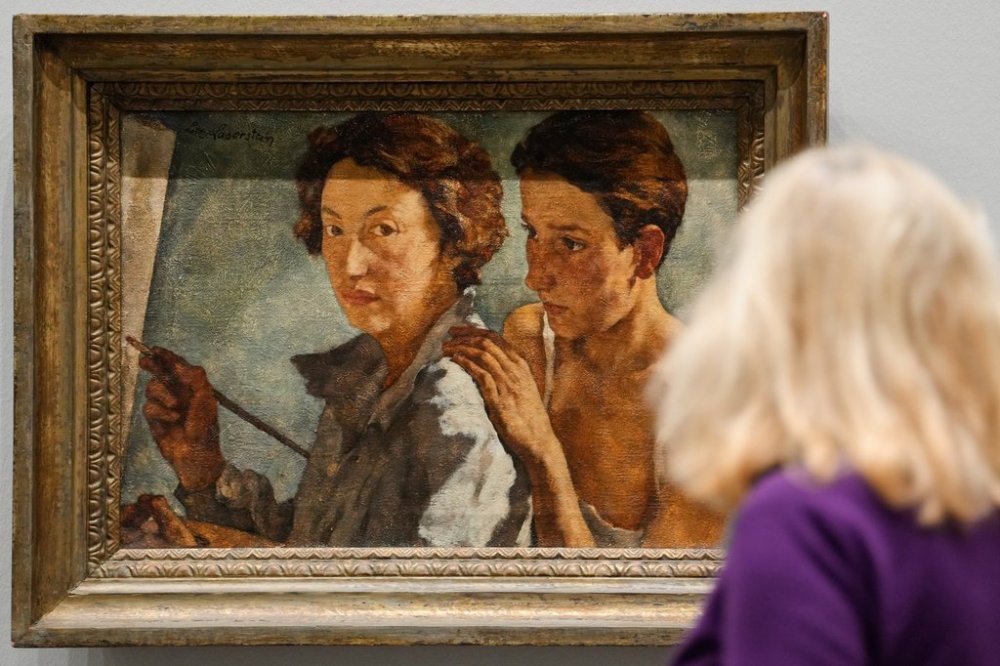
Among the works on display is one by German-Swedish artist Lotte Laserstein, who depicts herself at work as an artist together with her lover and preferred model Traute Rose. The oil on canvas painting from 1929/30 is called “I and My Model” and shows Laserstein with a palette and a paintbrush while Rose tenderly gazes over her shoulder.
In the oil painting “The Source” from 1913 by Ludwig von Hofmann, the German artist created a scene of three young, beautiful and naked men lingering around a spring, drinking from the water and watching one another.
The famous German author Thomas Mann bought the work in 1914 and it accompanied him through his exiles in California and Switzerland where it hung in his study. While he was married and had a family, Mann is known for his homosexual desires which he expressed in his personal diaries and also subtly in his fiction.
Perspectives of queer artists were often marginalized
Many of the works by queer artists were scattered around the globe because of the turmoil of the two world wars and because the artists often did not have any children to look after them. Often, their perspectives were also marginalized in the art-historical canon.
“We have been working very intensively for several years now to continually focus on new perspectives on modernism and to introduce artists who are not yet well known, or to present trends and styles that do not appear in the classic narrative of modernism,” said Gaensheimer, adding that the goal was to “broaden the perspective on what modernism was and who contributed to it.”
The exhibition is divided into eight different chapters, including one that’s dedicated to queer resistance since 1933, when the Nazis rose to power in Germany. Soon after, they began persecuting homosexuals, and later deporting and killing them in concentration camps.
While some artists showed resistance or emigrated, others worked together with fascist regimes to protect themselves.
A sometimes hidden, sometimes open celebration
Despite the many difficulties queer artists faced during the first half of the 20th century, they nonetheless celebrated life and queerness in their works.
In the painting “Bank Holiday Monday,” the artist Gluck, born in London in 1895 and also known as Hannah Gluckstein, depicts a stylish person with an extravagant yellow-red-blue colored scarf at a fairground. A second person is standing right behind and an intimate tension is palpable between the two seemingly androgynous figures. Both appear at the same time affectionate and self-confident.
The exhibition, which was curated in cooperation with a queer advisory board, will run through Feb. 15, 2026.
The museum will host many different readings, tours and workshops in the coming months, where visitors can further explore the themes of the show.